
What is the difference between power-frequency withstand voltage testing and induced withstand voltage testing?
Both power-frequency withstand voltage testing and induced withstand voltage testing are critical insulation tests for transformers, yet they differ in their testing methods, the specific insulation being checked, and their objectives. Simply put, the power-frequency withstand voltage test primarily checks the main insulation (between windings and ground, and between windings themselves), whereas the induced withstand voltage test primarily checks internal winding insulation—specifically between turns, layers, and sections.
1. What is the power-frequency withstand voltage test?
The power-frequency withstand voltage test typically involves using external high-voltage testing equipment to apply a specified high voltage at power frequency to the transformer winding under test and maintaining it for a set duration.
During the test, the other windings, the iron core, and the tank are generally grounded in accordance with requirements.
This test is primarily used to verify:
① Insulation between the high-voltage winding and ground;
② Insulation between the low-voltage winding and ground;
③ Insulation between the high-voltage and low-voltage windings;
④ Main insulation of bushings, leads, and related structures.
If there are serious insulation defects, phenomena such as flashover, breakdown, discharge, or a sudden increase in current may occur during the test.
2. What is the induced withstand voltage test?
The induced withstand voltage test involves applying an AC voltage higher than the rated value to one side of the transformer, thereby inducing the specified test voltage in the other windings.
This test primarily checks:
① Winding turn-to-turn insulation;
② Layer-to-layer insulation;
③ Section-to-section insulation;
④ Phase-to-phase insulation;
⑤ Insulation in the tap-changer area and within the windings.
Because the applied voltage is high, a power source with a frequency higher than the rated frequency—such as a variable-frequency power supply—is typically used to prevent excessive magnetic flux density in the iron core.
3. Key Differences Between the Two
| Comparison Item | Power-Frequency Withstand Voltage Test | Induced Withstand Voltage Test |
| Test Method | High voltage applied directly to the winding under test | Voltage induced in other windings by applying voltage to one side |
| Primary Objects Tested | Main insulation (winding-to-ground and winding-to-winding) | Turn-to-turn, layer-to-layer, section-to-section, and phase-to-phase insulation |
| Test Power Supply | Power-frequency high-voltage test equipment | Variable-frequency or multi-frequency power supply |
| Main Risks | Insulation breakdown to ground or external flashover | Internal winding insulation discharge or breakdown |
| Focus Area | Overall strength of main insulation | Internal longitudinal insulation strength of the winding |
4. Why is the frequency increased for the induced withstand voltage test?
If the number of transformer turns remains constant, increasing the applied voltage raises the magnetic flux density in the core. If the rated frequency were used, the core could easily enter an over-excited or saturated state, causing a rapid increase in no-load current and potentially leading to core overheating.
Increasing the test frequency allows for the control of core magnetic flux density while applying higher voltages; therefore, the induced withstand voltage test typically requires a variable-frequency power supply.
5. Can the two tests substitute for each other?
No.
The power-frequency withstand voltage test primarily verifies the insulation strength between windings and between windings and ground, but it has limited capability for testing turn-to-turn and layer-to-layer insulation.
The induced withstand voltage test subjects the internal windings to higher induced voltages, making it more effective at detecting defects in turn-to-turn, layer-to-layer, and section-to-section insulation; however, it cannot fully replace the power-frequency withstand voltage test for main insulation.
Therefore, as the two tests focus on different insulation areas, they are usually performed separately in accordance with product standards and technical requirements.
6. What precautions should be taken during testing?
When conducting power-frequency and induced withstand voltage tests, pay close attention to the following:
① Verify the test voltage, frequency, and duration;
② Check the wiring and grounding of the transformer under test;
③ Confirm that the voltage regulation device is at the zero position;
④ Set up over-voltage, over-current, and emergency stop protections;
⑤ Install safety barriers and audible/visual alarms;
⑥ Ensure full discharge after the test concludes;
⑦ Monitor for any abnormalities in current, sound, or discharge phenomena. During the induced withstand voltage test, special attention must also be paid to the power supply frequency and the issue of core over-excitation.
Conclusion
Power-frequency withstand voltage testing primarily assesses the main insulation of transformer windings (i.e., winding-to-ground and winding-to-winding insulation), whereas induced withstand voltage testing primarily assesses turn-to-turn, layer-to-layer, section-to-section, and phase-to-phase insulation.
As the objects of detection and testing methods differ for these two tests, they cannot simply be substituted for one another. In practice, the appropriate testing equipment and parameters should be selected based on the transformer type, voltage class, and relevant technical requirements.
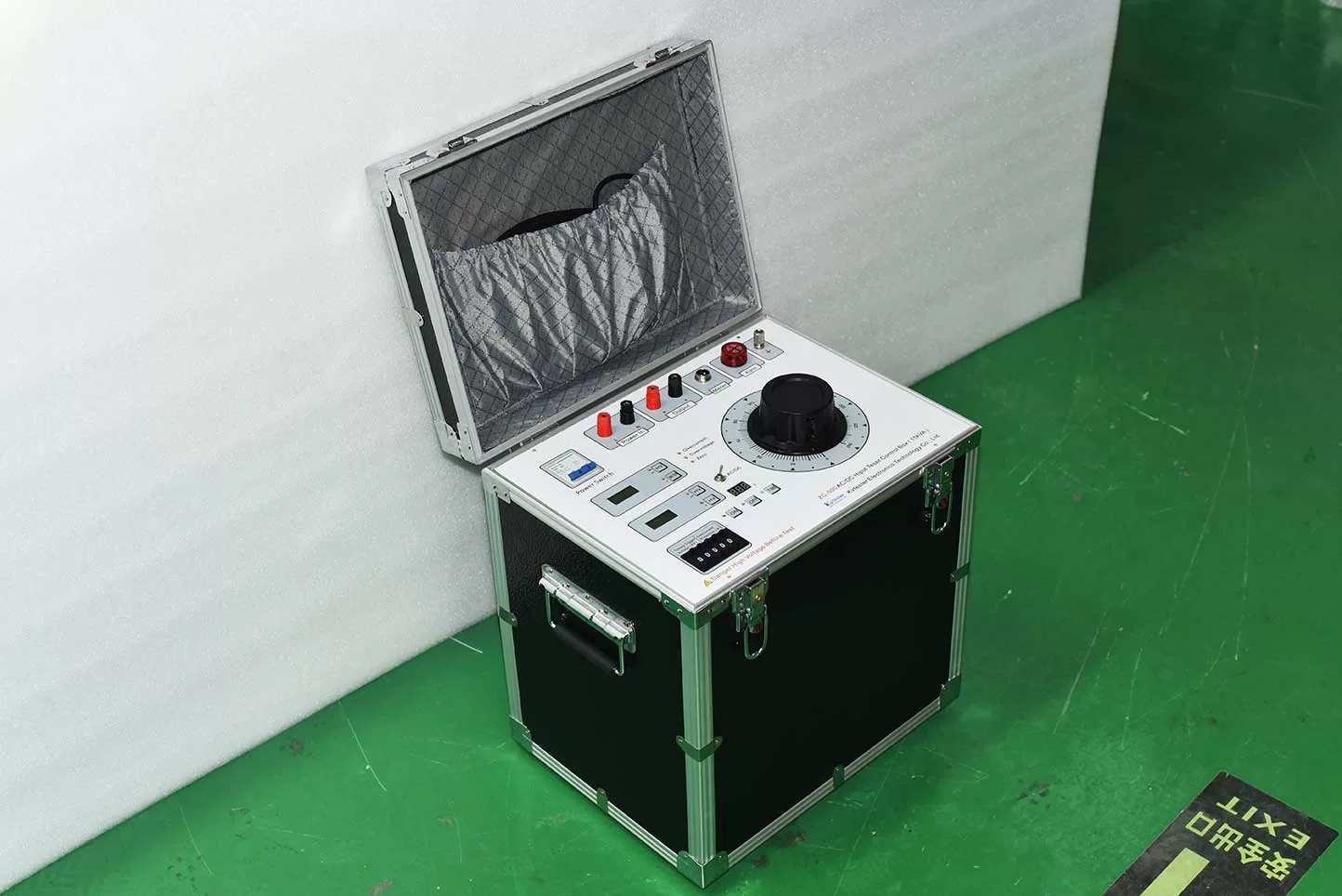
The ZC-500 Power-Frequency Withstand Voltage Control Unit (hereinafter referred to as the “tester”) utilizes digital control technology and offers strong anti-interference capabilities. Compared to previous-generation models, it is characterized by its compact size, light weight, and aesthetic design. Its output voltage is continuously adjustable from 0 to 250V, serving as a voltage regulation control device for equipment calibration, inspection, and testing. Featuring simple operation, a compact and rugged structure, reliable performance, and easy maintenance, this unit is an ideal control device for outdoor high-voltage testing and is widely used in sectors such as electric power, water conservancy, chemicals, and railways, as well as in laboratories.
Kvtester Electronics Technology Co.,Ltd. is a high-tech enterprise specializing in power testing, testing, research and development, production, and sales of testing equipment. It has been engaged in the electrical testing industry for many years, and its products are of high quality. We welcome customers to come and purchase. Service hotline: 0086-27-81778799, to learn more, visit the official website: www.kvtester.com
Related Products
Latest News
-
 2026-09-21Smart Transformer Testing Equipment: Features for Efficient Testing
 -
 2026-09-21Transformer Testing Equipment for Grid Maintenance Guide
 -
 2026-09-20CT PT Analyzer for Commissioning: Substation Testing Guide
 -
 2026-09-20ANSI Standard CT Tester: Specs, Tests & Buying Guide
 -
 2026-09-18Why does the required capacity of series resonant test equipment usually increase with cable length?