How to Choose Between 2500V and 5000V Insulation Resistance Testers? What Are the Differences?
How to Choose Between 2500V and 5000V Insulation Resistance Testers? What Are the Differences?
An insulation resistance tester, also known as a megohmmeter (or “megger”), is a standard instrument used to assess the insulation of power equipment. It is widely employed to measure the insulation resistance of electrical assets such as transformers, electric motors, power cables, and switchgear. Among the available settings, 2500V and 5000V are common high-voltage test ranges. So, what distinguishes the two, and how should one choose between them for practical testing?
1. Key Differences Between 2500V and 5000V Insulation Resistance Testers
The primary difference between 2500V and 5000V insulation resistance testers lies in the DC test voltage they output.
A 2500V insulation resistance tester applies a 2500V DC test voltage to the equipment under test; it is frequently used for insulation assessment of certain medium-voltage electrical equipment.
A 5000V insulation resistance tester provides a higher DC test voltage, making it suitable for power equipment that requires higher insulation levels or adheres to more stringent testing standards.
It is important to note that a higher test voltage does not necessarily yield more accurate measurement results. The appropriate test voltage should be selected based on the equipment’s rated voltage, insulation structure, and relevant testing standards.
2. For Which Equipment Is a 2500V Insulation Resistance Tester Suitable?
The 2500V setting is commonly used in the following scenarios:
① Insulation resistance testing for certain 10kV distribution transformers;
② Insulation assessment of medium-voltage motor windings;
③ Insulation checks for specific types of medium-voltage switchgear;
④ Testing of cables and other electrical equipment that specify this particular test voltage.
For 10kV-class power equipment, the 2500V setting is widely used; however, it is not mandatory for all 10kV equipment. The specific requirements should always be verified against applicable standards and the equipment’s technical documentation.
3. For Which Equipment Is a 5000V Insulation Resistance Tester Suitable?
The 5000V setting is primarily used for electrical equipment with higher insulation requirements, such as:
① Insulation testing for certain components of transformers rated at 35kV and above;
② High-voltage motors and generators, subject to specific testing requirements;
③ Certain high-voltage switchgear and power cables;
④ Large-scale electrical equipment that requires the measurement of the Absorption Ratio (DAR) and Polarization Index (PI).
While a 5000V test voltage meets the insulation testing requirements for many high-voltage devices, it may cause insulation damage to sensitive components or equipment that cannot withstand such high voltage.
Therefore, the test setting should not be determined solely based on the equipment’s voltage rating.
4. How to choose between a 2500V and a 5000V insulation resistance tester?
When selecting a device, consider the following aspects:
①. Based on the voltage rating of the equipment under test
For some 10kV power distribution equipment, a 2500V setting may be appropriate; for equipment rated at 35kV or higher, a 5000V setting may be considered, depending on the specific testing requirements.
②. Based on testing standards
Insulation resistance testing requirements vary by equipment type. Refer to standards such as GB 50150, applicable DL/T (Electric Power Industry) standards, and the manufacturer’s technical documentation to determine the appropriate test voltage.
③. Based on the measurement range
In addition to the output voltage, consider the instrument’s upper limit for resistance measurement, its accuracy, and its anti-interference capability to ensure it can meet the requirements for measuring high insulation resistance.
④. Based on instrument features
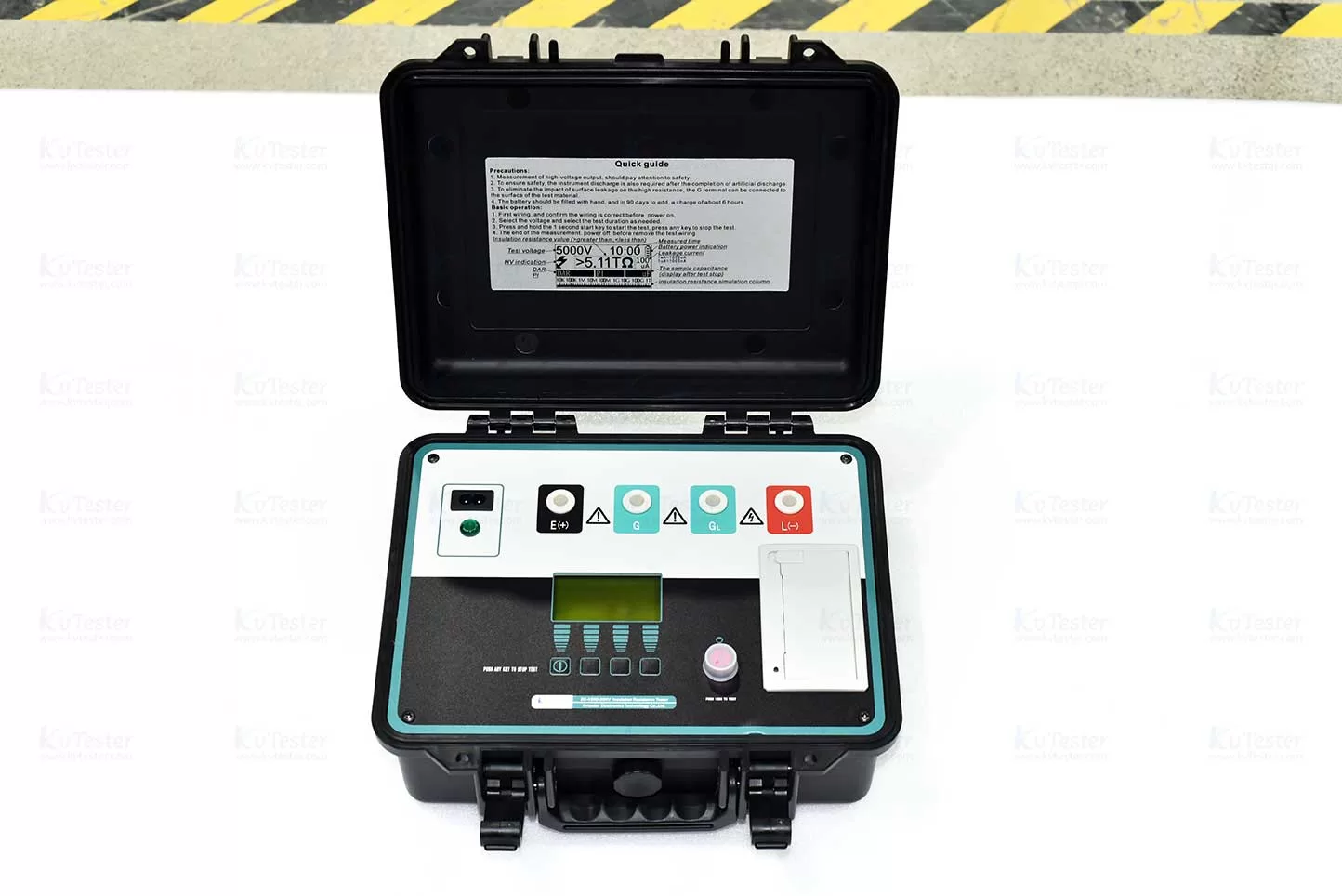
For large-capacity equipment such as transformers and generators, it is advisable to choose a digital insulation resistance tester that includes features like Absorption Ratio (DAR) measurement, Polarization Index (PI) calculation, automatic discharge, and data storage.
If an organization needs to test equipment with various voltage ratings, consider an insulation resistance tester with multiple selectable voltage settings (e.g., 500V, 1000V, 2500V, and 5000V) to increase the versatility of the instrument.
5. What precautions should be taken during insulation resistance testing?
Before testing, ensure that the equipment is powered off and isolated. Follow safety protocols to complete the necessary procedures, including verifying the absence of voltage, grounding the equipment, and discharging any stored energy.
During the test, select the appropriate test voltage and duration in accordance with established standards, and record relevant environmental data such as ambient temperature and humidity.
Once testing is complete, ensure the equipment under test is fully discharged before removing the test leads; this prevents electric shock accidents caused by residual charge.
6. Conclusion
There is no absolute superiority between 2500V and 5000V insulation resistance testers; the choice depends on whether the device meets your specific testing requirements.
For users primarily testing 10kV power distribution equipment, a 2500V tester is generally highly practical. For power testing organizations that handle a wider variety of equipment or higher voltage levels, a 5000V insulation resistance tester with multiple selectable voltage ranges typically offers greater flexibility.
Selecting the right insulation resistance tester helps improve testing efficiency, ensures the reliability of test data, and provides technical support for assessing the insulation status of power equipment.
Related Products
Latest News
-
 2026-11-10Analysis and Troubleshooting of Common Faults in High-Voltage Switch Mechanical Characteristic Testers
-
 2026-11-10Why do loop resistance testers use high-current testing? What is the difference between 100A and 200A?
-
 2026-11-10Working Principle and Precautions for Transformer DC Resistance Testers
-
 2026-11-10How Should Small and Medium-Sized Transformer Factories Configure Their Factory Acceptance Testing (FAT) Equipment?
-
 2026-11-05Smart CT PT Analyzer with USB Output for Easier Test Data Handling