
What factory tests are required for dry-type transformers?
What factory tests are required for dry-type transformers?
Upon completion of manufacturing, dry-type transformers must undergo factory tests to inspect the windings, core, insulation system, and accessory functions, ensuring that product performance meets design specifications, relevant standards, and the customer’s technical agreement.
Common factory tests for dry-type transformers include the following:
1. Visual and assembly inspection
This primarily involves checking the integrity of the transformer’s exterior, nameplate, terminals, insulation components, fasteners, and grounding devices. For transformers equipped with enclosures, cooling fans, and temperature control devices, the protective enclosure, ventilation ducts, fan wiring, and temperature sensor installation must also be inspected for proper condition.
2. Winding DC resistance test
This test measures the DC resistance of each phase in both high-voltage and low-voltage windings and compares the differences between the three phases. It serves to verify:
① The reliability of winding welds and lead connections;
② The quality of contact at tap terminals;
③ Whether there are broken strands or poor contact within the windings;
④ The balance of resistance across the three-phase windings.
Test results usually need to be converted to a specified reference temperature based on the actual winding temperature.
3. Voltage ratio, polarity, and connection group tests
The voltage ratio test verifies whether the actual voltage ratio between high-voltage and low-voltage windings matches the design value.
Polarity and connection group tests confirm the correctness of winding terminal designations (start/end), phase sequence, and phase relationships; they can detect issues such as incorrect winding turn counts, tap positions, or internal wiring errors.
For products with multiple tap positions, testing is generally required for each tap setting.
4. Insulation resistance test
This test primarily measures the insulation resistance between the high-voltage winding and the low-voltage winding/ground, as well as between the low-voltage winding and the high-voltage winding/ground. It is used to determine if the insulation is affected by moisture, contamination, or damage, or if there are potential grounding hazards. Grounding and discharging must be performed as required before and after testing to prevent safety risks associated with residual charge. 5. No-load Loss and No-load Current Test
For the no-load test, one side of the transformer is left open-circuited while a specified frequency and voltage are applied to the other side to measure:
① No-load loss;
② No-load current;
③ Three-phase voltage, current, and power;
④ No-load current percentage.
This test primarily reflects the properties of the core material, the quality of core assembly, and the condition of the magnetic circuit. If the measured values are excessively high, the core material, stacking quality, grounding status, and the waveform of the test power supply should be inspected.
6. Load Loss and Short-circuit Impedance Test
During this test, one winding is short-circuited, and a reduced voltage is applied to the other winding to drive the specified current through the windings, measuring:
① Load loss;
② Short-circuit impedance;
③ Impedance voltage;
④ Three-phase voltage, current, and power.
This test primarily reflects winding resistance, connection quality, winding dimensions, and assembly positioning. Load loss values usually need to be converted from the test temperature to a specified reference temperature.
7. Applied Power-frequency Withstand Voltage Test
Using external high-voltage test equipment, a specified high power-frequency voltage is applied to the winding under test to verify the main insulation strength—both between the winding and the ground, and between the high-voltage and low-voltage windings. The test setup must include overcurrent protection, a zero-start interlock, an emergency stop device, safety barriers, and high-voltage safety interlocks.
8. Induced Withstand Voltage Test
The induced withstand voltage test primarily checks the insulation between turns, layers, sections, and phases of the windings. A variable-frequency power supply is typically used to subject the windings to the specified induced voltage while avoiding core over-excitation. For certain products, partial discharge measurements may also be performed simultaneously during the induced withstand voltage test.
9. Partial Discharge Test
The partial discharge test is used to detect the presence of air gaps, delamination, point discharges, or other localized insulation defects within the cast insulation. This test places high demands on the test power supply, grounding, shielding, and on-site anti-interference capabilities; whether it is performed as a routine factory test for every unit is determined by product standards and technical agreements. 10. Inspection of temperature control and fan functions
For dry-type transformers equipped with temperature control systems, the following must also be inspected:
① Whether the temperature display is functioning normally;
② Whether the three-phase temperature sensors are operational;
③ Whether the fan start/stop function is operating correctly;
④ Whether the over-temperature alarm and trip signals are correct;
⑤ Whether the control circuit and terminal connections are secure.
This inspection is a key procedure that distinguishes dry-type transformers from standard oil-immersed transformers.
11. Other test items
Depending on the product capacity, voltage rating, and application requirements, the following tests may also be conducted:
① Noise test;
② Temperature rise test;
③ Lightning impulse test;
④ Thermal performance verification of the insulation system;
⑤ Enclosure protection and mechanical inspection;
⑥ Environmental, climatic, and combustion performance tests.
Some of these items are typically classified as type tests or special tests and are not required for every individual unit.
Conclusion
Routine factory tests for dry-type transformers primarily include measurements of DC resistance, turns ratio and vector group, insulation resistance, no-load loss, load loss, and short-circuit impedance, as well as power-frequency withstand voltage and induced withstand voltage tests. For products featuring temperature control, forced-air cooling, or special insulation requirements, additional inspections—such as temperature control and fan system checks, partial discharge tests, and other specialized tests—are required. The specific test items should be determined based on the transformer type, applicable standards, and the customer’s technical specifications.
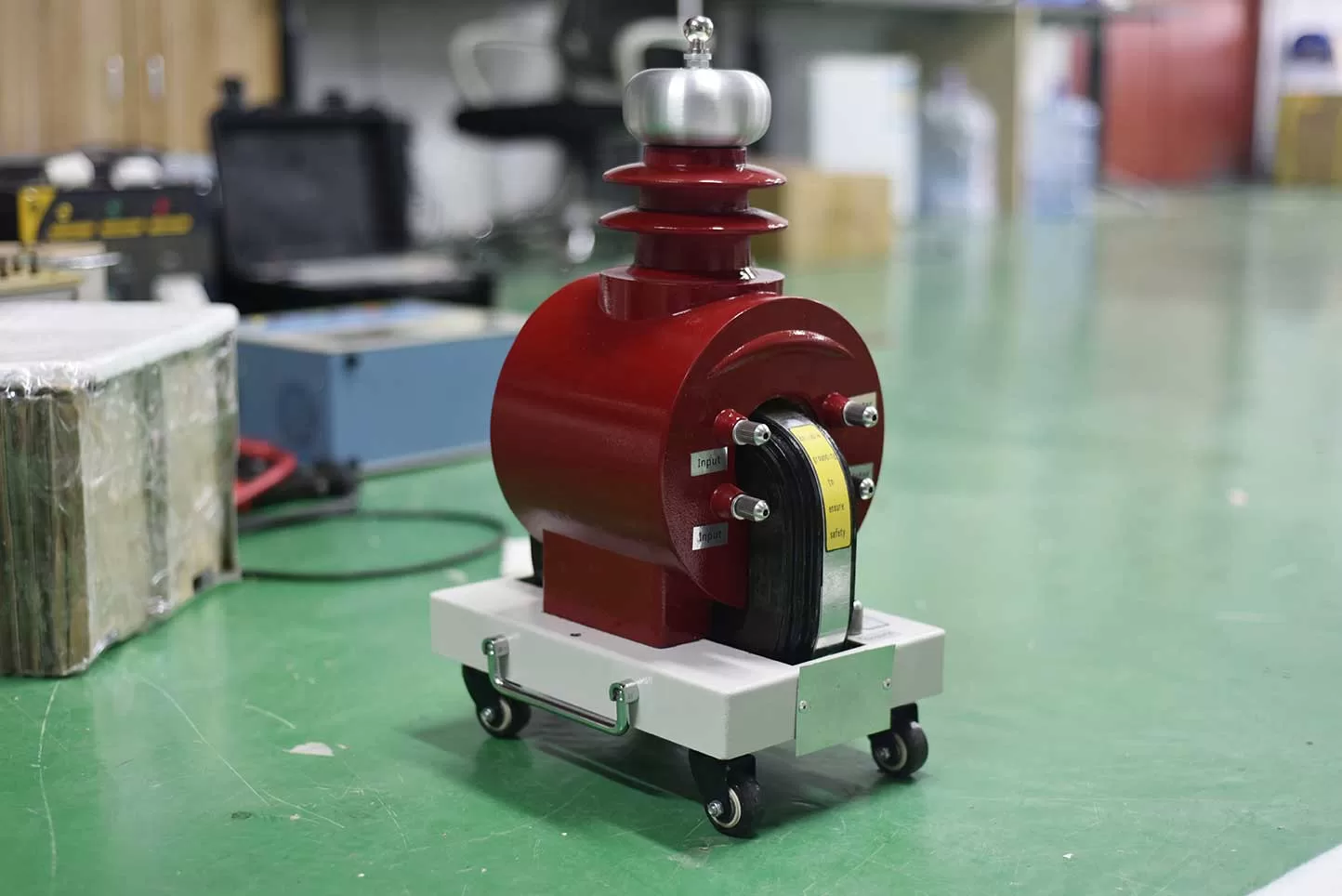
ZC-501C Dry Type AC/DC Hipot Tester includes a digital display control box and a HV transformer.The control box take numerical control technology, anti-interference ability, and compared with the previous generation of operating box, with small size, light weight, beautiful appearance and so on. The output voltage range is adjustable continuously from 0 to 200V. The operation is simple, compact and firm structure, reliable operation, convenient maintenance.
This new generation control box has the function to give an audible and visual alarm when the control box or the HV transformer are not connected to the ground. It is for the safety of the operational person and the devices itself. And it is easy to set the protection value on the panel for over voltage and over current.
The HV transformer is a Dry Type single-phase transformer. This device is especially suitable for power systems, mining enterprises, scientific and research department to have insulation strength test under power frequency for all kinds of high-voltage electrical instrument, electrical components, insulation materials. It is fundamental in high-voltage test.
Kvtester Electronics Technology Co.,Ltd. is a high-tech enterprise specializing in power testing, testing, research and development, production, and sales of testing equipment. It has been engaged in the electrical testing industry for many years, and its products are of high quality. We welcome customers to come and purchase. Service hotline: 0086-27-81778799, to learn more, visit the official website: www.kvtester.com
Related Products
Lasted News
-
 2026-08-13How should testing equipment for 10 kV transformers be configured?
 -
 2026-08-13What power supply capacity is required for a transformer test bench?
 -
 2026-08-12Pick the Right Transformer Testing Equipment Manufacturer
 -
 2026-08-12CT Analyzer Test Kit Buying Guide: Data-Backed Choices
 -
 2026-08-12CT Analyzer Burden Test: Turning Data Into the Right Design Direction