Home » News » Company News
Digital CT PT Analyzer for Smarter Transformer Testing
Transformer testing increasingly relies on electronic measurement, automated calculations, and digital result analysis. For engineers working with current transformers (CTs) and potential transformers (PTs), these capabilities can simplify complex measurement procedures and make test results easier to evaluate and manage.
A digital CT PT analyzer combines measurement hardware with digital processing to handle multiple testing tasks through an integrated instrument. However, digitalization involves more than adding a display or USB interface. It also concerns how the instrument acquires electrical signals, processes measurement data, calculates parameters, and presents results.
Understanding these capabilities helps testing teams evaluate whether a digital analyzer can improve their existing workflows and meet their measurement requirements.
What Does Digital Mean in a CT PT Analyzer?
In a CT PT analyzer, digital refers to the use of electronic signal acquisition and digital processing to measure, calculate, and present transformer test results.
During testing, the instrument applies or measures electrical signals according to the selected procedure. Its internal measurement and processing system then handles the acquired data to calculate relevant parameters and display the results.
Several capabilities contribute to this process.
Digital Signal Acquisition
Electrical signals are the starting point of transformer testing. A digital analyzer needs to acquire relevant voltage and current signals before it can process measurement data.
The signal acquisition process affects how the instrument captures electrical characteristics during a test. Suitable measurement circuits and signal processing help the analyzer obtain the data required for calculations such as transformation ratio, phase displacement, and excitation characteristics.
For CT and PT testing, different measurement tasks may require different signal ranges and test arrangements. Therefore, digital signal acquisition must be supported by appropriate measurement hardware rather than software alone.
Digital Data Processing and Calculation
After acquiring measurement signals, the analyzer processes the data to obtain useful electrical parameters.
Instead of requiring technicians to manually calculate every result, the instrument can perform supported calculations internally. Depending on the model and selected test, these may include transformation ratio, ratio error, phase displacement, excitation characteristics, and other evaluation parameters.
This integration reduces repetitive calculations and helps technicians review multiple results through a consistent interface.
Digital Interface and Result Presentation
A digital interface allows users to configure test parameters, select measurement functions, and review results through an electronic display.
More advanced instruments may also provide graphical wiring instructions, dynamic parameter displays, and automatic result evaluation. These features make it easier to follow the test procedure and understand the measurement output.
However, a digital display alone does not determine the overall capability of an analyzer. Its measurement hardware, processing functions, accuracy, and supported test procedures are equally important.
How Digital Technology Improves CT and PT Testing
The practical value of digital technology becomes clearer when looking at the complete testing workflow. It can help reduce repetitive operations, simplify result evaluation, and improve the way testing information is handled.
More Consistent Measurement Processes
Manual testing often involves several separate operations, including instrument configuration, signal measurement, parameter calculation, and result recording.
A digital CT PT analyzer can integrate supported operations into a more organized workflow. Technicians select a test item, enter the necessary parameters, connect the instrument according to its wiring instructions, and start the measurement.
For example, the CTA-1000E uses high-performance DSP and FPGA technology. It also provides a dynamic graphical interface that displays relevant parameters and wiring diagrams according to the selected test item.
This type of integration helps reduce unnecessary setup steps and makes the testing process easier to follow. It is particularly useful when technicians need to perform multiple measurements on different CTs and PTs.
Faster Data Analysis and Result Evaluation
Measurement data becomes more useful when it can be converted into clear technical results without extensive manual processing.
A digital analyzer can calculate supported parameters and evaluate results according to selected standards or testing criteria. This helps technicians identify important characteristics without repeatedly performing calculations outside the instrument.
For example, the CTA-1000D automatically determines relevant CT values and evaluates the results according to selected IEC or IEEE standards. Its specified automatic test duration is less than two minutes.
Automatic evaluation can reduce the time spent processing measurement results. Nevertheless, technicians still need to check the selected standard, transformer specifications, and test conditions before making acceptance decisions.
Better Test Data Management
Transformer testing generates measurement records that may need to be reviewed during maintenance, compared across production batches, or included in commissioning documentation.
Digital data management helps preserve these records in a more organized format. Depending on the analyzer, available functions may include internal storage, electronic data export, and computer-based analysis.
For testing teams handling large volumes of CT and PT measurements, these capabilities can make it easier to retrieve historical results and prepare technical reports.
Data management is also an important part of digital testing, but it should be considered separately from signal acquisition and measurement processing. An instrument may have advanced measurement functions without offering extensive storage or export capabilities.
What Makes Digital CT PT Testing Different from Traditional Testing?
The difference between digital and traditional testing equipment is not simply whether an instrument has a screen. Many conventional instruments already use electronic measurement circuits or digital displays.
A more useful comparison considers how measurement, calculation, and data handling are integrated into the complete testing process.
Measurement and Calculation
With a more manual testing arrangement, technicians may need to use separate instruments for different measurements and calculate some parameters independently.
An integrated digital analyzer can combine supported measurements and calculations in one instrument. This reduces the need to transfer readings between separate devices and can make the overall process more convenient.
Result Evaluation
In a basic measurement workflow, technicians may need to compare readings with reference values and calculate relevant errors themselves.
A digital analyzer with automatic evaluation can perform supported calculations and compare results against selected standards or criteria. This provides additional assistance when assessing CT performance.
The level of automation varies between models. Buyers should confirm whether the instrument only displays measurement values or also performs automatic evaluation.
Data Recording and Review
Manual records can require additional time to organize, particularly when testing involves multiple transformers or repeated measurements.
Digital storage and analysis functions allow supported instruments to retain electronic records for later review. Some models also provide software for report generation, data comparison, and evaluation.
For a more detailed discussion of electronic record handling, see our guide to Smart CT PT Analyzer with USB Output.
The important point is that digitalization is a combination of measurement, processing, and information management capabilities. USB connectivity is only one possible part of that system.
What Should You Look for in a Digital CT PT Analyzer?
Not every analyzer offers the same level of digital integration. When comparing equipment, buyers should evaluate its technical capabilities according to their actual testing requirements.
Measurement and Processing Capabilities
Start by checking whether the analyzer supports the CT and PT measurements required for your application.
Important considerations include:
- Required CT and PT measurement functions.
- Supported transformation ratio ranges.
- Measurement accuracy for different parameters.
- Excitation testing and characteristic analysis.
- Automatic calculation and result evaluation.
- Applicable testing standards.
The measurement hardware and processing capabilities should match the transformer specifications. A digital interface cannot compensate for an insufficient measurement range or unsuitable test method.
Automation and User Interface
Automation can reduce repetitive operations, but its practical value depends on how the instrument guides users through testing.
Consider whether the analyzer provides:
- Automatic test sequences.
- Parameter configuration based on selected test items.
- Dynamic wiring diagrams.
- Automatic calculation and evaluation.
- Clear measurement results and operating instructions.
A straightforward interface can help technicians reduce setup errors, especially when performing different CT and PT tests in the same working session.
Data Storage and Export
Data management requirements vary between users. A testing laboratory may need to preserve large volumes of measurement records, while a field maintenance team may only need to save and retrieve results for individual projects.
Before purchasing, check:
- Internal storage capacity.
- Whether records remain available after power failure.
- Supported data export methods.
- Availability of computer-based analysis software.
- Report generation and historical data comparison functions.
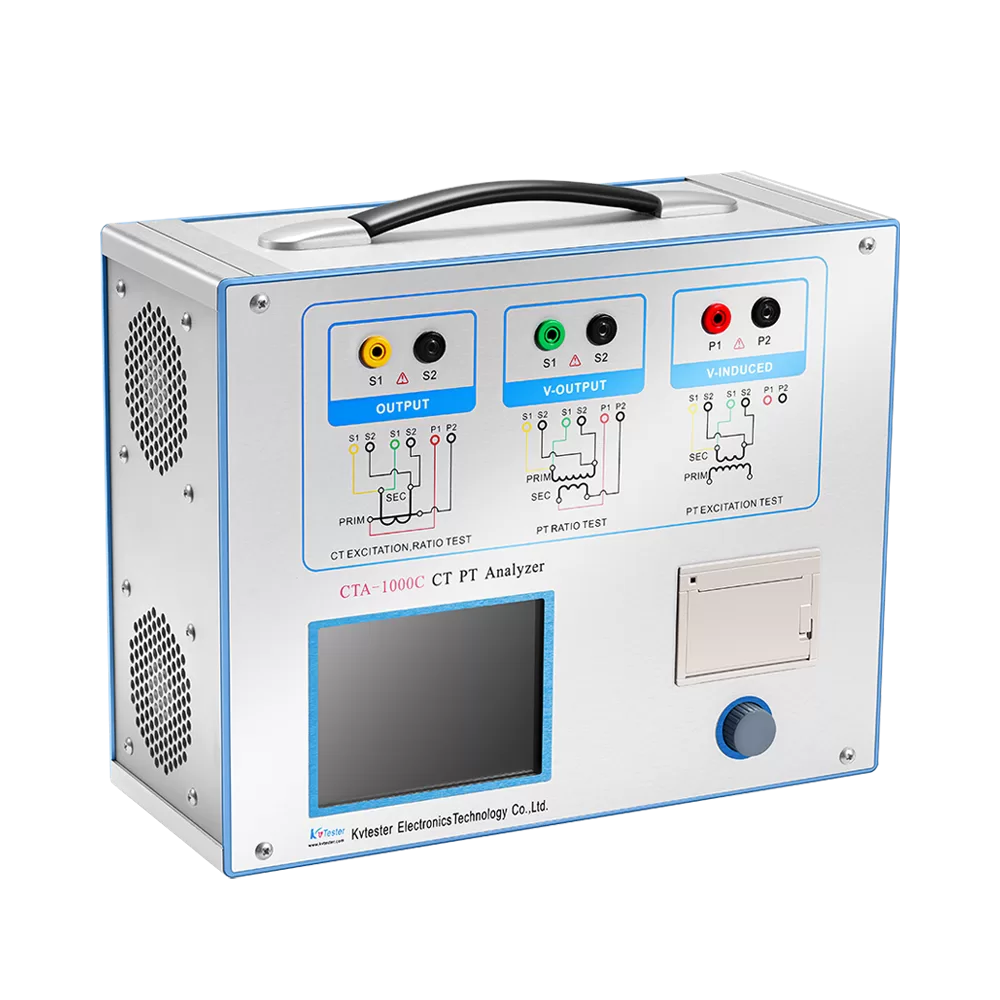
For example, our CTA-1000E CT/PT Analyzer uses a high-performance DSP and FPGA system and includes an 8.4-inch TFT LCD touchscreen. It can store up to 10,000 groups of test data, supports USB disk export, and provides background analysis software for report preservation, conversion, comparison, and evaluation.
These features are particularly relevant to testing teams that need to manage measurement records beyond the instrument itself.
Portability and Field Usability
Digital capabilities should also be practical in the working environment.
For field testing, consider the instrument’s weight, dimensions, power supply requirements, connection accessories, and operating temperature range. A multifunction analyzer may offer extensive processing and measurement capabilities, but it must also be convenient to transport and operate at the intended test location.
Digital CT PT Analyzer Solutions from Kvtester
At Kvtester, we provide CT/PT analyzers with different measurement and data processing capabilities for field testing, maintenance, and transformer manufacturing applications.The CTA-1000D and CTA-1000E are two models worth considering when evaluating digital CT/PT testing solutions.
The CTA-1000D focuses on automatic CT measurement and analysis. It can determine relevant CT characteristics and evaluate results according to selected IEC or IEEE standards. Its automatic test duration is specified as less than two minutes, and its weight is approximately 9 kg without accessories. It is suitable for users who need integrated CT analysis and convenient on-site testing.
The CTA-1000E places additional emphasis on integrated digital operation and data management. Its DSP and FPGA architecture, graphical touchscreen interface, storage for up to 10,000 test records, and computer-based analysis software support a more organized approach to measurement and record handling.
The appropriate model depends on the required CT and PT functions, measurement accuracy, testing workload, and data management needs. We recommend comparing the complete technical specifications rather than selecting equipment based only on its interface or digital features.
Conclusion
A digital CT PT analyzer brings together electronic measurement, digital processing, automatic calculation, and result management. These capabilities can help testing teams simplify measurement procedures, reduce repetitive data processing, and maintain more organized test records.
However, digitalization does not mean that every analyzer offers the same measurement performance or automation level. The right equipment should provide suitable test functions, measurement ranges, accuracy, and data management capabilities for the intended application.
If you are evaluating digital CT/PT testing equipment for field work, manufacturing, or laboratory applications, contact Kvtester. Share your testing requirements with our team to discuss a suitable analyzer configuration.
Related Products
Latest News
-
 2026-11-11CT PT Analyzer Polarity Test for Accurate CT and PT Verification
-
 2026-11-11Resonant Test System Commissioning for Reliable High-Voltage Testing
-
 2026-11-11Intelligent Transformer Testing Equipment Supplier
-
 2026-11-10Analysis and Troubleshooting of Common Faults in High-Voltage Switch Mechanical Characteristic Testers
-
 2026-11-10Why do loop resistance testers use high-current testing? What is the difference between 100A and 200A?