Home » News » Company News
Digital Portable CT Tester for Field Testing and CT Analysis
Current transformer (CT) testing is an important part of electrical system commissioning, routine maintenance, and fault diagnosis. Engineers need to verify measurement accuracy, check winding conditions, and confirm that CTs perform as expected under their intended operating conditions. A digital portable CT tester makes these tasks more convenient by combining electronic measurement, data processing, and portable operation in a single instrument.
However, not every CT tester supports the same measurements or analysis functions. Understanding the available tests, field requirements, and equipment specifications helps engineers select a suitable instrument for their applications.
What Is a Digital Portable CT Tester?
A digital portable CT tester is an electronic instrument used to test and analyze current transformers. It processes measured electrical signals digitally and presents the results on a display or through connected analysis software, depending on the model.
Compared with equipment designed primarily for laboratory use, a portable CT tester is intended to be transported between testing locations. This makes it useful for field engineers who need to perform measurements at substations, power plants, industrial facilities, and transformer testing sites.
How Digital CT Testing Works
Digital CT testing equipment typically combines signal measurement, data processing, calculation, and result display. Depending on its design, the instrument may automatically perform a test sequence and evaluate the measured results against specified criteria.
Key functions may include:
- Automated measurement: The tester performs supported measurement procedures according to the selected test settings.
- Digital analysis: The instrument calculates relevant parameters, such as transformation ratio, winding resistance, or excitation characteristics.
- Result evaluation: Some models compare measured results with configured limits or applicable standards.
- Data storage: Test records can be saved for later review, comparison, and reporting.
- Computer-based analysis: Supported instruments can transfer test data to software for further processing and documentation.
These capabilities can reduce repetitive manual calculations and help technicians maintain consistent testing records. The exact functions depend on the instrument, so buyers should confirm which tests and analysis features are included.
Why Portability Matters for Field Engineers
CT testing often takes place where the transformer or switchgear is installed. Moving equipment to a laboratory may be impractical, especially during commissioning or scheduled maintenance.
A portable instrument can offer several practical advantages:
- Easier transportation between substations and maintenance locations.
- Reduced space requirements when working around installed electrical equipment.
- More convenient access to measurement and analysis functions at the test site.
- Simplified recordkeeping when the instrument supports internal storage or data export.
- Greater flexibility for teams that perform different CT tests across multiple locations.
Portability alone does not determine whether a tester is suitable. Engineers must also consider its measurement range, supported CT types, connection requirements, and the test procedures needed for the project.
What Can a Digital Portable CT Tester Measure?
The measurement capabilities of a digital portable CT tester determine how useful it will be for commissioning, maintenance, and troubleshooting. Before selecting a model, identify the CT parameters that need to be verified.
CT Ratio and Polarity
The current transformer ratio describes the relationship between primary and secondary current. Ratio testing helps verify that the CT provides the expected transformation relationship, while polarity testing checks the relationship between the primary and secondary terminals.
These checks are important because an incorrect ratio or polarity can affect metering, protection, and the interpretation of electrical measurements.
When evaluating ratio and polarity testing functions, consider the following:
- Whether the supported ratio range covers the CTs in your application.
- Whether the instrument can test the relevant CT configurations.
- Whether it provides automatic ratio calculations and polarity indications.
- Whether the results can be saved for commissioning or maintenance records.
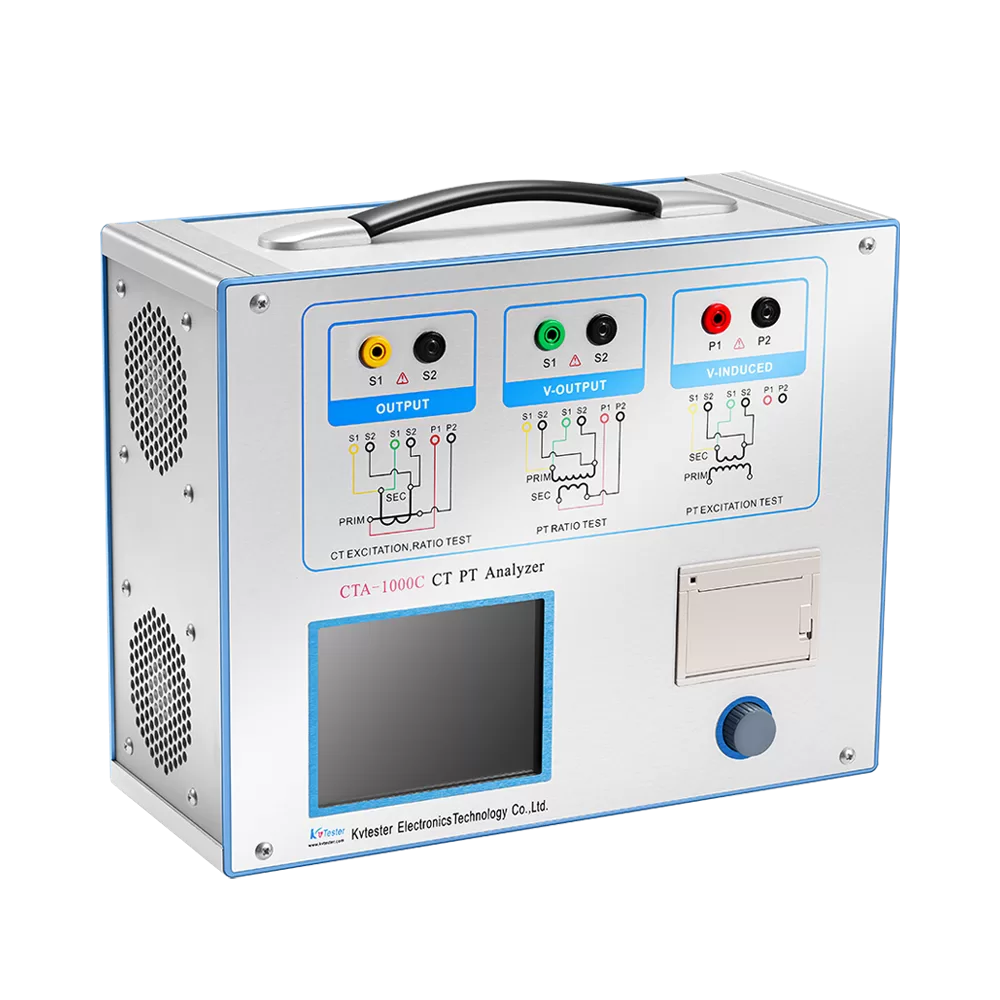
For field teams that need several CT measurement functions in one instrument, the CTA-1000D CT/PT Analyzer is one option to consider. It supports CT ratio and polarity testing alongside other CT analysis functions, helping technicians handle multiple testing tasks with a single portable instrument.
Excitation Curve and Knee Point
The excitation curve shows the relationship between the voltage applied to a CT secondary winding and the resulting excitation current. It helps engineers assess the magnetic characteristics of the core and identify the knee point where the curve changes significantly.
These measurements are particularly relevant when evaluating protection CTs, because core saturation can affect the ability of a CT to reproduce primary current accurately during fault conditions.
Excitation testing can help engineers:
- Examine the CT’s magnetization characteristics.
- Determine the knee point using the applicable test method.
- Compare results with the relevant CT specification or previous measurements.
- Identify changes that may require further investigation.
The knee-point definition and acceptance criteria depend on the applicable standard and CT specification. Engineers should use the correct test method rather than treating one measured value as a universal pass-or-fail threshold.
Winding Resistance and Secondary Burden
Secondary winding resistance testing measures the resistance of the CT secondary circuit under the specified test conditions. Abnormal resistance may indicate connection problems, winding damage, or differences that warrant further investigation.
Secondary burden testing evaluates the electrical load connected to the CT secondary circuit. Excessive burden can affect the CT’s performance and should be considered alongside the CT’s rated burden and accuracy requirements.
When selecting a tester for these measurements, check whether it supports:
- Secondary winding resistance measurement.
- Secondary burden or impedance measurement.
- The required measurement range and accuracy.
- Data storage for comparing results across phases or maintenance periods.
Not every digital CT tester includes all these functions. Confirm the capabilities of the selected model before planning a complete testing procedure.
Ratio Error and Phase Displacement
For metering applications, CT ratio error and phase displacement are important because they affect the accuracy of current measurement and energy metering.
Ratio error describes the difference between the actual transformation relationship and the rated ratio. Phase displacement describes the phase-angle difference between the primary and secondary current according to the applicable convention.
These parameters can help engineers evaluate whether a CT meets the accuracy requirements for its intended application. Their assessment may require specific test conditions, suitable reference measurements, and the appropriate evaluation method.
When comparing instruments, verify whether ratio error and phase displacement are measured directly or calculated through a supported analysis procedure. Also confirm the applicable accuracy class and standard before interpreting the results.
Where Portable CT Testers Are Used
Digital portable CT testing equipment is useful in applications where engineers need to verify CT performance at the installation site or during production and quality inspection.
Substation Commissioning and Maintenance
During substation commissioning, technicians need to verify that current transformers are correctly connected and perform according to the project requirements. Portable CT analyzers can support checks before the equipment enters service.
Typical tasks include:
- Verifying transformation ratio and polarity.
- Measuring excitation characteristics where required.
- Checking secondary winding resistance.
- Assessing supported burden and accuracy parameters.
- Recording results for commissioning documentation.
During routine maintenance, technicians can compare current measurements with previous records to identify changes that may need further examination. The test scope should be determined by the CT type, protection or metering function, and the maintenance procedure.
CT Manufacturing and Laboratory Testing
CT manufacturers and electrical testing laboratories may need to verify product characteristics during production, inspection, and quality control. A digital tester with suitable measurement functions can help standardize test procedures and organize the resulting data.
Important considerations for these environments include:
- Measurement accuracy across the required CT ratios and ratings.
- Repeatability under consistent test conditions.
- Availability of the tests required by the product specification.
- Data storage, export, and report generation.
- Compatibility with the manufacturer’s quality inspection procedures.
For higher-volume testing, the required throughput and automation level may also influence equipment selection. A portable analyzer can be suitable for flexible testing tasks, while a dedicated automated system may be more appropriate for repetitive production-line testing.
How to Choose the Right Digital Portable CT Tester
A suitable instrument should match the CTs being tested, the required measurements, and the conditions in which the equipment will be used. Reviewing these factors before purchase helps avoid paying for unnecessary features or choosing a tester that cannot complete the intended test sequence.
Check Test Functions and CT Types
Begin by defining the CT types and applications covered by your work. Protection CTs and metering CTs may have different testing priorities, and the required functions can vary by project.
Prepare a list of the measurements you need, such as:
- Ratio and polarity testing.
- Excitation curve and knee-point analysis.
- Secondary winding resistance measurement.
- Burden or impedance measurement.
- Ratio error and phase displacement evaluation.
Then compare the list with the instrument’s specifications. Do not assume that every portable CT analyzer supports every test simply because it is described as a multifunction instrument.
If you are comparing different models, Kvtester provides a range of CT/PT testing equipment for different testing requirements. Reviewing the supported functions of each model is a useful starting point for narrowing down your options.
Compare Accuracy and Measurement Range
The measurement range must cover the CT specifications encountered in your application, while the instrument’s accuracy must be appropriate for the intended evaluation.
Review the following specifications:
- Supported CT ratio range.
- Excitation voltage and current ranges, where applicable.
- Resistance measurement range and accuracy.
- Supported burden and error measurements.
- Applicable test standards and evaluation methods.
Accuracy specifications should be interpreted in context. Different parameters may have different accuracy limits, and a tester’s measurement accuracy is not the same as the overall accuracy of the CT being tested.
Correct connections, suitable test conditions, and adherence to the operating instructions are also necessary for obtaining reliable results.
Consider Weight, Power Supply, and Data Storage
A portable CT tester should be practical to transport and operate at the intended location. Physical specifications and data management features can make a noticeable difference when technicians conduct repeated field tests.
Consider these factors:
- Weight and dimensions: Check whether the instrument can be transported comfortably with its required accessories.
- Power supply: Confirm that the available supply is compatible with the tester’s requirements.
- User interface: Clear instructions and straightforward test selection can help reduce setup errors.
- Data storage: Determine whether the instrument can retain enough records for your testing workload.
- Data export: Check whether results can be transferred to a computer for reporting, archiving, or further analysis.
For example, the CTA-1000E CT/PT Analyzer supports storage for up to 10,000 groups of test data and provides USB data export and computer-based analysis features. These capabilities can be useful for teams that need to retain and compare test records across multiple projects.
Review Test Procedures and Safety Requirements
A digital tester can automate supported measurements, but it does not remove the need for correct test preparation and safe working practices.
Before selecting and using an instrument, confirm that the test procedure is compatible with the CT design and the equipment’s operating instructions.
Engineers should also:
- Follow the applicable electrical isolation and site safety procedures.
- Verify the CT terminal connections against the correct wiring diagram.
- Use the specified test leads and accessories.
- Follow the manufacturer’s instructions for test execution and disconnection.
- Save and review results before making maintenance or acceptance decisions.
Testing procedures can differ depending on whether the CT is installed in a live electrical system, isolated for maintenance, or tested during manufacturing. The equipment and procedure must be appropriate for the actual working conditions.
Digital Portable CT Testing Solutions from Kvtester
Choosing a digital portable CT tester is ultimately a matter of matching measurement capabilities with practical field requirements. A suitable instrument should provide the tests you need, cover the required measurement ranges, and make it convenient to record and review results.
Kvtester offers CT/PT analyzers designed for different testing and analysis requirements. The CTA-1000D CT/PT Analyzer is suitable for applications requiring automated CT testing and analysis. It supports measurements including ratio, polarity, excitation characteristics, and winding resistance, helping technicians complete multiple testing tasks with one portable instrument.
For applications that require multifunction testing and organized data management, the CTA-1000E CT/PT Analyzer is another option to consider. It supports storage for up to 10,000 groups of test data, USB data export, and computer-based analysis, making it easier to retain and review test results.
The best choice depends on the required tests, CT specifications, applicable standards, and expected workload. Before making a decision, compare the full technical specifications with your testing requirements rather than relying on portability or the number of advertised functions alone.
Conclusion
A digital portable CT tester can help engineers perform current transformer measurements more efficiently by combining electronic measurement, data processing, and convenient field operation. Its value depends on whether the supported tests and measurement ranges match the CTs and applications involved.
When selecting equipment, prioritize the required measurement functions, accuracy, operating conditions, and data management capabilities. Confirm the applicable test procedures and standards as well, particularly when the instrument will be used for commissioning, protection CT evaluation, or quality acceptance.
If you are looking for a digital portable CT tester for field maintenance, commissioning, or manufacturing inspection, contact Kvtester. Share your CT type, required test parameters, accuracy requirements, and intended application so our team can help you identify a suitable testing solution.
Related Products
Latest News
-
 2026-10-30What are the differences in test items between dry-type and oil-immersed transformers?
-
 2026-10-30What are the differences in equipment configuration for comprehensive test benches designed for 10kV, 20kV, and 35kV transformers?
-
 2026-10-30How to Choose the Right Transformer Comprehensive Test Bench?
-
 2026-10-30What factors affect the accuracy of transformer test results?
-
 2026-10-30What is the basic principle of partial discharge testing?