Home » News » Company News
Variable Frequency CT Tester: Why Frequency Matters
A Variable Frequency CT Tester uses adjustable test frequency to evaluate current transformer characteristics, especially during excitation and saturation testing. But why does frequency matter, and what changes when a CT is tested with a variable-frequency method instead of a conventional fixed-frequency approach?
The answer is closely related to the CT core, excitation voltage, saturation behavior, and the way test equipment generates and analyzes the required test signals.
What Does Variable Frequency Mean in CT Testing?
In CT testing, variable frequency means that the test signal frequency can be changed according to the testing method rather than being limited to the normal system frequency.
This is particularly useful for excitation characteristic testing. The tester applies a controlled signal to the CT secondary winding and measures the relationship between excitation voltage and current. By collecting these values, engineers can build the CT’s volt-ampere characteristic curve and evaluate its magnetic behavior.
Kvtester uses frequency-conversion principles in CT/PT testing equipment to simplify traditional testing arrangements. Our variable-frequency CT/PT testing solution can perform comprehensive CT and PT tests without relying on a separate voltage regulator, booster, and current riser.
This is an important distinction: variable frequency is not simply an extra specification on a CT tester. It changes how the test signal is generated and how certain CT characteristics can be evaluated.
Why Does Test Frequency Matter for a Current Transformer?
A CT contains a magnetic core, so its response depends on the relationship between voltage, current, frequency, and magnetic flux. When excitation testing is performed, the test frequency becomes part of the test conditions.
Frequency and CT Excitation Characteristics
Excitation testing examines how the CT secondary current changes as the applied voltage increases. At lower excitation levels, the current generally increases gradually. As the magnetic core approaches saturation, the excitation current rises much more rapidly.
The resulting curve provides information about the magnetic characteristics of the CT core. The knee point is one of the important parameters derived from this behavior, particularly for protection CTs.
A variable-frequency method gives the tester another degree of control over the excitation test. Instead of treating frequency as a fixed condition, the testing system can use frequency conversion as part of the measurement method.
Frequency and Required Test Voltage
One practical reason for using a lower test frequency is that it can reduce the voltage required to reach a comparable magnetic flux condition when the applicable test method permits this approach.
This matters because the required excitation voltage can become very high for some CTs. A suitable test method can therefore affect the output requirements of the equipment as well as the overall test setup.
The actual frequency range, output voltage, and test method must still match the CT and the applicable standard. Variable frequency does not mean that one frequency setting is suitable for every CT.
Frequency Is Part of the Test Method
For this reason, frequency should be evaluated together with output capability, measurement accuracy, automatic calculation, and the CT type being tested.
Simply choosing a tester because it has a “variable frequency” label is not enough. The important question is whether its frequency-conversion method supports the CT tests you actually need to perform.
How Does Variable Frequency Help With CT Excitation Testing?
Excitation testing is where variable-frequency technology becomes especially relevant.
The basic process is straightforward: the tester applies an excitation signal to the CT secondary winding, increases the test condition, measures the resulting excitation current, and uses the collected data to generate the excitation curve.
From this curve, engineers can evaluate parameters such as knee point voltage and current, saturation behavior, and other protection-related characteristics. Kvtester also explains that excitation results should be assessed against the CT design, application, and applicable testing requirements rather than against one universal knee-point value.
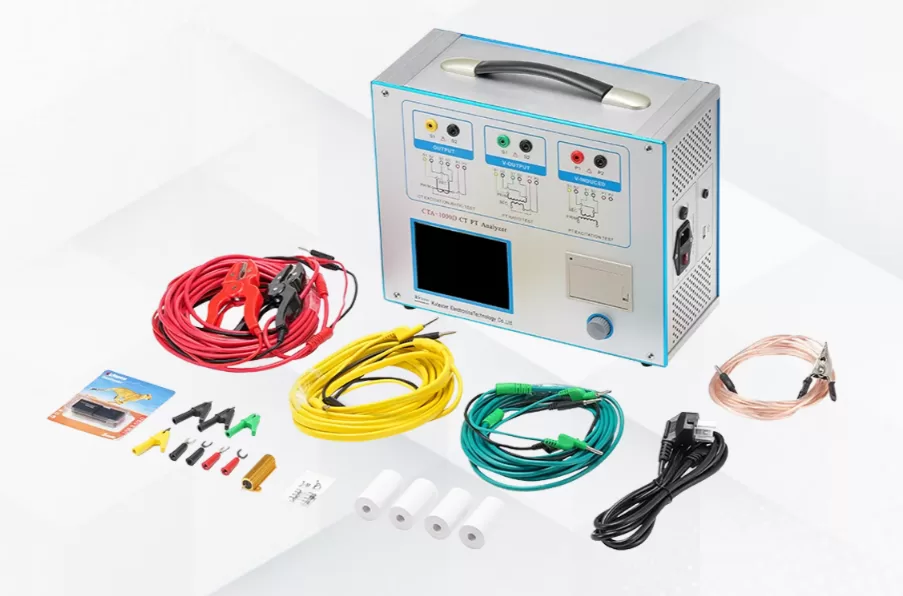
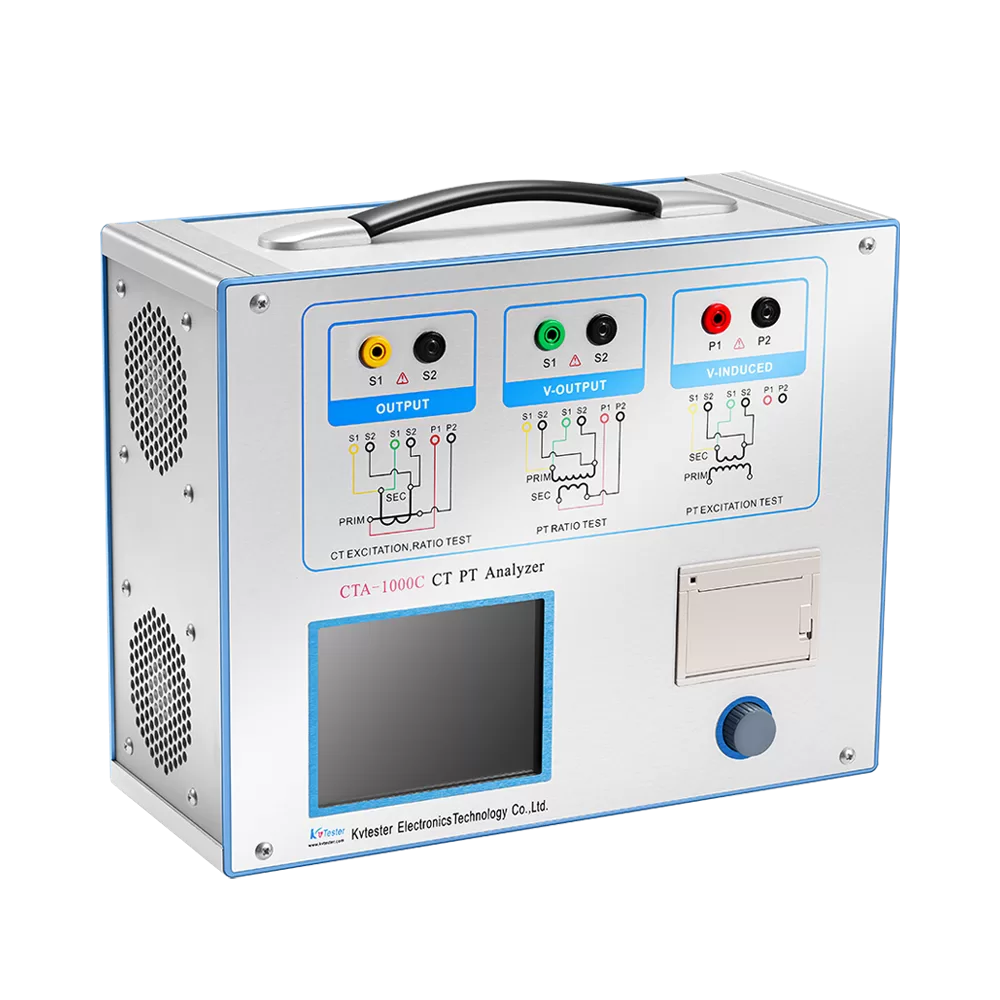
For applications requiring integrated CT/PT analysis, the CT/PT Analyzer CTA-1000D combines excitation and saturation testing with ratio, phase-angle, winding resistance, burden, polarity, ALF, FS, and residual magnetism measurements.
The CTA-1000D provides 0–120 V output voltage, 0–5 A effective output current, and 0–400 VA effective output power. Its automatic test duration is less than 2 minutes under specified conditions, and its weight is less than 9 kg, making it suitable for on-site CT testing. Its ratio measurement accuracy is 0.02% typical for ratios from 1 to 2,000.
The important point is that the instrument should be selected according to the required excitation test and the complete CT testing workflow, rather than frequency capability alone.
What Changes When CT Testing Uses Variable Frequency?
The biggest change is the relationship between the test signal and the equipment required to produce it.
Test Equipment Configuration
Traditional CT excitation testing can involve a voltage regulator, booster, current source, and other supporting equipment. A frequency-conversion CT tester can integrate more of these functions into one testing system.
This can reduce the amount of equipment that needs to be connected at the test location and simplify the wiring arrangement.
Kvtester’s variable-frequency CT/PT testing approach was developed to replace a more complex combination of traditional equipment for comprehensive CT/PT testing.
Excitation Test Operation
With an integrated analyzer, the operator does not need to manually calculate every point on the excitation curve.
The tester can control the test process, collect voltage and current data, generate the excitation curve, and calculate relevant parameters according to the selected testing method.
This is particularly useful when several CTs must be tested during commissioning, manufacturing, or maintenance.
Field Testing Efficiency
Variable-frequency testing can also be valuable when equipment needs to be transported to a substation or another testing location.
The benefit is not simply that the tester is smaller. A well-integrated system can reduce the number of separate devices, connections, and manual calculation steps required for a test.
Which CT Tests Benefit Most From Variable Frequency?
Not every CT test depends equally on frequency conversion. The strongest connection is with tests that examine the magnetic characteristics of the CT core.
Excitation and Knee Point Testing
Excitation testing records the voltage-current relationship of the CT secondary winding. The resulting curve helps identify the transition toward saturation.
The knee point provides an important reference for evaluating protection CT performance, but its acceptance value must be considered according to the CT design and applicable standard.
Excitation Curve Analysis
The excitation curve is more informative than a single voltage or current value because it shows the CT’s response across the test range.
Engineers can use the curve to compare the measured magnetic behavior with expected characteristics and investigate abnormal results.
Other CT Measurements
A comprehensive CT analyzer may also measure ratio, polarity, winding resistance, burden, phase angle, and other parameters.
However, these tests should not all be described as benefits of variable frequency. Ratio or polarity testing, for example, has a different measurement purpose from excitation testing.Keeping this distinction clear helps users choose equipment based on actual testing requirements.
For a broader explanation of excitation curves, knee point voltage, ALF, FS, and related CT parameters, our CT and PT excitation testing guide provides additional technical context.
Where Is Variable Frequency CT Testing Used?
Variable-frequency CT testing can be useful wherever CT excitation characteristics need to be evaluated efficiently.
CT Manufacturing
Manufacturers can use excitation and other CT measurements during development and production. Automated data collection also helps reduce repetitive manual calculations when multiple units need to be tested.
Substation Commissioning
During commissioning, engineers may need to verify CT ratio, polarity, excitation characteristics, winding resistance, burden, and other parameters.
A portable analyzer that combines several functions can reduce the need to change equipment between individual tests.
Maintenance and Troubleshooting
For maintenance work, excitation characteristics can help engineers investigate changes in CT magnetic behavior.
However, an unusual excitation result should not immediately be treated as a CT failure. Connections, winding selection, entered parameters, and test conditions should also be checked.
Testing Laboratories
Laboratories generally place greater emphasis on measurement accuracy, repeatability, applicable standards, and data management.
The appropriate variable-frequency method therefore depends on the CT type, required test parameters, and laboratory procedures.

What Should You Check Before Choosing a Variable Frequency CT Tester?
The frequency specification is only one part of the selection process.
Check the Frequency Range and Control
First confirm how the tester controls frequency and whether its available frequency range is appropriate for the intended CT testing method.
A broader frequency range is not automatically better if your required test procedure uses only a specific range.
Check Test Voltage and Current
The tester must provide sufficient output for the CTs being tested, particularly when excitation characteristics and knee point need to be evaluated.
Compare the required test voltage and current with the equipment’s actual output specifications rather than focusing only on the nominal tester category.
Check Automation
Automatic frequency control, data acquisition, curve generation, and parameter calculation can significantly reduce manual work.
This becomes more valuable when the same testing procedure must be repeated across many CTs.
Check the Complete CT Test Functions
Consider the full workflow. If you need excitation, ratio, polarity, winding resistance, burden, and phase-related measurements, an integrated CT analyzer may be more practical than a device designed for only one test.
Consider Portability
For field testing, size and weight can affect the actual efficiency of the testing process.For example, the CTA-1000D weighs less than 9 kg and has dimensions of 370 × 320 × 170 mm. Its maximum test voltage is 180 V, while its specified output voltage is 0–120 V. These figures give a clearer basis for evaluating field suitability than simply calling a tester “portable.”
Variable Frequency Is More Than a Tester Feature
Variable frequency matters because it changes the way certain CT characteristics can be tested. Its value is most apparent in excitation and saturation-related testing, where the relationship between frequency, voltage, current, and magnetic flux directly affects the test method.
When selecting a tester, look beyond the variable-frequency specification. Consider the frequency control, output capability, excitation testing functions, automation, measurement accuracy, and portability in relation to your actual testing requirements.
If you are looking for a suitable solution for CT excitation testing, substation commissioning, or transformer testing, Kvtester can help you evaluate the right equipment based on your application and technical requirements. Contact us to discuss your testing needs and get professional equipment recommendations.
Related Products
Latest News
-
 2026-11-19Generator Rotor AC Impedance Tester for Fault Detection
-
 2026-11-19Anti-interference Transformer Tester for Substation
-
 2026-11-19How Does a CT Tester Work? Understanding Its Working Principle
-
 2026-11-19CT Test Bench for Automated Current Transformer Testing
-
 2026-11-13What testing instruments are required for the handover testing of 10kV transformers?