
Why does the required capacity of series resonant test equipment usually increase with cable length?
Why does the required capacity of series resonant test equipment usually increase with cable length?
When selecting equipment for AC withstand voltage testing on cables, a common question arises: why do manufacturers specify different series resonant equipment configurations for cables of the same voltage rating (e.g., 10kV or 35kV) depending on whether the length is 500 meters or 2000 meters? The primary reason is that cable length affects the total capacitance of the test object, and this total capacitance is directly linked to the test current, resonant frequency, and reactor capacity.
1. Why can a power cable be treated as a capacitor?
An insulating medium exists between the internal conductor and the metal shielding layer of a power cable; electrically, this creates significant distributed capacitance.
For a specific cable model, manufacturers usually specify the capacitance per unit length (e.g., capacitance per kilometer). As the cable length increases, the total capacitance increases accordingly. During AC withstand voltage testing, this capacitance becomes a crucial component of the series resonant test circuit.
2. How does the test current change as capacitance increases?
Capacitive current can be approximated by the formula: I = 2πfCU, where I is the current, f is the test frequency, C is the capacitance of the test object, and U is the applied voltage.
If the test frequency and voltage remain constant, an increase in cable capacitance (C) leads to a corresponding increase in current (I). Therefore, when testing cables of the same voltage rating, the requirements for the test circuit’s current-carrying capacity differ depending on whether the cable is 1000 meters or 2000 meters long. This is a key reason why cable length influences the required capacity of series resonant equipment.
3. Why is it difficult to test long cables using a standard power supply?
For large capacitive loads, if a standard AC test power supply were to provide the entire amount of capacitive reactive power directly, the required power supply capacity would rise significantly as the test object’s capacitance increased. In contrast, a series resonant system utilizes the mutual compensation between the reactor’s inductive reactive power and the cable’s capacitive reactive power; this allows the power supply to primarily compensate for losses within the test circuit, thereby reducing the requirement for input power supply capacity.
However, this does not mean that the equipment capacity remains unaffected when the cable length increases. As the test current increases, the reactor itself must possess the corresponding current and capacity ratings.
4. Cable length also affects the resonant frequency.
The series resonant frequency is given by: f = 1 / (2π√LC). From this formula, it is evident that if the reactor inductance (L) remains constant, an increase in the test object’s capacitance (C) will result in a decrease in the resonant frequency.
Therefore, when determining whether a series resonant test system can handle a range of cable lengths (from short to long), one must not only verify capacity and current ratings but also ensure that the resonant frequency under all operating conditions falls within the adjustable range of the variable-frequency power supply. This is why frequency calculations are essential during professional equipment selection.
5. Why are reactors often designed with a multi-section structure?
To expand the equipment’s application range, many series resonant systems utilize multi-section reactor modules. When dealing with high test voltages, reactors can be connected in series to increase the overall voltage withstand capability; for cables with high capacitance or requiring high test currents, parallel or combined configurations can be adopted based on design requirements. This allows the system to accommodate both short cables and a certain range of long cables. However, such combinations are not arbitrary; each connection method requires the calculation of parameters such as equivalent inductance, resonant frequency, and the voltage and current ratings of individual reactor sections.
6. Is it best to simply select the highest possible equipment capacity?
While increasing capacity theoretically expands the range of applicable operating conditions, “bigger is not always better” in actual procurement. Higher capacity often entails a greater number of reactors, increased weight and cost, and more demanding requirements for on-site transport, handling, and power supply. If a user only tests short-to-medium length cables, excessive configuration can actually reduce the economic efficiency and convenience of the equipment. Therefore, a more rational approach is to perform calculations based on the longest cable currently in use while maintaining a reasonable margin for potential future projects.
7. Which cable length should be specified during equipment selection?
You should specify the “maximum cable length likely to be tested in a single operation.” If a project involves a total of 10 kilometers of cable divided into a dozen sections—with the longest single section being only 1 kilometer—then the equipment should not be selected based on a 10-kilometer load. Information regarding the cable’s cross-sectional area, model, or capacitance per unit length should also be provided, as total capacitance can vary between different cable models even if their lengths are identical.
Therefore, the notion that “the longer the cable, the higher the required series resonance capacity” is merely a general rule of thumb for conceptual understanding. When actually configuring the equipment, a comprehensive calculation—factoring in voltage, capacitance, frequency, current, reactor combinations, and on-site operating conditions—is essential to arrive at a truly optimal solution.
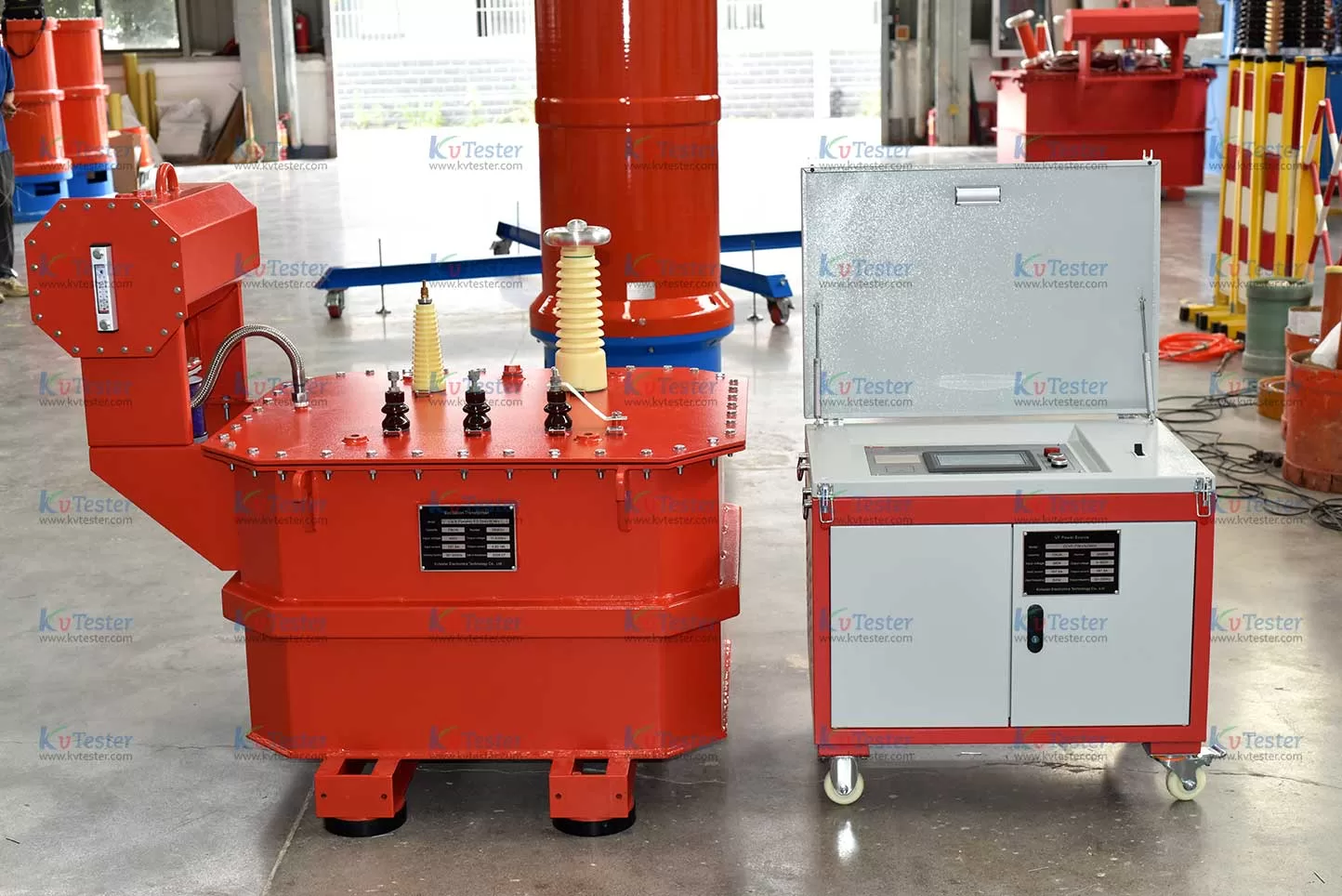
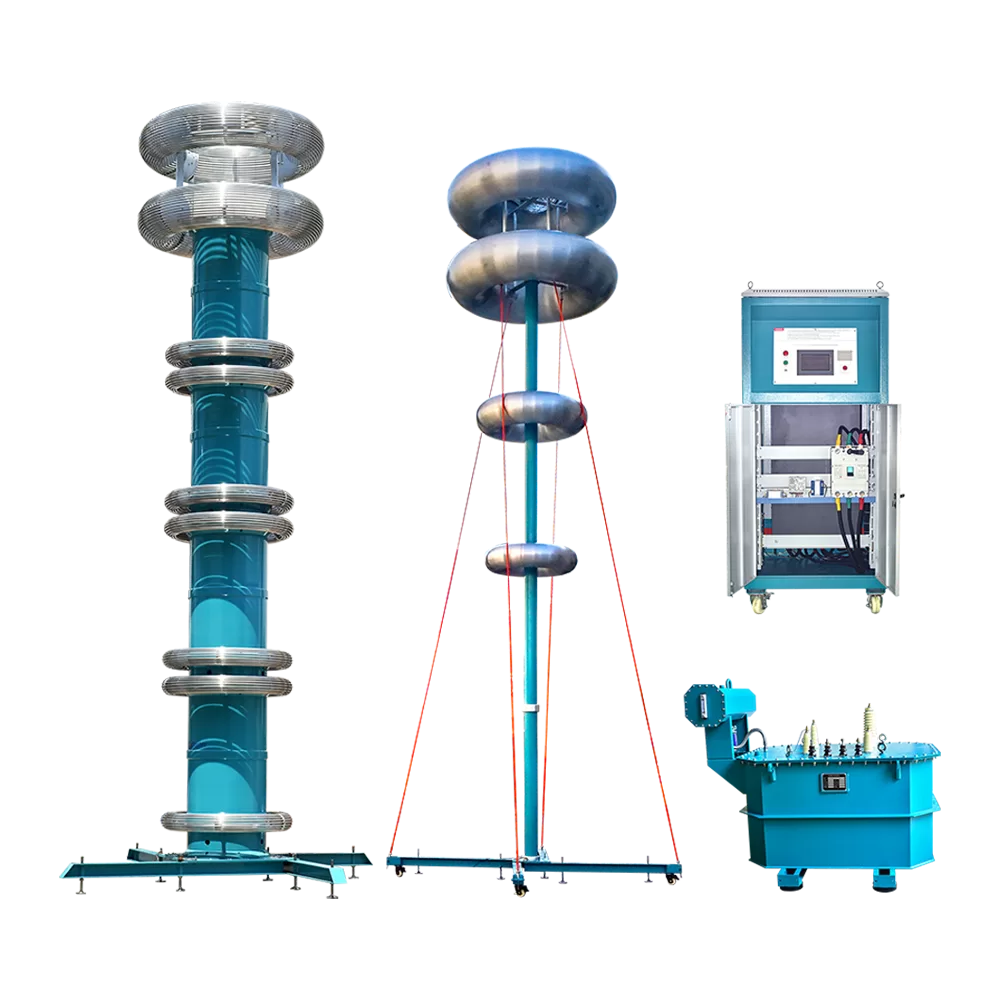
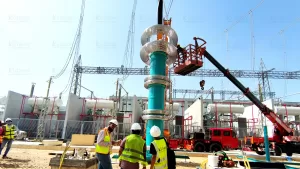
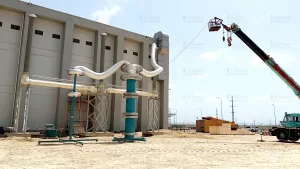
ZCVF-A series frequency conversion series resonant AC withstand voltage device is suitable for AC withstand voltage test of transformer, circuit breaker, switch, GIS system, cable, bushing, insulator and other equipment. It has the functions of high voltage over-voltage protection, low voltage over-current protection, detuning protection, zero position protection, flashover protection, emergency shutdown, under-voltage protection and so on. It not only meets the requirements of equipment test conditions for high voltage and small current, but also meets the requirements of equipment test conditions for low voltage and large current, and has a wide application range.
Kvtester Electronics Technology Co.,Ltd. is a high-tech enterprise specializing in power testing, testing, research and development, production, and sales of testing equipment. It has been engaged in the electrical testing industry for many years, and its products are of high quality. We welcome customers to come and purchase. Service hotline: 0086-27-81778799, to learn more, visit the official website: www.kvtester.com
Related Products
Latest News
-
 2026-09-18How should 35kV cable series resonant withstand voltage test equipment be configured?
 -
 2026-09-18How to Select AC Withstand Voltage Test Equipment for 10kV Cables?
 -
 2026-09-18What parameters must be provided to the manufacturer when purchasing series resonant withstand voltage test equipment?
 -
 2026-09-18How do you select a series resonant withstand voltage test system? Key parameters to consider
 -
 2026-09-18Multi-function Transformer Testing Equipment OEM Guide