Home » News » Company News
Automatic CT Tester with Data Logger: Improving Grid Commissioning Efficiency
Grid commissioning requires careful verification of current transformers (CTs) before a substation or power system is energized. Engineers need to confirm that each CT meets its required electrical characteristics and that test results are properly recorded for review and acceptance.
An automatic CT tester can simplify this process by combining multiple measurements and automated evaluation in one instrument. When data storage and export functions are also available, engineers can organize test records more efficiently, compare results, and prepare commissioning documentation.
What Is an Automatic CT Tester with Data Logger?
An automatic CT tester is an instrument designed to measure and evaluate the electrical characteristics of current transformers. Instead of requiring separate instruments for every measurement, it can perform several CT tests through a unified operating process.
Depending on the model, these tests may include:
- CT transformation ratio and phase-angle error
- Excitation characteristics and saturation
- Secondary winding resistance
- Polarity
- Secondary burden
- Accuracy-related parameters, such as ALF and FS
Automatic testing helps reduce repetitive manual operations and makes it easier to obtain consistent measurement results. Some analyzers can also evaluate CT performance according to selected IEC or IEEE standards.
A data logger serves a different but closely related purpose. It records measurement results so that engineers can review, compare, export, and retain test information. Depending on the equipment, data management may involve internal storage, USB export, or supporting computer software.
For grid commissioning, these two capabilities work together. Automatic testing helps engineers complete measurements efficiently, while data management supports result verification and project documentation.
Why Is CT Testing Important During Grid Commissioning?
Current transformers provide measurement signals for metering instruments, protection relays, and monitoring systems. Incorrect CT characteristics or wiring problems can affect the accuracy of these systems and may lead to incorrect protection or measurement behavior.
Testing before energization helps identify potential problems while there is still an opportunity to correct them.
Verifying CT Ratio and Polarity
The CT ratio determines how primary current is converted into secondary current. Engineers need to confirm that the actual ratio matches the nameplate and the requirements of the connected metering or protection equipment.
Polarity is equally important. Incorrect polarity can cause abnormal current direction or phase relationships in connected circuits. This is particularly important in differential protection and other schemes that compare current signals from different locations.
Checking Excitation Characteristics
The excitation test helps engineers understand the relationship between the voltage applied to the secondary winding and the resulting excitation current.
The excitation curve can reveal the CT’s magnetic characteristics and help identify its knee-point voltage. These results are important when evaluating protection CT performance and its ability to operate within the required range.
For protection applications, engineers may also need to examine parameters such as the accuracy limit factor (ALF), depending on the CT type and project requirements.
Measuring Secondary Winding Resistance
Secondary winding resistance affects voltage drop and the overall performance of the CT secondary circuit.
Measuring winding resistance helps identify abnormal resistance values that may result from winding problems, loose connections, or other defects. The results should be assessed against the applicable CT specifications and testing procedure.
Evaluating CT Burden and Accuracy
The secondary burden includes the connected instruments, relays, cables, and other components in the secondary circuit.
If the actual burden exceeds the CT’s rated capacity, its measurement performance may be affected. Engineers should therefore verify the burden and consider ratio and phase-angle errors under the relevant test conditions.
Preparing CT Records Before Energization
Testing is not complete when the measurements are finished. Commissioning teams also need to retain results for acceptance, technical review, and future maintenance.
A clear record should identify the CT, its installation location, the test items, measurement results, applicable criteria, and any corrective actions. Organized records make it easier to confirm that all required units have been tested before energization.
What Features Should an Automatic CT Tester Provide?
The right automatic CT tester should cover the measurements required by the commissioning procedure. A large number of functions is not enough on its own; engineers should also check the instrument’s measurement range, accuracy, output capability, and evaluation methods.
Automatic CT Testing and Evaluation
Automatic testing reduces the need for repeated manual calculations and individual instrument adjustments.
For example, our CTA-1000D CT/PT Analyzer automatically determines relevant CT parameters and evaluates the results according to the selected IEC or IEEE standard.
Its automatic test duration is specified as less than two minutes. This can help commissioning teams improve testing efficiency when checking multiple CTs in the field.
Automatic operation does not eliminate the need for correct connections and test preparation. Engineers still need to identify the CT type, confirm the required parameters, and follow the appropriate safety procedures.
CT Ratio and Phase-Angle Measurement
A suitable analyzer should measure both transformation ratio and phase-angle accuracy.
These measurements help verify whether the CT can provide the required current signals to metering and protection equipment. The instrument’s ratio range and accuracy should match the CTs being tested.
Excitation Curve and Knee-Point Analysis
Excitation testing is particularly important for protection CTs. The tester should provide the excitation characteristics needed to evaluate the magnetic performance of the CT.
Depending on the required test procedure, engineers may also need knee-point voltage and current, saturation-related parameters, and accuracy limit calculations.
Polarity and Winding Resistance Testing
Polarity and secondary winding resistance are essential checks during commissioning.
Combining these functions in one analyzer can reduce equipment changes and simplify the testing process. It also helps engineers maintain a more consistent workflow when checking multiple CTs.
Burden and Accuracy Evaluation
The analyzer should support burden measurement and the relevant accuracy-related calculations required by the project.
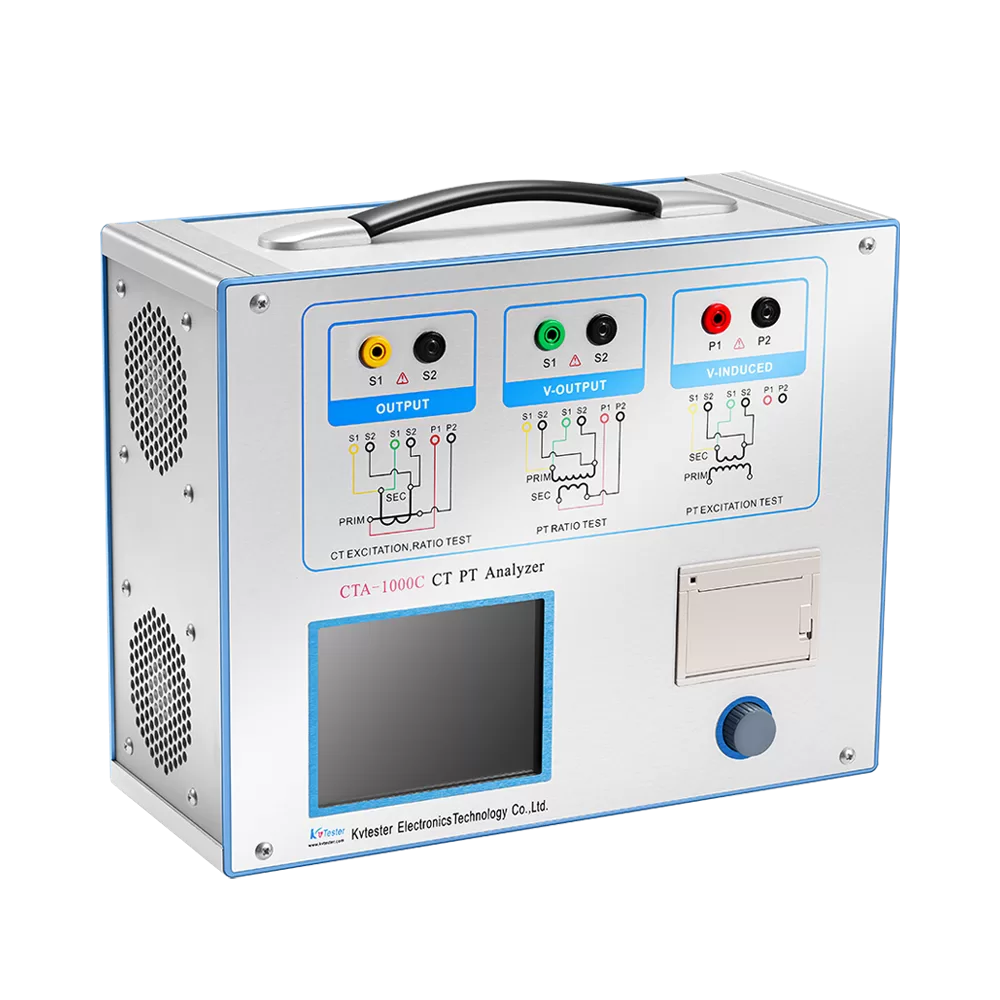
For example, the CTA-1000C supports CT ratio and phase-angle accuracy, excitation characteristics, winding resistance, burden impedance, and polarity testing. Its CT ratio measurement range is 1–40,000, with a stated accuracy of ±0.05%.
Its output capability is 0–180 Vrms, 12 Arms, and 36 A peak. These specifications provide useful reference points when evaluating whether the instrument is suitable for the CTs and test procedures involved.
How Does a Data Logger Improve CT Commissioning Work?
Data logging becomes particularly useful when commissioning teams need to test many CTs across several switchgear panels or substations. Instead of relying entirely on handwritten notes, engineers can use electronic records to organize and review measurement results.
Automatic Test Data Recording
Recording test results helps reduce the risk of missing or incorrectly transcribing measurement values.
A useful record should include the CT identification, test item, measured value, test date, and relevant evaluation information. The exact fields depend on the instrument and the project’s documentation requirements.
Storage and Review of Historical Results
Internal storage allows engineers to retain test results for later review. This is helpful when a commissioning project involves multiple CTs or when the team needs to revisit earlier measurements.
When selecting equipment, check the available storage capacity and whether records can be identified and retrieved conveniently.
USB Data Export and Computer Analysis
USB export can make it easier to transfer test results to a computer for further analysis and documentation.
For projects with more extensive data management requirements, supporting software can help engineers organize results, compare measurements, and prepare reports.
Our CTA-1000E provides a useful example of this type of data management capability. It has an internal solid-state drive that can store up to 10,000 groups of test data, supports USB data export, and includes background analysis software for saving, converting, analyzing, and comparing test results.
This makes it worth considering when built-in data storage and report management are important selection requirements. Its data functions should be evaluated separately from the automatic testing capabilities of other CT analyzer models.
Test Report Preparation and Documentation
Commissioning reports provide evidence that the required inspections and measurements have been completed.
A structured report can include:
- Project and substation information
- CT identification and nameplate data
- Test date and test personnel
- Measurement results
- Evaluation criteria and conclusions
- Any abnormal findings and corrective actions
The availability of electronic test data can make report preparation more efficient. However, engineers should still check whether the instrument’s export format meets the project’s documentation requirements.
Comparing Results Across Different CT Units
Comparing results across CTs can help engineers identify unusual measurements within the same installation.
For example, significant differences in winding resistance or excitation characteristics may deserve further investigation. Comparisons should always consider differences in CT design, rated parameters, and test conditions rather than treating every CT as identical.
How to Choose the Right CT Tester for Grid Commissioning
Selecting an automatic CT tester with data logging requires more than comparing product names. The instrument should match the CT specifications, commissioning procedures, and documentation requirements of the project.
Measurement Range and Accuracy
Check the CT ratio range, winding resistance range, burden range, and phase measurement accuracy.
The instrument must cover the actual values expected from the CTs being tested. Measurement accuracy should also meet the requirements of the applicable testing standard and project acceptance procedure.
Supported CT Types and Accuracy Classes
Different CTs serve different purposes. Protection CTs, metering CTs, and special-purpose CTs may require different test parameters.
Confirm that the analyzer supports the CT types and accuracy classes used in the project. If the commissioning procedure requires specific calculations, such as ALF, FS, or knee-point analysis, verify that these functions are available.
Automation and Testing Efficiency
For projects involving many CTs, automatic evaluation can reduce repetitive operations and help standardize the testing process.
Consider the time required for each test, the connection procedure, the user interface, and how easily engineers can switch between different test items.
Data Storage Capacity and Export Options
If electronic test records are a project requirement, check the instrument’s internal storage capacity, USB interface, supported export formats, and available analysis software.
Do not assume that every automatic CT analyzer includes a built-in data logger. Some instruments focus primarily on measurement and automatic evaluation, while others provide more extensive data storage and reporting functions.
Portability and Field Operating Conditions
Grid commissioning often takes place in substations where equipment needs to be transported between different installation points.
Weight, dimensions, power supply requirements, operating temperature, and connection accessories can all affect field efficiency.
A portable analyzer can simplify on-site testing, but portability should not come at the expense of the measurement functions required by the project.
Applicable IEC and IEEE Standards
The testing procedure should follow the standards and acceptance criteria specified for the project.
Check which standards the analyzer supports and whether its automatic evaluation functions are appropriate for the CT type being tested. Engineers should also confirm that the selected criteria match the project’s technical documentation.
Frequently Asked Questions About Automatic CT Testers
What Tests Should Be Performed on CTs During Grid Commissioning?
Common CT commissioning tests include ratio, polarity, excitation characteristics, secondary winding resistance, and burden measurement. Depending on the CT application and project requirements, engineers may also need to evaluate phase-angle error, ALF, FS, and other performance parameters.
Can an Automatic CT Tester Generate Test Reports?
This depends on the model. Some analyzers support internal data storage, USB export, or computer-based analysis software. Before purchasing, confirm whether the available reporting functions meet the project’s documentation requirements.
How Much Test Data Can a CT Tester Store?
Storage capacity varies by model. For example, the CTA-1000E can store up to 10,000 groups of test data. Other analyzers may have different data management capabilities, so storage capacity should be checked in the product specifications.
Why Is Data Logging Important for Substation Commissioning?
Data logging helps commissioning teams retain measurement results, review test history, compare different CT units, and prepare technical documentation. It also makes it easier to trace test records when questions arise during acceptance or future maintenance.
Does Automatic Testing Mean No Manual Operation Is Required?
No. Automatic testing simplifies measurement and evaluation, but engineers still need to connect the instrument correctly, select the appropriate test parameters, and follow safety procedures. The quality of the results depends on both the instrument and the testing process.
Conclusion
An automatic CT tester with data logging can support a more organized and efficient grid commissioning process. Automatic measurement and evaluation help reduce repetitive work, while electronic data storage and export make it easier to review results and prepare commissioning records.
When selecting equipment, focus on the required CT tests, measurement accuracy, supported standards, automation level, and data management functions. The best choice is an analyzer that matches the actual CT specifications and project acceptance requirements.
At Kvtester, we provide CT/PT testing solutions for different field and technical requirements. If you are selecting equipment for substation commissioning or need help comparing CT analyzer functions, contact us to discuss your testing requirements.
Related Products
Latest News
-
 2026-11-04Transformer Capacity and Load Tester: Functions & Selection
-
 2026-11-04Anti-interference CT Tester: How to Improve Measurement Stability in the Field
-
 2026-11-03Transformer Tester for Maintenance: Essential Tests
-
 2026-11-03PT Tester for Power Utilities and Essential Testing Requirements
-
 2026-11-03CT Analyzer with Low Frequency: Working Principle and Benefits