Home » News » Company News
Anti-interference CT Tester: How to Improve Measurement Stability in the Field
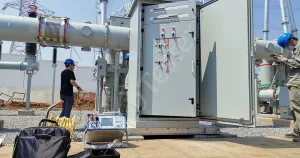
Current transformer testing often takes place in substations, switchyards, and other electrical environments where strong electromagnetic fields and power supply disturbances may be present. These conditions can affect measurement stability and make it more difficult to obtain consistent test results.
An anti-interference CT tester is designed to address these challenges through suitable circuit design, signal processing, shielding, and interference control measures. However, reliable field testing depends on more than the instrument itself. Test connections, grounding, power supply quality, and operating conditions also influence measurement results.
Understanding these factors helps engineers select a suitable CT tester and improve the reliability of on-site testing.
What Is an Anti-interference CT Tester?
An anti-interference CT tester is an instrument used to test current transformers while reducing the influence of external electrical and electromagnetic disturbances on measurement results.
A current transformer (CT) converts high primary current into a smaller secondary current for metering and protection systems. Its performance directly affects the accuracy of electrical measurements and the reliability of protection devices.
Common CT testing tasks include ratio measurement, polarity verification, excitation characteristic testing, winding resistance measurement, and burden testing. These measurements require reliable signal acquisition, especially when testing takes place near high-voltage equipment.
Compared with a standard CT tester, an instrument intended for demanding field environments should provide suitable interference control and stable measurement performance. This may involve electromagnetic compatibility design, signal isolation, filtering, and reliable internal data processing.
Why Is CT Testing Vulnerable to Electromagnetic Interference?
CT testing environments can contain several sources of electromagnetic disturbance. These disturbances may enter the measurement system through power supply lines, test cables, grounding connections, or surrounding electromagnetic fields.
Electromagnetic Fields Around Substations
Substations contain transformers, circuit breakers, busbars, and other high-voltage equipment. These installations generate electric and magnetic fields during operation.
When testing equipment is placed close to these sources, electromagnetic coupling may affect measurement circuits and signal transmission. The actual impact depends on the field strength, distance, cable arrangement, shielding, and instrument design.
Power Supply Interference
Unstable power supplies and electrical noise can also affect testing instruments.
Voltage fluctuations, harmonic components, and disturbances from nearby electrical equipment may influence the instrument’s internal power circuits and measurement signals.When power supply interference remains significant, an AC purification power supply with a capacity greater than 200 VA can be considered.
Grounding and Test Cable Interference
Incorrect grounding and poorly arranged test cables can introduce unwanted signals into the measurement circuit.Long cables may also pick up electromagnetic interference, particularly when they run close to high-current conductors or other sources of electrical noise.
To reduce these risks, technicians should follow the instrument’s wiring instructions, use suitable test leads, and keep signal cables away from strong interference sources whenever possible.
How Does Electromagnetic Interference Affect CT Test Results?
Electromagnetic interference can affect the stability and repeatability of CT measurements. The specific impact depends on the measurement method and the severity of the disturbance.
Unstable Measurement Readings
One common symptom is fluctuating measurement values.For example, repeated measurements under unchanged test conditions may produce inconsistent readings. This can make it difficult to determine whether the variation comes from the CT itself, the test connection, or external interference.
Errors in Ratio and Phase Angle Measurements
External interference may introduce unwanted signals into the measurement process. If these signals are not adequately controlled, they can affect the reliability of ratio and phase angle measurements.
Fluctuations in Excitation Test Results
Excitation testing is used to evaluate the magnetic characteristics of a CT and determine its excitation curve and saturation behavior.Unstable signals or poor test connections may affect the recorded voltage and current values. As a result, the excitation curve may become less consistent, making it harder to identify the saturation characteristics accurately.
Reduced Test Repeatability
If electromagnetic interference changes during testing, measurement results may vary even when the CT and test configuration remain unchanged.
For maintenance teams and testing organizations, poor repeatability can increase testing time and make comparisons between inspection records less reliable.
What Features Should an Anti-interference CT Tester Have?
When evaluating an anti-interference CT tester, users should examine both its internal design and its performance under actual operating conditions. The following features and design considerations are particularly relevant.
Electromagnetic Compatibility and Shielding
Electromagnetic compatibility (EMC) describes the ability of equipment to operate properly in its electromagnetic environment without causing or experiencing unacceptable interference.
A suitable CT tester should have an appropriate EMC design for its intended application. This may include shielding of sensitive circuits, suitable enclosure design, and protection against conducted or radiated disturbances.
When comparing instruments, ask manufacturers for relevant EMC test reports and immunity specifications. These documents provide more useful evidence than a general claim that a product has strong anti-interference performance.
Signal Isolation and Filtering
Signal isolation helps reduce unwanted electrical coupling between different parts of a measurement system. Filtering can also help suppress unwanted frequency components while retaining the signals required for measurement.
These techniques are useful in environments where electrical noise may affect low-level measurement signals.
However, users should not assume that every CT tester uses the same isolation or filtering methods. The actual design and performance should be confirmed through technical documentation.
Stable Data Acquisition and Processing
A reliable measurement system needs to acquire and process signals consistently.
Stable sampling, suitable analog-to-digital conversion, and effective signal processing help maintain measurement quality. These capabilities are especially important when measuring phase angle, excitation characteristics, and other parameters that require accurate signal analysis.
Users should also check whether the instrument provides repeatable results under the operating conditions expected at their testing locations.
Grounding and Test Lead Design
The instrument’s grounding arrangement and test lead design also influence measurement quality.
Suitable cable shielding, reliable connectors, and clear grounding instructions help reduce unwanted interference and connection-related errors.
For resistance measurements, a proper four-terminal connection is particularly important because it helps reduce the influence of test lead resistance on the measured value.
Kvtester provides a CT analyzer connection guide covering wiring arrangements and common connection checks.
Measurement Repeatability in Field Conditions
A tester should be evaluated under conditions similar to its intended working environment.
Users can compare repeated measurements, observe whether readings remain stable, and check whether the instrument performs consistently at different test locations.
It is also useful to review the operating temperature and humidity range, power supply requirements, and relevant EMC documentation.
A stable result under laboratory conditions does not necessarily guarantee the same performance in a substation. Field evaluation is an important part of equipment selection.
CT Testing Solutions from Kvtester
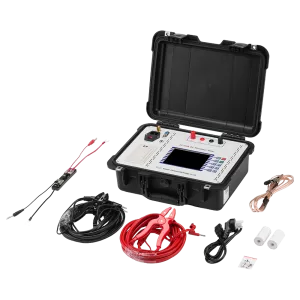
At Kvtester, we provide CT/PT analyzers for testing current transformers in manufacturing, commissioning, and maintenance applications.
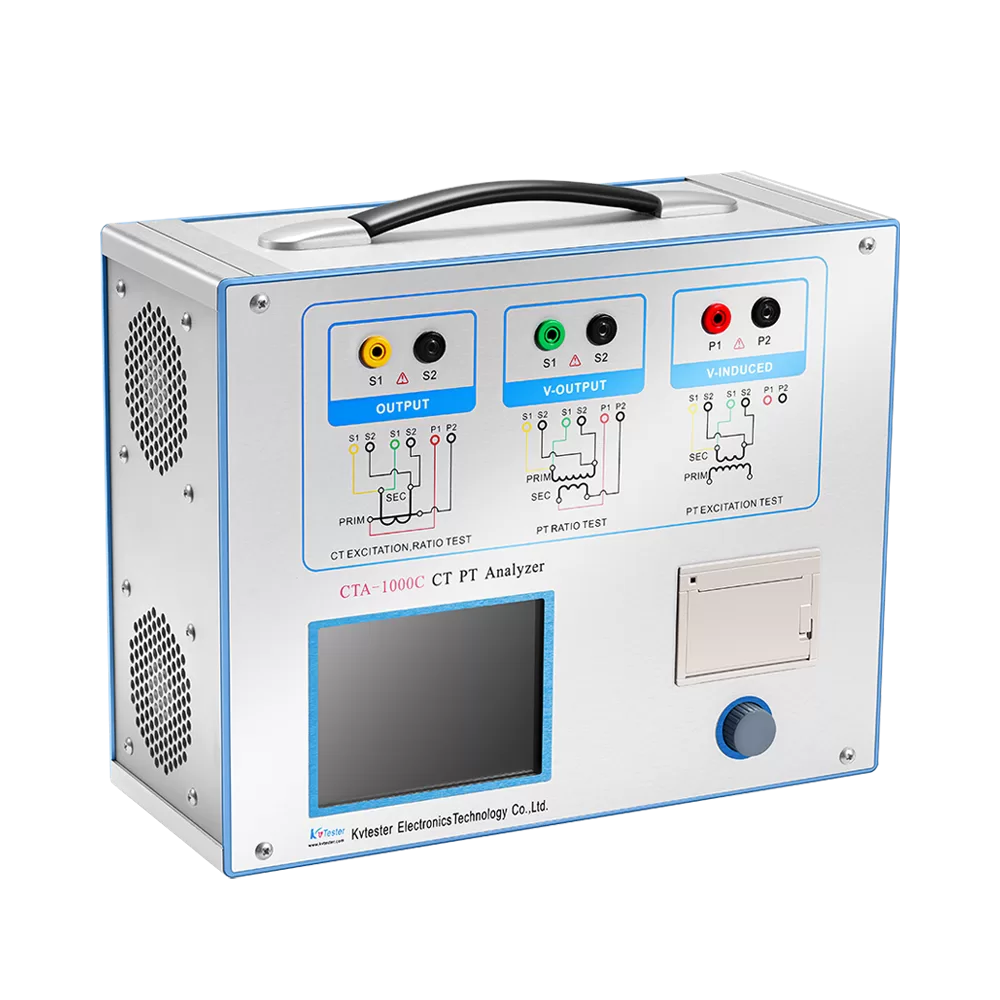
Our CTA-1000D CT/PT Analyzer supports automatic evaluation of CT characteristics according to selected IEC or IEEE standards. It is designed to help technicians complete several CT measurements with one portable instrument.
Its main CT testing functions include:
- CT ratio and phase angle accuracy measurement.
- Excitation and saturation characteristic testing.
- Winding resistance measurement.
- Burden impedance measurement.
- CT polarity testing.
- Residual magnetism measurement.
- Accuracy limit factor (ALF) and instrument security factor (FS) evaluation.
The CTA-1000D has an automatic test duration of less than two minutes under specified conditions. Its weight is approximately 9 kg without accessories, making it convenient to transport between testing locations.
Some of its key specifications include:
- CT ratio measurement accuracy: 0.02% typical and 0.05% guaranteed for ratios from 1 to 2,000.
- Output voltage: 0–120 V.
- Output current: 0–5 A effective, 15 A peak.
- Output power: 0–400 VA effective, 1,500 VA peak.
- Winding resistance resolution: 1 mΩ.
- Operating temperature: -10°C to +50°C.
- Dimensions: 370 × 320 × 170 mm.
These functions and specifications make the CTA-1000D an option for users who need portable CT analysis and multiple measurement functions.
However, measurement accuracy and automatic testing time should not be treated as substitutes for an EMC immunity rating. If your application involves strong electromagnetic fields, confirm the relevant interference resistance requirements with our technical team before selecting the instrument.
You can review the full functions and specifications of our CTA-1000D CT/PT Analyzer to determine whether it matches your CT testing requirements.
Frequently Asked Questions About Anti-interference CT Testers
Why Is Anti-interference Performance Important in CT Testing?
CT testing often takes place near high-voltage equipment and other sources of electromagnetic disturbance. Interference may cause unstable readings, affect measurement repeatability, or reduce confidence in test results.
Suitable interference control helps maintain measurement reliability in demanding field environments.
Can Electromagnetic Interference Affect CT Ratio and Phase Angle Measurements?
Yes. External electrical disturbances may enter measurement circuits and affect the signals used to calculate CT ratio and phase angle.
The actual impact depends on interference strength, instrument design, cable arrangement, and test conditions. Proper wiring and a suitable testing environment help reduce these risks.
How Can I Reduce Interference During On-site CT Testing?
Several practical measures can help:
- Keep the tester away from strong electric and magnetic fields whenever possible.
- Avoid placing test cables close to high-current conductors.
- Use the recommended grounding and cable connections.
- Check the power supply before testing.
- Consider an AC purification power supply if power interference remains significant.
- Repeat measurements under consistent conditions to check result stability.
Technicians should also follow the instrument manual and applicable electrical safety procedures.
Conclusion
Choosing an anti-interference CT tester requires attention to both measurement performance and the electromagnetic conditions of the testing environment. Shielding, signal isolation, filtering, grounding, and stable data acquisition are important design considerations, while field repeatability and EMC documentation help verify whether an instrument is suitable for actual applications.
Users should also consider CT ratio, excitation, winding resistance, burden, phase angle, and residual magnetism testing when selecting a CT analyzer.
At Kvtester, we offer CT/PT testing instruments for different field and laboratory requirements. If you need help selecting a suitable CT analyzer for your application, contact our team to discuss your testing conditions and technical requirements.
Related Products
Latest News
-
 2026-11-04Transformer Capacity and Load Tester: Functions & Selection
-
 2026-11-04Automatic CT Tester with Data Logger: Improving Grid Commissioning Efficiency
-
 2026-11-03Transformer Tester for Maintenance: Essential Tests
-
 2026-11-03PT Tester for Power Utilities and Essential Testing Requirements
-
 2026-11-03CT Analyzer with Low Frequency: Working Principle and Benefits