
Why Are DC Withstand Leaks Critical in Transformer Testing?
Transformers are critical components within power systems, and the condition of their insulation directly impacts operational safety. Once insulation deteriorates, it can lead to dielectric breakdown, power outages, or even equipment damage. Consequently, during manufacturing acceptance, commissioning, and maintenance procedures, DC withstand voltage and leakage current tests serve as essential tools for assessing a transformer’s insulation performance.
1. Verifying Insulation Withstand Capability
① A DC withstand voltage test involves applying a high-voltage DC potential—exceeding the transformer’s normal operating voltage—to its insulation system. The objective is to observe whether the insulation can remain stable and withstand this stress for a specified duration without suffering a dielectric breakdown.
② This process acts as an insulation “stress test,” enabling the early detection of manufacturing defects, moisture ingress, aging, or localized weak points within the insulation, thereby preventing the equipment from being operated in a compromised state.
2. Leakage Current Reflects Insulation Health
① When subjected to high-voltage DC, a minute electric current—known as leakage current—flows through the insulating medium.
② Under normal conditions, the leakage current should gradually stabilize. However, if the current magnitude is abnormally high, continues to rise, or exhibits significant fluctuations, it typically indicates potential issues such as moisture ingress, contamination, aging, or a risk of partial discharge within the insulation.
③ Compared to simply determining whether a dielectric breakdown occurs, leakage current data offers greater sensitivity, allowing for the earlier detection of potential problems.
3. Facilitating Trend Analysis and Preventive Maintenance
① A single test provides only a snapshot of the insulation’s current condition, whereas a series of test results over time reveals the underlying trends in insulation performance.
② If a transformer’s leakage current shows a consistent upward trend year after year—even in the absence of an immediate breakdown—it suggests that the insulation’s integrity may be deteriorating. In such cases, further diagnostic testing—such as dissolved gas analysis (DGA), partial discharge measurement, or dielectric loss analysis—should be conducted.
③ Therefore, leakage current testing serves not only as a tool for acceptance testing but also as a vital basis for implementing condition-based maintenance strategies.
4. Mitigating Operational Risks
① Transformer insulation failures are often sudden and catastrophic events. By conducting DC withstand voltage and leakage current tests, the reliability of the insulation can be verified prior to commissioning or following maintenance work, thereby significantly reducing the risks of dielectric breakdown, power outages, and equipment damage during operation.
Summary: DC withstand voltage testing verifies the transformer insulation’s ability to withstand high-voltage stress, while leakage current testing provides an indication of the overall health and integrity of the insulation system. When combined, these two approaches enable a more comprehensive assessment of transformer insulation performance, serving as a crucial testing method for ensuring the safe operation of transformers, extending equipment lifespan, and reducing operation and maintenance costs.
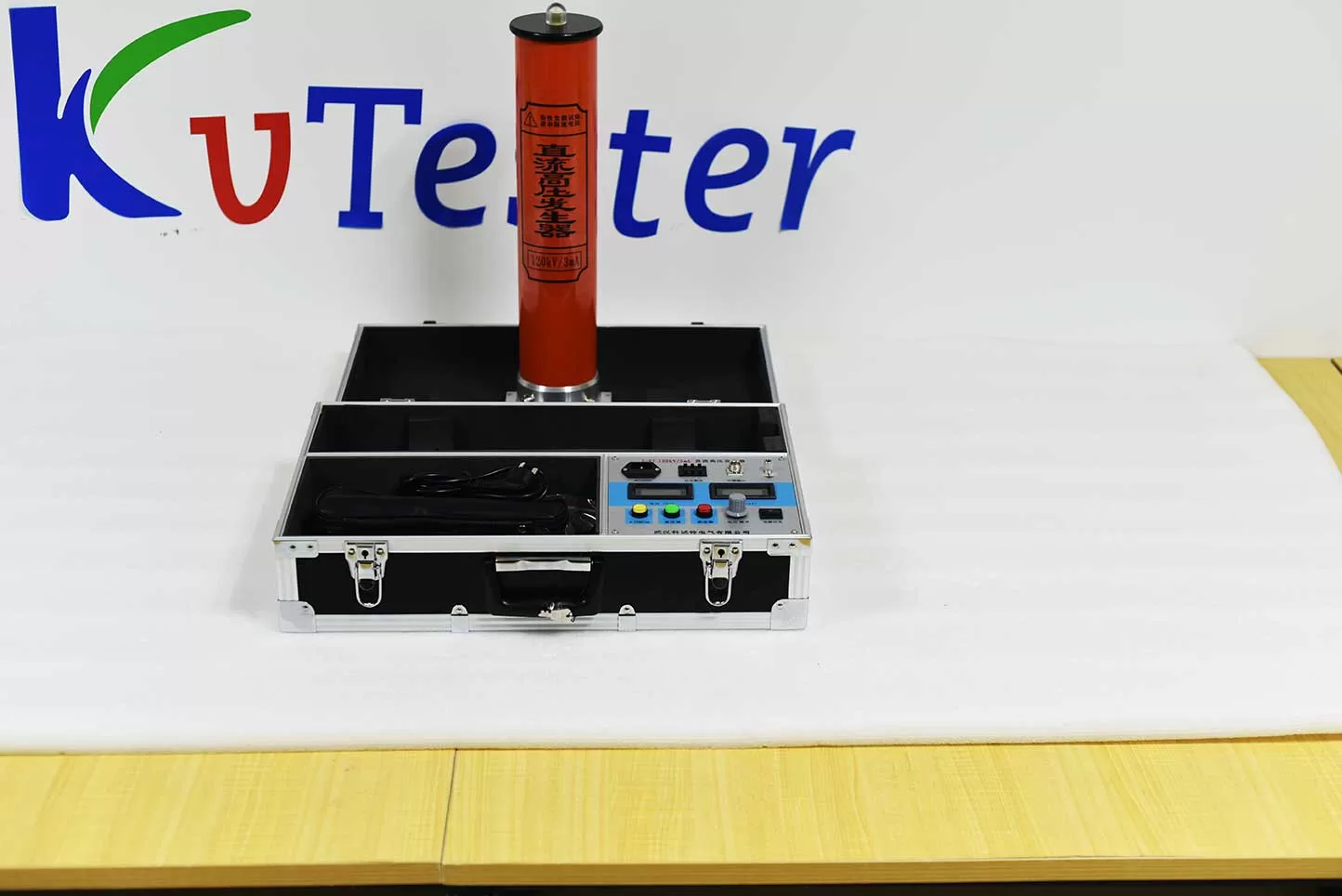
The ZC-540A series DC high voltage generator is a new generation portable DC high voltage tester designed and manufactured according to the new Chinese power industry standard DL/T848.1-2004 “General Technical Conditions for DC High Voltage Generators”. Mainly suitable for DC withstand voltage testing of high-voltage electrical equipment such as zinc oxide lightning arresters, magnetic blowing lightning arresters, power cables, generators, transformers, switches, etc. in power departments, power departments of factories, mining enterprises, research institutions, railways, chemical industries, power plants, etc. The KST-540 series DC high-voltage generator adopts an intermediate frequency voltage doubling circuit and PWM intermediate frequency pulse width modulation technology, greatly improving voltage stability. According to electromagnetic compatibility theory, special shielding, isolation, and grounding measures are adopted to discharge the DC high-voltage generator at rated voltage without damaging the instrument.
Kvtester Electronics Technology Co.,Ltd. is a high-tech enterprise specializing in power testing, testing, research and development, production, and sales of testing equipment. It has been engaged in the electrical testing industry for many years, and its products are of high quality. We welcome customers to come and purchase.
Related Products
Latest News
-
 2026-09-20CT PT Analyzer for Commissioning: Substation Testing Guide
 -
 2026-09-20ANSI Standard CT Tester: Specs, Tests & Buying Guide
 -
 2026-09-18Why does the required capacity of series resonant test equipment usually increase with cable length?
 -
 2026-09-18How should 35kV cable series resonant withstand voltage test equipment be configured?
 -
 2026-09-18How to Select AC Withstand Voltage Test Equipment for 10kV Cables?