
Home » News » Company News
How to Perform CT Analyzer Testing and Evaluate the Test Results?
CT analyzer testing provides a practical way to check the electrical characteristics and accuracy of current transformers before they are put into service or during routine maintenance. A complete test involves measuring the CT ratio, excitation characteristics, phase angle, winding resistance, burden, and polarity can all provide useful information about CT performance.
A clear testing procedure also makes the final results easier to review and compare. With suitable CT PT test equipment, we can organize these measurements into a consistent workflow for manufacturing, commissioning, calibration, and field testing.
What Does CT Analyzer Testing Measure?
A CT analyzer can perform several measurements that help us understand whether a current transformer meets its required specifications. The exact combination of tests depends on the CT type, application, and selected testing standard.
The main CT analyzer tests generally include:
- CT ratio and ratio error
- Phase-angle accuracy
- Excitation characteristics
- Saturation characteristics
- Saturation inflection point
- Winding resistance
- Burden impedance
- CT polarity
- ALF and FS
- Residual magnetism
Each measurement answers a different technical question. For this reason, evaluating the complete group of results is more useful than judging CT performance from a single value.
How Should You Prepare for a CT Analyzer Test?
Good preparation helps keep the testing process stable and makes the results easier to interpret. Before connecting the analyzer, we first confirm the CT information and then check the test circuit.
Check the CT Test Parameters
The analyzer needs the correct CT parameters before testing begins. Depending on the test, these may include:
- Primary current
- Secondary current
- CT ratio
- Accuracy class
- Rated burden
- Applicable testing standard
The entered parameters provide the reference for subsequent measurements and automatic evaluation. Therefore, incorrect nameplate information can lead to misleading test results even when the electrical connection is correct.
Check the CT Test Connection
The CT should be properly isolated from the operating circuit before testing. We then connect the test leads to the required terminals and check the polarity and grounding connections.
Before applying the test signal, it is also useful to verify that all connections are secure. A poor connection can affect measurements and may result in unnecessary repeated tests.
How to Perform a CT Ratio and Phase-Angle Test
CT ratio testing checks the relationship between the primary and secondary sides of the current transformer. Phase-angle testing provides additional information about the CT’s measurement accuracy.
The testing sequence can be kept simple:
- Connect the CT to the analyzer.
- Enter the required CT parameters.
- Select the ratio and phase-angle test.
- Start the measurement.
- Record the measured ratio and ratio error.
- Review the phase-angle result against the required accuracy.
The measured ratio should be considered together with the CT’s rated ratio. If the ratio error is outside the required range, the next step is to check the test connection, entered parameters, and CT condition before drawing a conclusion.
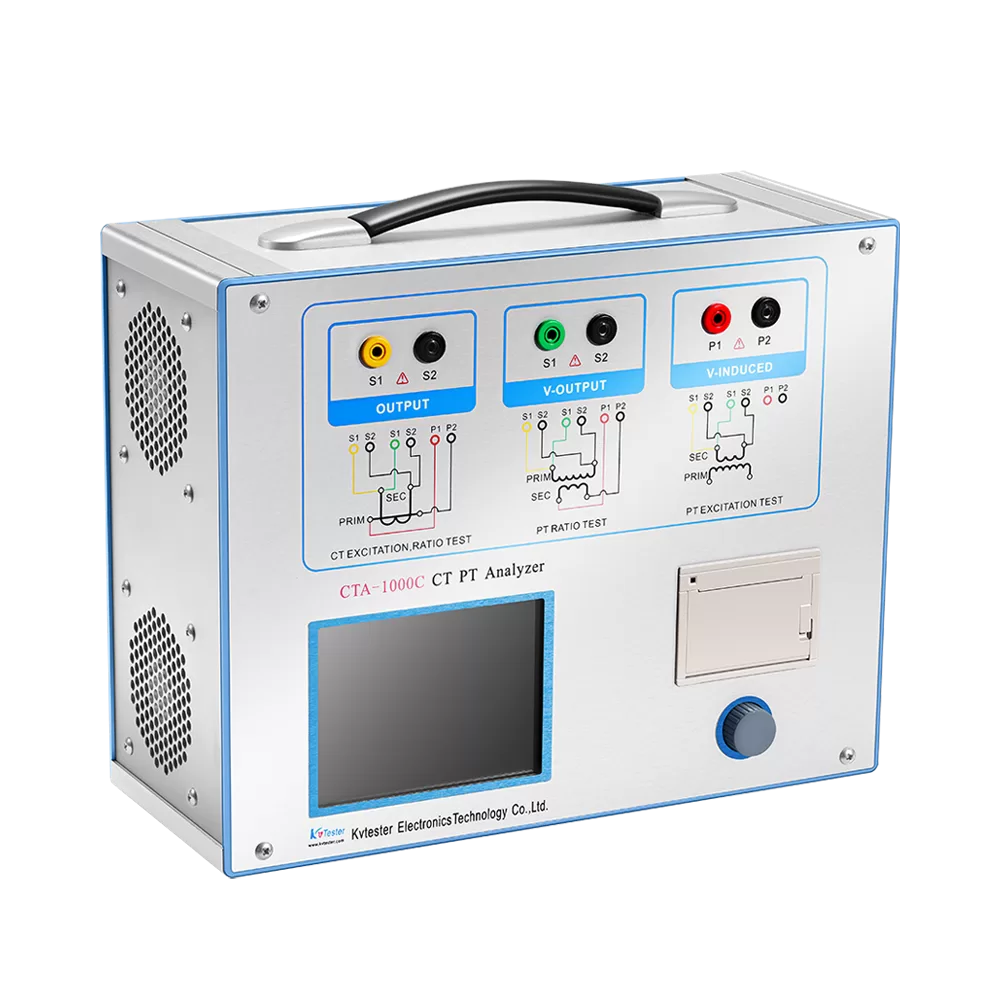
For applications that require a wider CT ratio range, the CTA-1000C CT/PT Analyzer supports CT ratios from 1 to 40,000 with a CT ratio accuracy of ±0.05%. This range can be useful when one analyzer needs to cover CTs with substantially different ratios.
How Do Excitation and Saturation Tests Show CT Performance?
Ratio accuracy does not fully describe the behavior of a CT. Excitation testing provides a different view by showing how excitation current changes as the applied voltage increases.
This is particularly important when the CT is used for protection, because its behavior near saturation can affect the available secondary signal.
Read the Excitation Curve
During excitation testing, we look at the relationship between excitation voltage and excitation current.
The resulting curve can help us identify changes in the CT’s magnetic behavior as voltage increases. Rather than focusing on one point, we review the overall excitation characteristic.
Important information includes:
- Excitation voltage
- Excitation current
- Excitation curve
- Saturation behavior
- Saturation inflection point
A consistent excitation curve makes the result easier to compare with the CT’s required characteristics and previous measurements.
Check the Saturation Inflection Point
The saturation inflection point is an important part of excitation analysis, especially for protection CT testing.
The value should be considered together with the CT’s design, application, and applicable standard. A result should not be evaluated only by comparing it with an isolated numerical value without considering the intended CT application.
Kvtester analyzers can automatically determine excitation-related results and evaluate the CT according to the selected IEC or IEEE standard, reducing manual calculation during repetitive testing.
How Do Winding Resistance and Burden Results Help?
Once ratio and excitation measurements have been completed, winding resistance and burden testing provide additional information about the CT secondary circuit.
These measurements are particularly useful when investigating abnormal readings or checking a CT during commissioning and maintenance.
Review the Winding Resistance
Winding resistance testing measures the resistance of the CT winding.
The measured value should be considered in relation to the CT requirements and test conditions. When previous test records are available, comparing measurements under similar conditions can make changes easier to identify.
For example, the CTA-1000C provides a DC resistance measurement range of 0–300 Ω with an accuracy of 0.2% ± 2 mΩ.
The resistance result should still be interpreted together with other CT test results rather than used as the only basis for evaluating the CT.
Check the Burden Result
Burden testing checks the impedance associated with the CT secondary circuit.
The measured burden can be compared with the CT’s rated or required burden to determine whether the secondary circuit is operating within the intended range.
The CTA-1000C supports burden measurement from 0 to 1,000 VA with an accuracy of 0.2% ± 0.02 VA.
How Should CT Analyzer Test Results Be Evaluated?
After all required measurements are complete, we recommend reviewing the results as one group. This provides a clearer picture than looking at ratio, excitation, or resistance independently.
A practical evaluation sequence is:
- Check the CT ratio and ratio error.
- Review phase-angle accuracy.
- Examine the excitation curve.
- Check the saturation inflection point.
- Review winding resistance.
- Check the burden result.
- Confirm polarity.
- Compare the complete results with the selected IEC or IEEE requirements.
Look for Consistent Results
The individual measurements should make sense when considered together.
For example, an unexpected ratio result should first lead us to check the connection and entered parameters. Likewise, an unusual resistance value can be investigated alongside the excitation and other CT measurements.
This approach helps distinguish a testing problem from a potential CT problem and avoids making a decision based on a single abnormal value.
Compare Results With the Required Standard
CT test results need a clear reference. The applicable standard, CT accuracy class, rated parameters, and intended application all affect how the results should be interpreted.
Automatic evaluation can simplify this process because the analyzer can use the selected testing standard as part of the result assessment.

How Can CT Analyzer Testing Be Made More Efficient?
For manufacturers, testing laboratories, commissioning teams, and maintenance engineers, testing efficiency becomes increasingly important when multiple CTs need to be tested.
An efficient workflow reduces repeated parameter entry, manual calculations, and unnecessary changes between different test functions.
For field applications, the CTA-1000D CT/PT Analyzer provides automatic CT testing and IEC/IEEE evaluation. Its automatic test duration is less than 2 minutes, and the instrument weighs less than 9 kg.
The goal is not simply to shorten the test. A useful CT analyzer should make the complete process—from parameter setup to measurement and result evaluation—more straightforward.
What Should You Consider When Choosing a CT Analyzer?
The right CT analyzer depends on the testing work you actually need to perform. Instead of focusing only on a single accuracy specification, we recommend looking at the complete testing capability.
Match the Analyzer to Your CT Testing Range
Check the CT ratio range first, particularly when testing different CT types in a manufacturing or testing environment.
A wider ratio range can reduce the need to change equipment between different CT specifications. Kvtester provides analyzers covering different CT ratio requirements, so the appropriate model can be selected according to the actual testing range.
Check the Required Test Functions
The analyzer should cover the measurements required for your work, such as:
- Ratio and phase-angle accuracy
- Excitation and saturation
- Winding resistance
- Burden
- Polarity
- ALF and FS
- Residual magnetism
If CT and PT testing are both part of the workload, it is also useful to consider whether the same equipment can support both requirements.
Consider Accuracy, Automation, and Portability
Measurement accuracy is important, but it should be considered together with automatic testing, evaluation functions, test duration, and equipment weight.
For field applications, a portable analyzer with automated testing can reduce the workload for commissioning and maintenance teams. For production and laboratory environments, the measurement range and supported test functions may have greater importance.
How Can Kvtester Support Your CT Testing Workflow?
We develop CT analyzer solutions around the measurements required for current transformer testing, including ratio, phase angle, excitation, saturation, winding resistance, burden, and polarity.
Our equipment is designed to support testing from parameter setup through measurement and result evaluation, helping testing teams reduce manual work and keep the process consistent.
For specific requirements such as CT ratio range, measurement accuracy, test functions, or field application, you can contact Kvtester to discuss the appropriate testing solution.
Related Products
Latest News
-
 2026-09-302026 Top 3 Chinese Insulation Resistance Transformer Testing Equipment Manufacturers
 -
 2026-09-30Industrial CT Tester: How Is It Used for Current Transformer Factory Testing?
 -
 2026-09-30How Can a CT PT Analyzer Improve CT and PT Quality Testing in the Laboratory?
 -
 2026-09-30How to Perform Current Transformer Testing Step by Step?
 -
 2026-09-30How Do You Troubleshoot Common DC Resistance Tester Operation Problems?