
Home » News » Company News
How Does a PT Tester Work in a Power Plant?
How can you verify whether a potential transformer is performing correctly in a power plant? Which tests are needed to check its ratio, polarity, excitation characteristics, and secondary circuit? And how can these tests be completed efficiently in the field?
A PT tester combines the measurement functions needed for these checks in one system. By selecting the appropriate test and entering the transformer parameters, engineers can perform measurements, review the results, and keep test records without switching between multiple instruments.
What Does a PT Tester Check in a Power Plant?
A potential transformer needs to provide reliable voltage transformation for measurement and protection systems. PT testing therefore focuses on several electrical characteristics rather than a single measurement.
Typical PT test items include:
- Turns ratio
- Polarity
- Excitation characteristics
- Winding resistance
- Burden
- Ratio error
The required tests depend on the transformer and the purpose of the inspection. For commissioning, maintenance, or troubleshooting, selecting the appropriate test items first helps keep the testing process focused and efficient.
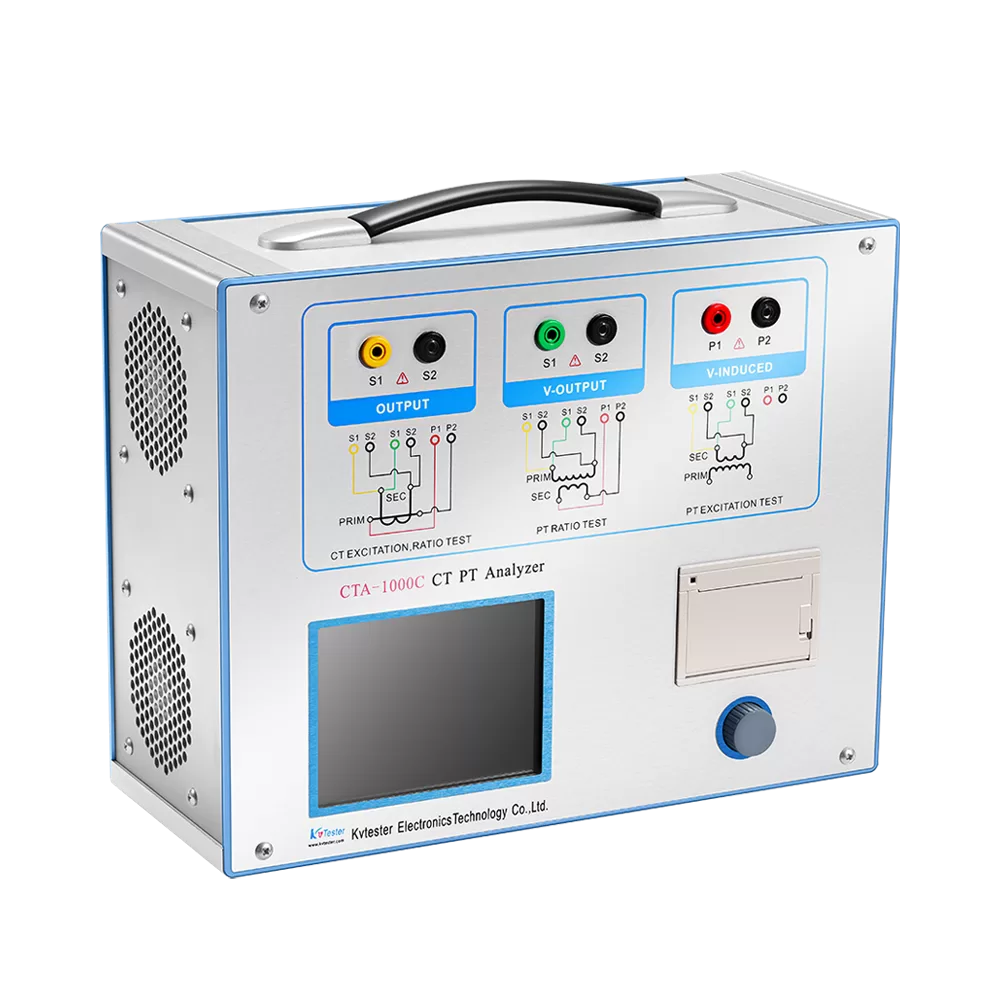
For different instrument transformer applications, our CT/PT test equipment provides testing functions that can be matched to specific measurement requirements.
Which PT Tests Matter Most?
Each test provides different information about the transformer. Looking at them separately also makes it easier to understand what a PT tester actually measures.
PT Turns Ratio and Polarity
The turns ratio confirms the relationship between the primary and secondary voltages. A deviation from the expected ratio can indicate a problem that requires further investigation.
Polarity testing checks the relationship between the corresponding primary and secondary terminals. Correct polarity is particularly important when the PT is connected to measurement or protection circuits.
PT Excitation Characteristics
Excitation testing examines the relationship between the applied voltage and excitation current. The resulting characteristic helps engineers understand the transformer’s magnetic behavior and identify its saturation characteristics.
This test is particularly useful when a more complete assessment is required beyond a basic ratio or polarity check.
Winding Resistance and Burden
Winding resistance provides information about the condition of the secondary winding and its connections. Burden testing evaluates the load connected to the secondary circuit.
Together with ratio and excitation measurements, these tests provide a broader view of PT performance.
How Does a PT Tester Perform the Measurement?
Although the individual tests are different, the overall workflow is straightforward. The engineer first prepares the transformer information, then connects the equipment according to the selected test and reviews the measured values after testing.
Enter the Required Parameters
Before measurement, enter the transformer information needed for the selected test.
Depending on the test, this can include the rated ratio, accuracy class, rated voltage, and other relevant parameters. Correct parameter entry is important because the tester uses this information during measurement and result calculation.
Make the Test Connections
The PT must be connected according to the selected measurement method.
A clear connection arrangement helps reduce wiring mistakes and makes the testing process easier to repeat. When several test items are required, using a tester that provides connection guidance can also simplify field work.
Run the Test and Record the Results
After the connection is confirmed, select the required test and start the measurement.
Automatic measurement can reduce repeated manual adjustments. Test data can then be reviewed and stored for later comparison or reporting.
For example, our CTA-1000E CT/PT analyzer integrates multiple CT and PT testing functions, helping engineers complete instrument transformer tests through a single testing system.
How Should PT Test Results Be Reviewed?
A measured value should always be considered in relation to the transformer specifications and the purpose of the test.
When reviewing PT test results, check the relevant values together rather than relying on one measurement:
- Measured turns ratio
- Ratio error
- Polarity
- Excitation characteristics
- Winding resistance
- Burden
For example, a ratio result may appear acceptable while another measurement indicates that further inspection is necessary. Reviewing the complete set of applicable test results provides a more reliable basis for evaluating the transformer.
What Makes PT Testing Practical for Power Plants?
Power plant testing often takes place in demanding field environments. Equipment may need to be transported between locations, used during commissioning, or brought back for periodic maintenance.
For this reason, practical PT test equipment should combine suitable measurement functions with easy operation, portability, and efficient data management.
Portable Equipment for Field Testing
A portable tester reduces the effort required to move equipment to the transformer location.
For power plant applications, equipment selection should consider not only its testing functions but also its physical design and suitability for on-site work. A compact testing system can make it easier for engineers to move between testing points.
Efficient Test Data Management
When several transformers need to be tested, keeping organized records becomes just as important as completing the measurement itself.
The ability to save test data, transfer results, and generate reports allows engineers to maintain consistent records for commissioning and maintenance work.
Which PT Tester Specifications Should You Check?
The right tester should be selected according to the transformer and the required test procedure. Instead of focusing only on measurement accuracy, consider whether the complete system can cover the tests you actually need.
Key factors include:
- PT turns ratio range
- Measurement accuracy
- Excitation testing capability
- Polarity testing
- Winding resistance measurement
- Burden measurement
- Output capability
- Automatic testing
- Data storage
- Report management
- Portability
When selecting a PT tester for a power plant, these specifications should be considered together with the rated parameters of the PT and the testing procedures used by the engineering team.
PT Testing Applications in Power Generation
PT testing can be part of commissioning, maintenance, inspection, and troubleshooting across different power generation facilities.
Our power generation testing solutions cover thermal power plants, hydropower stations, PV solar power plants, and wind farms.
Although the testing environment differs between facilities, the basic selection principle remains the same: match the tester’s functions and measurement ranges with the transformer and the required test procedure.
Choosing a PT Tester for Your Power Plant
A practical selection should begin with the tests you actually need to perform. Once those requirements are clear, you can determine which measurement ranges and functions are necessary.
Before making a decision, check:
- What type of PT needs to be tested?
- Which test items are required?
- What ratio range needs to be covered?
- What measurement accuracy is required?
- Are excitation and saturation tests necessary?
- Is winding resistance or burden measurement required?
- Will the equipment be used mainly in the field?
- How many test records need to be stored?
- How will test reports be managed?
If the testing team also handles CT testing, a combined CT/PT analyzer can provide a practical solution for instrument transformer testing.
How Can Kvtester Support PT Testing?
At Kvtester, we develop power testing equipment for power plants, utility companies, industrial users, and electrical engineering services.
Our CT/PT testing solutions cover different instrument transformer testing requirements, allowing customers to select equipment according to their actual test functions and application conditions.
For PT testing, the CTA-1000E combines multiple instrument transformer testing functions in one system, making it suitable for applications where both PT and CT testing requirements need to be considered.
If you are planning PT testing for a power plant, we can help you match the required test functions and specifications with a suitable configuration. You can contact Kvtester with the PT type, rated parameters, and required test items to discuss your application.
Related Products
Latest News
-
 2026-09-302026 Top 3 Chinese Insulation Resistance Transformer Testing Equipment Manufacturers
 -
 2026-09-30Industrial CT Tester: How Is It Used for Current Transformer Factory Testing?
 -
 2026-09-30How Can a CT PT Analyzer Improve CT and PT Quality Testing in the Laboratory?
 -
 2026-09-30How to Perform Current Transformer Testing Step by Step?
 -
 2026-09-30How to Perform CT Analyzer Testing and Evaluate the Test Results?