What is the purpose of a power-frequency withstand voltage test?
What is the purpose of a power-frequency withstand voltage test?
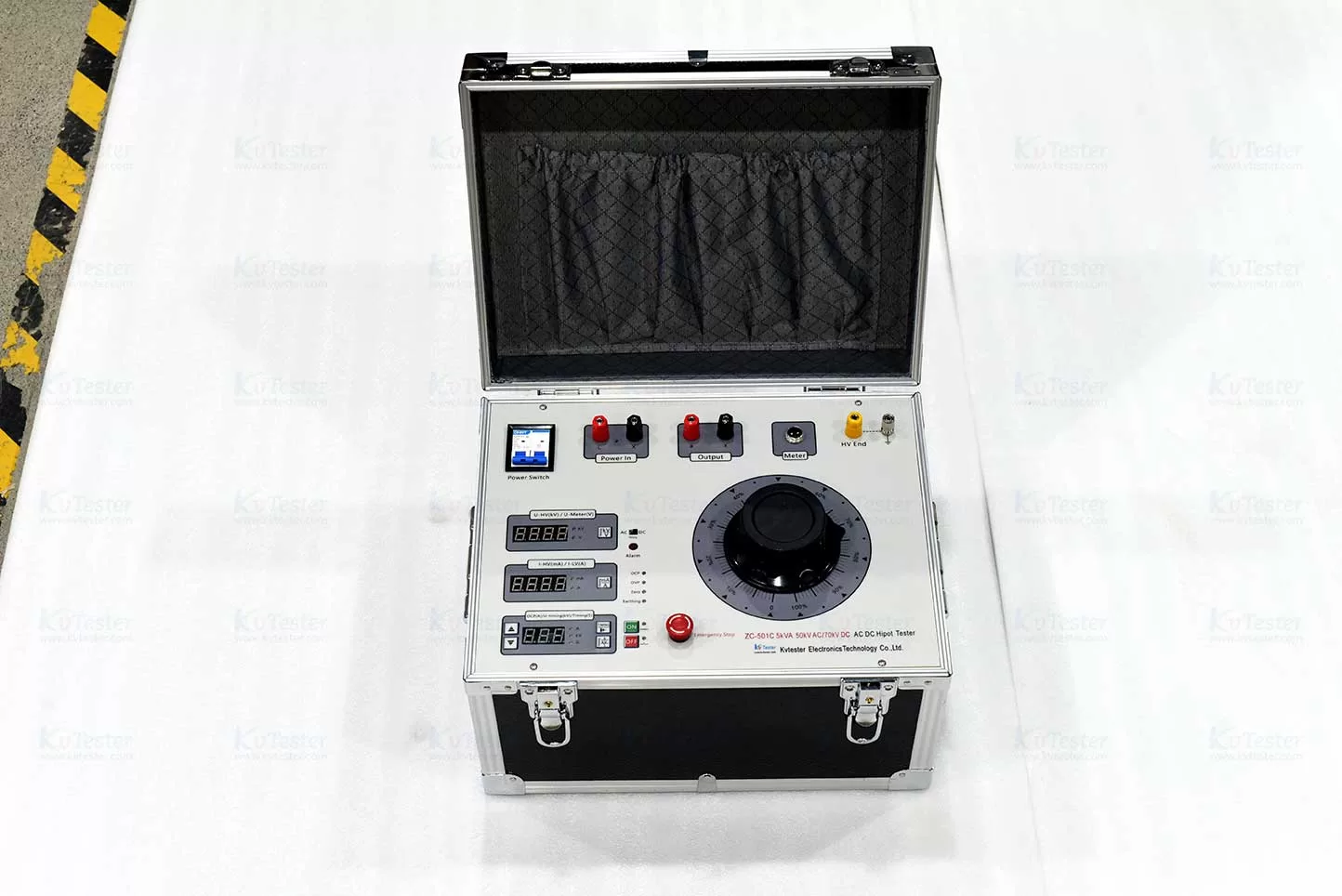
The power-frequency withstand voltage test is a key component of insulation testing for power equipment. It is primarily used to assess the insulation strength of transformers, cables, instrument transformers, switchgear, and other high-voltage electrical equipment. The test determines whether the equipment can safely withstand a specified AC test voltage for a set duration without experiencing dielectric breakdown, flashover, or other anomalies. Compared to tests such as insulation resistance measurement or dielectric loss analysis, the power-frequency withstand voltage test applies a significantly higher voltage, providing a more direct assessment of insulation integrity; hence, it is often classified as an “insulation strength test.”
1. Verifying that the equipment’s insulation has sufficient withstand capability
During actual operation, electrical equipment is subjected to continuous working voltage and may also be exposed to system-related overvoltages (such as those caused by switching operations). By applying an AC test voltage—higher than the normal operating voltage—to the equipment for a specified duration, the power-frequency withstand voltage test evaluates whether the insulation structure can endure the resulting electric field intensity. If the equipment does not experience breakdown, flashover, or other irregularities under the prescribed test voltage and duration, it indicates that its primary insulation possesses the required withstand capacity under those conditions.
2. Detecting serious insulation defects
Throughout the processes of manufacturing, transportation, installation, or long-term operation, insulation systems may develop issues such as moisture ingress, contamination, mechanical damage, insufficient insulation clearances, or localized insulation degradation. Some of these defects may not be clearly evident during insulation resistance measurements; however, under the stress of a higher AC voltage, they may manifest as partial discharges, flashovers, or even complete dielectric breakdown. Consequently, the power-frequency withstand voltage test serves as an effective tool for identifying concentrated insulation defects that could compromise the safe operation of the equipment.
3. Validating insulation quality following installation or maintenance
For electrical equipment that has been newly installed, overhauled, or has had insulation components replaced, the power-frequency withstand voltage test serves as a vital method for verifying the quality of the installation or maintenance work.
For instance, if issues such as inadequate insulation clearances, foreign objects left inside the equipment, or damage sustained during installation occur—following internal wiring adjustments, the installation of insulation components, or the replacement of bushings—these problems are likely to be exposed during the withstand voltage test. Therefore, the power-frequency withstand voltage test plays a significant role in verifying insulation integrity during both commissioning (handover) tests and post-maintenance inspections.
4. Why is measuring insulation resistance alone insufficient?
Insulation resistance testing primarily reflects the insulation level of equipment under a DC voltage; it is useful for identifying issues such as moisture ingress or contamination, but it cannot fully replace an AC withstand voltage test.
Some equipment may exhibit high insulation resistance while still harboring localized weak points, insufficient insulation clearances, or other concentrated defects. In contrast, a power-frequency withstand voltage test directly assesses the insulation strength of equipment under a high AC voltage. Consequently, the two tests focus on different aspects. In practice, a comprehensive assessment typically requires integrating results from insulation resistance measurements, dielectric loss tests, withstand voltage tests, and other relevant diagnostic procedures.
5. What precautions should be taken during a power-frequency withstand voltage test?
As a type of insulation test that carries a relatively high risk of causing damage, the power-frequency withstand voltage test must be conducted strictly in accordance with applicable standards, equipment technical documentation, and the specific test protocol. Test voltages and durations must not be arbitrarily increased or extended. Before testing, it is essential to verify that the equipment is in a proper state, and to ensure that appropriate measures for discharging, grounding, safety isolation, and personnel protection are in place. During the voltage-ramping phase, operators should monitor the test current and listen for any unusual sounds or signs of electrical discharge. If any anomalies are detected, the test must be stopped immediately so that the cause can be investigated.
Summary
The primary objective of a power-frequency withstand voltage test is to verify whether the insulation of electrical equipment meets specified AC withstand voltage requirements and to detect any serious insulation defects. Such tests provide a critical basis for evaluating insulation quality—whether for new equipment, during installation handover, or following maintenance—thereby ensuring the equipment can be safely put into operation. When conducting these tests, the test voltage, duration, and wiring configuration must be determined in strict compliance with relevant standards and the equipment’s technical specifications to prevent any damage caused by improper test conditions.
Related Products
Latest News
-
 2026-10-23How to Select the Appropriate Capacity of a High-Voltage Test Transformer
-
 2026-10-23Transformer Tester for Substation Testing and Selection
-
 2026-10-23Substation CT Tester: How to Choose the Right CT Tester for Commissioning
-
 2026-10-20CVT Compatible CT PT Analyzer: Selection Guide
-
 2026-10-20China CT PT Analyzer Supplier: Manufacturer Guide