Home » News » Company News
CVT Compatible CT PT Analyzer: Selection Guide
How do you choose a CVT compatible CT PT analyzer for accurate voltage transformer testing? Can a standard CT/PT analyzer test a capacitive voltage transformer (CVT), and which specifications should you check before purchasing? The right choice depends on the transformer type, required test functions, voltage level, and measurement accuracy. Understanding these factors helps you avoid compatibility problems and select equipment that meets your testing needs.
What Is a CVT Compatible CT PT Analyzer?
A CVT compatible CT PT analyzer is a testing instrument designed to evaluate voltage transformer characteristics, including those of capacitive voltage transformers. However, not every CT/PT analyzer supports CVT testing.
Current transformers (CTs) measure current, while potential transformers (PTs), also called voltage transformers (VTs), reduce high voltage to a level suitable for metering and protection. A CVT uses a capacitive voltage divider as part of its voltage transformation system.
These differences affect the required testing method and equipment configuration.
A suitable analyzer should support the specific transformer type and the tests required by your application. For CVT applications, confirm that the instrument supports CVT error testing rather than relying only on its general CT/PT designation.
Can a Standard CT PT Analyzer Test a CVT?
Not necessarily. A conventional CT/PT analyzer may support current transformer testing and certain electromagnetic PT tests without supporting the full testing requirements of a CVT.
Before selecting an instrument, check three essential factors:
- Transformer compatibility: Confirm that the manufacturer explicitly supports capacitive voltage transformers (CVTs) and, where applicable, coupling capacitor voltage transformers (CCVTs).
- Testing method: Verify that the instrument supports the required CVT error measurement procedure.
- Operating range: Check the applicable voltage levels, measurement ranges, output capability, and accuracy.
A product description that mentions PT testing does not automatically confirm CVT compatibility. Similarly, a wide CT ratio range does not establish that an instrument can perform CVT error testing.
The safest approach is to match the instrument’s documented capabilities to the transformer specifications and required test procedure.
What Tests Should a CVT Compatible Analyzer Support?
The required test functions depend on the purpose of the inspection, the transformer design, and the applicable testing procedure.
Voltage Ratio and Ratio Error Testing
Voltage ratio testing checks the relationship between the primary and secondary voltages. Ratio error indicates how much the measured transformation ratio differs from the expected ratio.
These measurements help assess whether a voltage transformer meets the requirements for its intended metering or protection application.
Phase-Angle Error Measurement
Phase-angle error describes the difference between the phase angles of the primary and secondary voltage quantities, after accounting for the transformer’s nominal ratio and polarity conventions.
This parameter is particularly important when evaluating measurement accuracy. Check the instrument’s phase measurement range, resolution, and accuracy separately from its ratio specifications.
Secondary Winding Resistance and Burden Measurement
Secondary winding resistance helps evaluate the condition of the secondary winding and its connections. Secondary burden measurement assesses the load connected to the transformer secondary circuit.
Depending on the instrument and test procedure, these measurements may help identify issues affecting measurement performance.
Other Applicable Tests
Excitation characteristics, polarity checks, and other diagnostic functions may be relevant to particular transformer types. However, not every test applies to every CVT design or is supported by every analyzer.
Always verify the supported functions against the specific transformer and testing standard before purchasing equipment.
CT PT Analyzer vs. VT CVT Analyzer: What Is the Difference?
The main difference is the transformer type and testing capability the instrument is designed to support.
| Comparison | CT/PT Analyzer | Dedicated VT/CVT Analyzer |
| Main application | Current transformer testing and supported PT tests | Voltage transformer testing, including CVT applications when specified |
| Typical CT tests | Ratio, phase-angle error, excitation, winding resistance, and burden | Depends on the model; CT testing should not be assumed |
| CVT error testing | Must be explicitly confirmed | Supported when specified by the manufacturer |
| Key selection factor | CT/PT functions, output capability, and accuracy | CVT compatibility, voltage range, error testing, and accuracy |
At Kvtester, we provide different instruments for different testing requirements.
The CTA-1000D supports CT ratio and phase-angle accuracy, excitation characteristics, winding resistance, burden impedance, polarity, and residual magnetism analysis. Its automatic test duration is specified as less than 2 minutes, and its weight is approximately 9 kg without accessories.
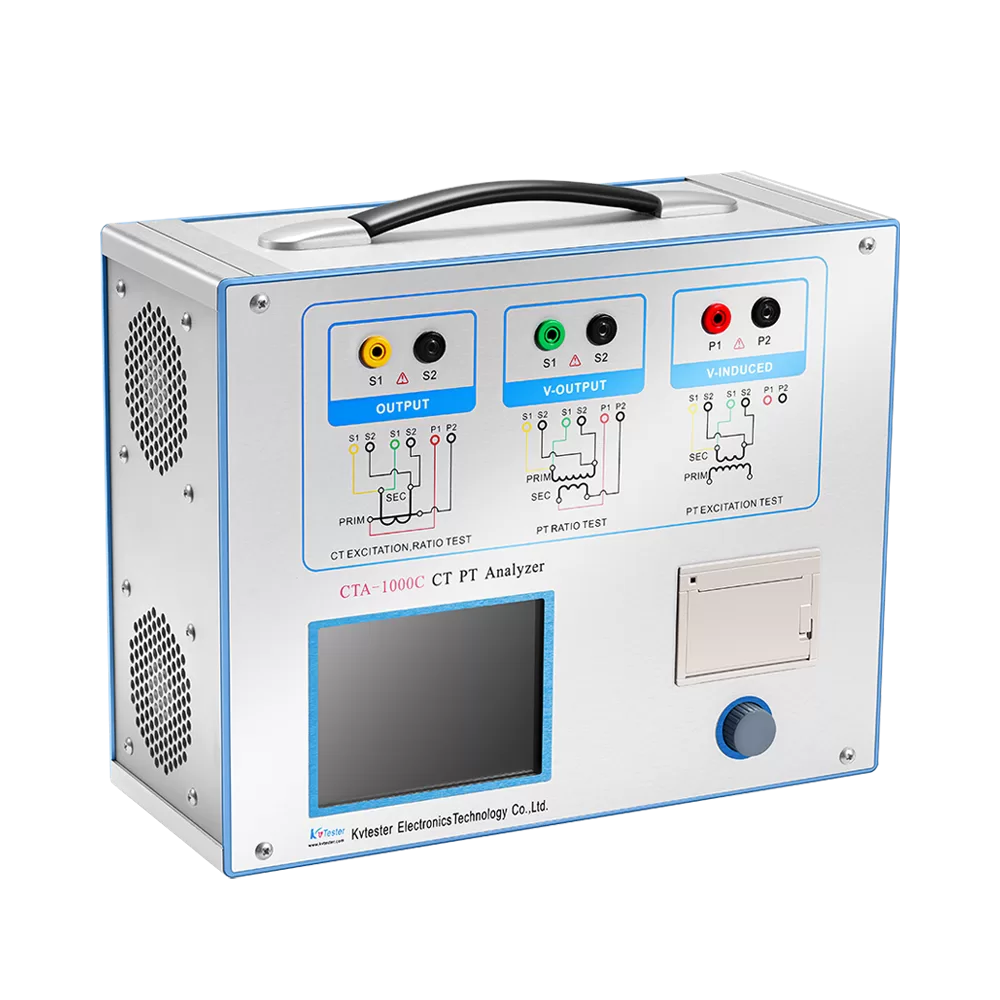
The CTA-1000C also supports CT/PT testing, with a stated CT ratio range of 1–40,000 and PT ratio range of 1–40,000. Its specified CT ratio accuracy is ±0.05%, while its PT ratio accuracy is ±0.2%.
These specifications help users evaluate conventional CT/PT testing requirements. They should not be interpreted as confirmation that either model performs CVT error testing.
How to Choose a CVT Analyzer for Your Voltage Level and Test Requirements
The right analyzer should match your transformer specifications, required measurements, and working environment. Use the following criteria to narrow your options.
Confirm the Transformer Type and Voltage Level
Identify whether you need to test an electromagnetic PT, a CVT, or a CCVT. Then check the rated voltage and the instrument’s supported operating range.
For example, our dedicated PTA-2000C VT/CVT Analyzer supports electromagnetic PT and capacitive CVT error testing across voltage levels from 6 kV to 800 kV. Its maximum output voltage is 3 kV, and its stated accuracy class is 0.05.
This range may suit applications involving different voltage levels, but the specific transformer configuration and required test procedure must still be verified.
Match Measurement Accuracy to the Application
Check ratio accuracy, phase measurement accuracy, resolution, and the applicable measurement ranges. Do not compare instruments using a single accuracy figure if that figure applies to only one measurement function.
For calibration and metering applications, confirm that the specified accuracy meets the requirements of the relevant procedure and standard.
Check Output Capability and Test Conditions
Review output voltage, output current, measurement range, power supply, and environmental conditions. These specifications affect whether an instrument is suitable for the intended test.
Do not assume that a higher output rating automatically means better measurement accuracy or broader transformer compatibility.
Consider Field Operation and Data Management
For on-site testing, portability, clear operating instructions, wiring checks, and efficient data recording can improve the workflow.
For example, the PTA-2000C supports storage of up to 10,000 groups of test data and uses an 8-inch touchscreen. These features can help organize results during calibration, factory inspection, and routine maintenance.
For users comparing conventional CT/PT instruments, our CT/PT test equipment range includes analyzers and testing systems for different applications. Select a model according to its documented functions rather than its product category alone.
How Is a CVT Analyzer Used in Substation Testing and Maintenance?
CVT analyzers can support several stages of transformer testing, provided that the selected instrument supports the required procedure.
- Commissioning and acceptance testing: Check relevant transformer characteristics before equipment enters service.
- Periodic maintenance: Evaluate specified measurement parameters during scheduled inspections.
- Metering accuracy verification: Measure ratio and phase-angle errors where required by the applicable procedure.
- Troubleshooting: Investigate abnormal test results and determine whether further inspection is needed.
The actual workflow depends on the transformer design, test method, and applicable safety requirements. Before testing, confirm the instrument’s wiring instructions, isolation requirements, and permitted operating conditions.
For conventional current transformer applications, the CTA-1000D CT/PT Analyzer provides automatic CT evaluation, including ratio and phase-angle accuracy, excitation, winding resistance, burden impedance, and polarity. It is intended for CT testing and supported PT tests; CVT compatibility should not be inferred from these functions.
What Should You Check Before Buying a CVT Compatible CT PT Analyzer?
Use this checklist to confirm that the selected instrument fits your project.
- Transformer type: Does the instrument explicitly support the CVT or CCVT model you need to test?
- Voltage range: Does its supported range cover the rated voltage of the transformer?
- Required tests: Can it perform the required ratio, phase-angle error, or other specified measurements?
- Accuracy: Do the accuracy and resolution meet your testing requirements?
- Test method: Is the instrument compatible with the applicable procedure and standard?
- Output capability: Are the output and measurement specifications suitable for the intended test?
- Data management: Does it provide the storage, review, and reporting functions you need?
- Technical support: Can the manufacturer confirm compatibility and clarify any configuration requirements before purchase?
These checks help distinguish a general CT/PT analyzer from an instrument designed for CVT testing. They also make it easier to compare products on technical suitability instead of price or the number of advertised functions.
Which CVT Compatible Analyzer Meets Your Testing Needs?
The best analyzer is the one that supports your transformer type, required test procedure, voltage range, and accuracy requirements.
For conventional CT testing and supported PT measurements, the CTA-1000C and CTA-1000D provide different measurement specifications and testing functions. For applications that specifically require CVT error testing, a dedicated VT/CVT analyzer is the more appropriate starting point.
At Kvtester, we offer testing solutions for current transformers, electromagnetic voltage transformers, and capacitive voltage transformers. To identify a suitable configuration, prepare the transformer type, rated voltage, required test items, and applicable standards before requesting a recommendation.
Need help confirming CVT compatibility? Contact Kvtester with your transformer specifications and testing requirements so we can help you identify an appropriate testing solution.
Related Products
Latest News
-
 2026-10-20China CT PT Analyzer Supplier: Manufacturer Guide
-
 2026-10-20CT PT Test System: Testing Methods and Equipment Selection
-
 2026-10-16How can measurement errors in no-load tests be minimized?
- 2026-10-16Why is the no-load test on a transformer typically conducted by applying voltage to the low-voltage side?
-
 2026-10-16What are the consequences of non-compliant short-circuit impedance?