
Home » News » Company News
IEC Standard CT Tester Buyer’s Guide for Utilities and Testing Companies
Buying a CT tester can be difficult when your project involves different CT classes, changing IEC requirements, and strict test-report requirements. The most suitable instrument is not simply the one with the highest output or the longest function list. It is the one that matches the current transformers you work with, the tests your team must complete, and the conditions where the work takes place.
For power utilities, transformer and instrument transformer manufacturers, testing companies, and renewable-energy EPC teams, a practical selection process helps avoid missing functions, repeated testing, and equipment that does not fit the job. Kvtester power testing equipment supports CT/PT testing, transformer testing, relay protection, and high-voltage test applications. This guide explains what to compare before selecting an IEC Standard CT Tester for field commissioning, factory inspection, maintenance, or calibration work.
Confirm the Applicable IEC Standard Before Comparing Specifications
Check the project specification before selecting a CT tester. Specify IEC 61869-1 and IEC 61869-2. The standard named for the project should match the CT type, test items, calculation method, and reporting process required for the work.
During technical clarification, identify the standard version, CT classes, required functions, and any limits that apply to the proposed model. A sample report is also useful because it shows how the selected standard, CT class, rated ratio, burden, measured values, calculated values, and assessment information will be recorded.
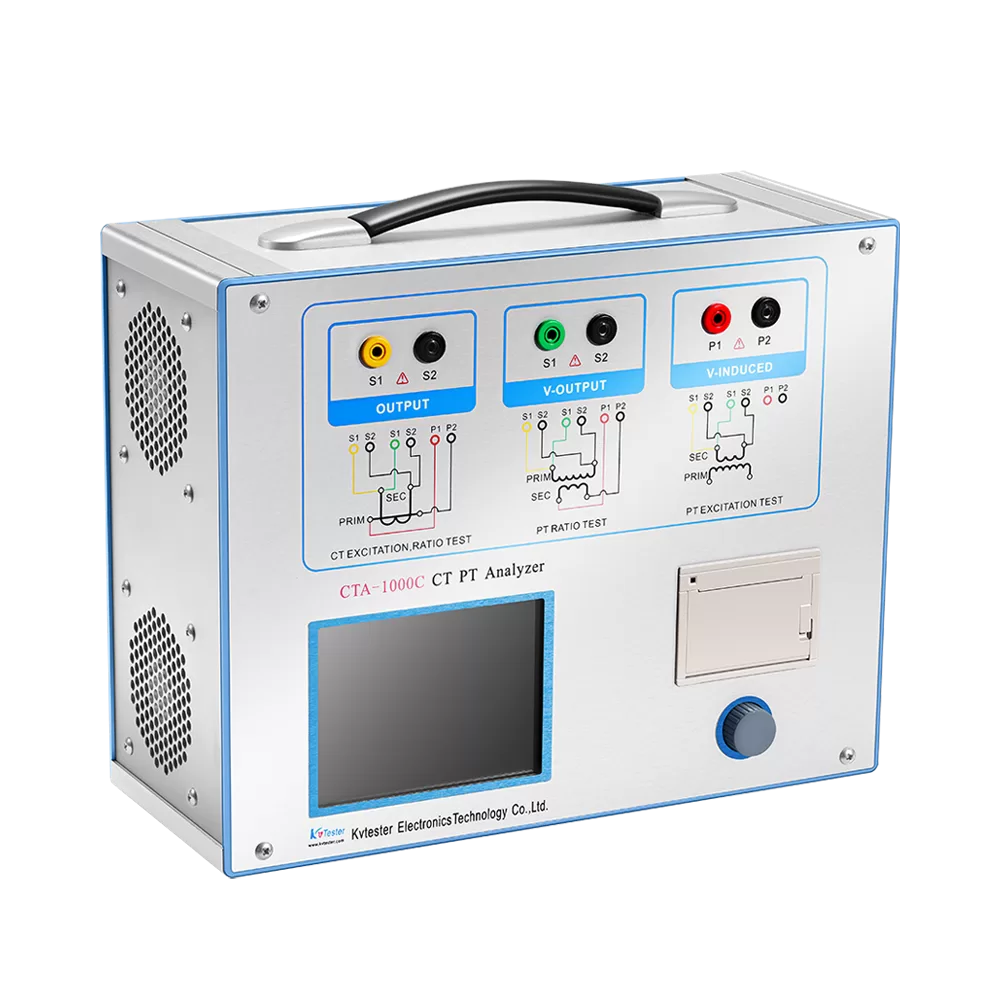
The CTA-1000C CT/PT Analyzer supports CT and PT testing for applications based on IEC 61869-2:2012. It is intended for teams that need to evaluate standard references together with practical CT and PT measurement functions.
Match the Tester to Your CT Type
Metering CTs
For metering CT work, ratio performance and phase measurement are usually the main selection points. The tester should support the required ratio range and provide clear specifications for ratio accuracy, phase accuracy, winding resistance, and burden measurement. These values influence incoming inspection, calibration work, metering checks, and quality control.
Protection CTs
Protection CT applications require more than ratio and polarity testing. Buyers should consider excitation characteristics, saturation behavior, knee-point voltage and current, secondary burden, winding resistance, and the protection parameters needed for the CT class or relay-protection design. Depending on the application, this may include ALF, FS, composite error, residual magnetism, time constants, and transient-related values.
For applicable CT types, the CTA-1000C can complete excitation characteristic, ratio, polarity, secondary winding resistance, secondary burden, ratio error, and phase displacement tests. It can also provide knee-point voltage and current, 10% error curves, ALF, FS, secondary time constant, remanence coefficient, and saturated and unsaturated inductance results.
Multi-Ratio, Multi-Tap, Bushing, and GIS CTs
Different installed CT arrangements require different test connections. If your project includes multi-ratio or multi-tap CTs, bushing CTs, GIS CTs, or special protection classes, confirm the CT nameplate data and connection arrangement before selecting the instrument. The required wiring diagram, test leads, and testing method should be reviewed as part of the technical evaluation.
For CT resistance, ratio, and excitation work, four-terminal wiring helps reduce the effect of lead resistance on the measurement. Connection arrangements should also be available for standard CTs, transformer bushing CTs, and GIS CT applications when these configurations are part of the project scope.
Compare the Specifications That Affect Your Results
Ratio and Phase Measurement
Compare the ratio range, stated accuracy, phase measurement range, phase accuracy, and resolution. A single headline accuracy value does not cover every function. Confirm which specification applies to ratio testing, phase testing, excitation voltage measurement, winding resistance, and burden measurement, together with the test conditions for each value.
The CTA-1000C provides a CT ratio range of 1 to 40000 with ±0.05% accuracy, a PT ratio range of 1 to 40000 with ±0.2% accuracy, and phase accuracy of 0.5 min. These values should be assessed against the CT ratio, accuracy class, project method, and expected report content.
Excitation and Knee-Point Capability
For protection CT testing, do not compare only the maximum voltage. Review output voltage, current, available output power, excitation curve generation, knee-point calculation method, voltage and current measurement accuracy, and the practical capability to test the CTs in your project. High knee-point requirements should be reviewed against actual CT nameplate data and the planned test method.
The CTA-1000C provides an output of 0 to 180 Vrms, 12 Arms, and 36 A peak. Its low-frequency testing method helps reduce the terminal voltage needed to achieve the same core-flux condition during the relevant CT test procedure.
Winding Resistance and Burden
Secondary winding resistance and burden testing should be included when the test plan requires verification of connected load, CT secondary condition, or calculation of related CT performance. Review the measurement range, accuracy, connection method, lead-resistance handling, and report format.
The CTA-1000C provides a secondary resistance range of 0 to 300 Ω with 0.2% ±2 mΩ accuracy and an AC burden range of 0 to 1000 VA with 0.2% ±0.02 VA accuracy. Four-terminal measurement is used to reduce the effect of test-lead resistance on resistance-related measurements.
Choose the Right Format for Field or Factory Work
Portable CT/PT Analyzer for Commissioning and Maintenance
For substations, renewable-energy projects, service teams, and commissioning contractors, portability affects daily productivity. Check the instrument weight, dimensions, transport case, input supply, operating temperature, humidity limits, test-lead arrangement, and report export method. These factors influence how efficiently an analyzer can move between transformer bays, switchgear areas, and remote project locations.
The CTA-1000C weighs less than 10 kg and measures 365 mm × 290 mm × 153 mm. It operates from -10°C to 50°C at humidity up to 90%. Test data can be stored in the instrument and copied to a PC by USB for analysis and Word report conversion.
Automatic Test System for Production and Metering Work
Factories and metering test centers may need a different solution from a portable analyzer. Where the workflow requires automatic CT accuracy testing, repeated test cycles, multiple test positions, or computer-managed reports, a dedicated CT test system may be a better fit.
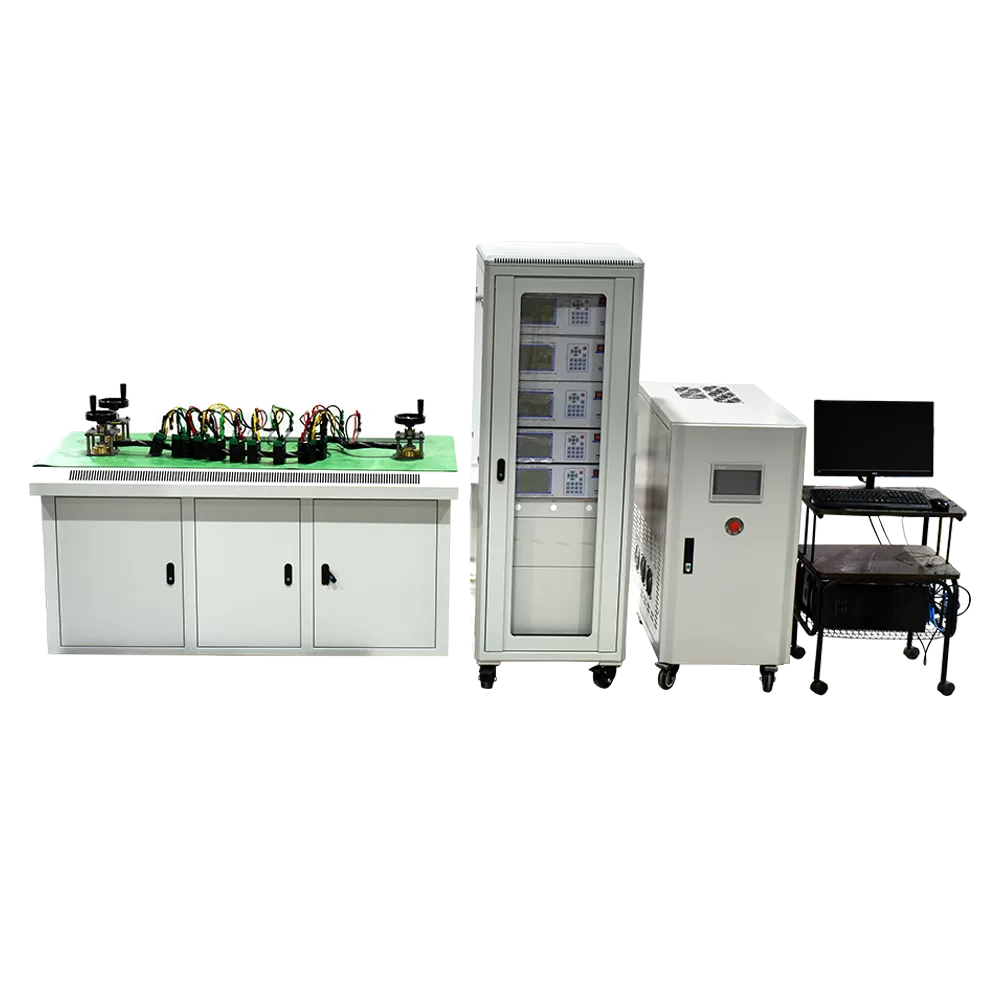
The ZCHG-12 CT/PT Test System supports automatic CT accuracy testing and error calibration. Its functions include CT accuracy testing, demagnetization, inter-turn insulation testing, polarity checking, computer-controlled automatic testing, and Word report output. It can test up to 12 CT objects at one time and supports IEC 61869-1 and IEC 61869-2 applications.
Review Safety and Connection Requirements
CT testing must follow the applicable site isolation procedure and instrument operating instructions. Before testing, verify the CT condition, isolate the related circuit as required, confirm the status of other windings and connected equipment, and establish a reliable protective earth connection. Do not connect or disconnect test leads while a test is in progress.
Reliable grounding, correct test-lead connection, and suitable working conditions are essential for safe testing. Do not touch exposed live parts, operate in humid or explosive environments, or continue using an instrument that is suspected to be damaged. These requirements should be included in the work method, training plan, and project safety documentation.
Before ordering, review the operating manual, wiring diagrams, safety instructions, test-lead details, grounding arrangement, output protection information, and the connection procedure for the CTs in your project.
Check Reporting, Data Storage, and Calibration Support
Professional CT testing requires more than a result shown on the screen. Before buying, review how the instrument stores test records, identifies the CT and winding under test, exports data, displays curves, and produces reports for handover or internal quality control.
Review a report sample that reflects your actual application. It should show the equipment or asset identification, CT ratio, selected test items, entered rated values, measured values, calculated values, excitation or error curves where applicable, and assessment information. If your organization uses a specific report layout, identify this requirement before quotation.
Calibration documentation should also be considered before purchase. Confirm which functions are included in the supplied calibration record, the recommended recalibration process, the available technical support channel, and how serial-number traceability is maintained after delivery.
Questions to Ask a CT Tester Supplier Before Ordering
- Which IEC standard versions and CT classes are supported by the proposed model?
- Can the analyzer complete the required tests for our metering, protection, or transient CTs?
- Which values are directly measured and which are calculated by the software?
- What are the guaranteed accuracy specifications for ratio, phase, resistance, burden, and excitation measurements?
- Can you provide a test report sample for a CT similar to ours?
- Does the configuration include the required test leads, accessories, software functions, and report tools?
- Can you provide connection guidance for multi-tap, bushing, or GIS CTs?
- What are the operating limits, grounding requirements, output protections, and safety procedures?
- What factory test records, calibration documents, training, and technical support are available after delivery?
Select by Project Evidence, Not by a Single Headline Figure
The most suitable IEC Standard CT Tester is the one that matches your CT types, test plan, applicable standards, accuracy requirements, field conditions, and reporting process. Start with the CT nameplate details, required test items, project standard, and expected report format. This information makes it easier to identify an appropriate analyzer or test system configuration.
For a broader technical comparison before finalizing your requirements, review high-precision CT tester specifications. The guide covers CT type, standard support, excitation capability, ratio and phase performance, reporting, safety, calibration, and service considerations.
Related Products
Latest News
-
 2026-09-09High Precision Transformer Testing Equipment Price & FAT Guide
 -
 2026-09-09How to Use a CT Tester for Reliable Maintenance Field Testing?
 -
 2026-08-26Proper Usage and Operating Procedures for DC High-Voltage Generators
 -
 2026-08-26How do you choose a DC high-voltage generator?
 -
 2026-08-26What is a DC High-Voltage Generator?