
Home » News » Company News
How Does a Variable Frequency Relay Tester Test Over/Underfrequency Relays?
How can you verify that an overfrequency relay operates at the correct frequency? How do you determine the actual operating point of an underfrequency relay? And how can you measure relay operating time accurately while the frequency is changing?
A reliable frequency relay test needs more than a variable frequency output. The test system must provide a controlled electrical signal, adjust the frequency smoothly, detect the relay’s operating response, and record the corresponding test values. Understanding how these steps work can help you select the right test method and equipment for your protection testing requirements.
How Variable Frequency Relay Testing Works
The principle is straightforward: apply the required electrical signal to the relay, change the frequency in a controlled way, and monitor when the relay operates.
The important part is controlling these actions together. The frequency needs to change according to the test procedure, while the relay contact and operating time are monitored at the same time.
For teams handling different protection functions, choosing suitable relay protection testing equipment can also simplify the overall testing workflow.
Frequency variation and relay response
For a frequency relay, the key test point is the frequency at which the relay changes state.
A dedicated High-Low Frequency Test module can be used to perform frequency relay testing. Automatic frequency conversion also makes it possible to measure frequency slip during the test.
This means the frequency change becomes part of the measurement process rather than simply a manual adjustment.
Testing an Overfrequency Relay
An overfrequency relay responds when the applied frequency rises to its operating condition. The test therefore increases the frequency while monitoring the relay contact.
A practical test sequence can be divided into several straightforward steps.
Set the test output
Connect the relay according to its test requirements and configure the required AC voltage or current output.
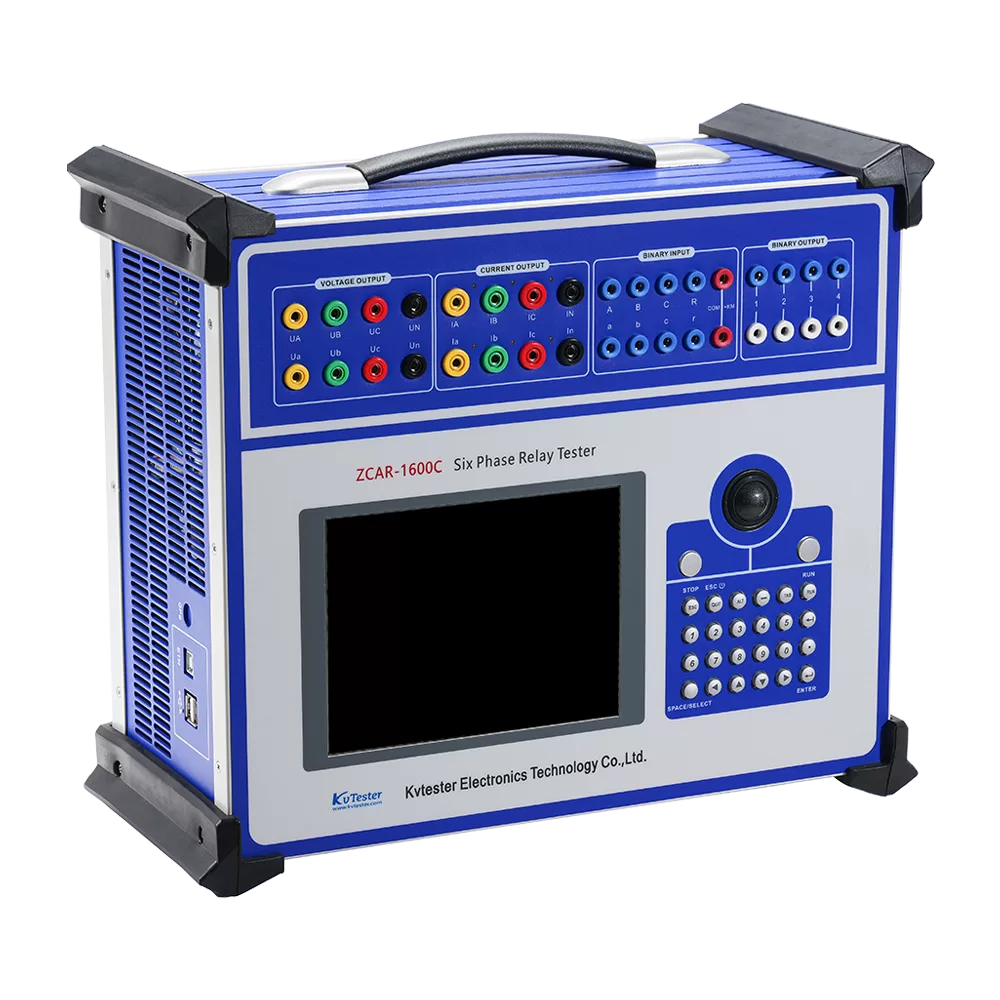
For the ZCAR-1600C, AC voltage output ranges from 0 to 120 V per phase and 0 to 240 V line-to-line. The fundamental-wave frequency range is 0–1000 Hz for both AC current and AC voltage output.
Increase the frequency
Start from an appropriate frequency below the expected operating point, then increase the frequency according to the test procedure.
As the frequency approaches the relay setting, monitor the relay contact until it operates.
Record the operating point
The frequency at which the relay operates is the main value to record.
For repeated tests, automatic frequency conversion helps maintain a consistent frequency-changing process, while frequency slip measurement provides additional information about the test response.
Testing an Underfrequency Relay
Underfrequency testing uses the same basic principle, but the frequency moves downward instead of upward.
The test begins above the expected operating threshold and reduces the frequency until the relay responds. Once the test direction is clear, the main task is to control the frequency change and capture the relay response accurately.
Apply the required signal
Connect the relay and apply the required AC output.
Before reducing the frequency, confirm that the relay is in its normal operating state so that the response can be identified correctly.
Reduce the frequency
Decrease the output frequency gradually while monitoring the relay contact.
When the relay operates, record the corresponding frequency. This value can then be compared with the relay’s specified operating condition.
Measure the response time
The operating frequency is only part of the test. Operating time is also important when checking protection performance.
The ZCAR-1600C provides a time measurement range of 0.1 ms to 9999 s, with measurement accuracy below 0.1 ms.
This allows short relay responses and longer protection delays to be measured within the same test system.
What Output Does a Variable Frequency Relay Tester Need?
Frequency range is important, but it is not the only specification that determines whether a tester is suitable. The output voltage, current capacity, number of channels, and timing capability also need to match the intended test work.
For example, the ZCAR-1600C provides:
- Six AC voltage channels
- Six AC current channels
- 0–30 A per phase for six-phase current output
- Up to 0–60 A per phase for three-phase current output
- Up to 0–180 A with six-phase parallel current output
- 0–120 V AC phase voltage
- 0–240 V AC line voltage
- 0–1000 Hz fundamental-wave frequency output
- 0.1 ms–9999 s time measurement range
The six-phase voltage and current outputs can also be combined into different test configurations, making the equipment suitable for more than frequency relay testing.
For applications that require detailed output and protection-testing specifications, the ZCAR-1600C relay protection tester provides the relevant configuration and performance details in one place.
Automatic Frequency Testing Makes Repeated Tests Easier
A single relay test may require only a few frequency changes. When the same procedure needs to be repeated across multiple tests, consistent operation and test-data management become much more important.
The ZCAR-1600C supports automatic validation, protection-setting scanning, fault playback, real-time test-data storage, vector display, and online report printing.
These functions help keep repeated testing organized while reducing the amount of manual work involved in recording and reviewing test results.
Choosing the Right Variable Frequency Relay Tester
The right tester should be selected according to the actual relay and test procedure. Looking only at the maximum frequency range is not enough.
Check the frequency range
First, confirm that the tester covers the frequency range required by the relay and the planned test.
The ZCAR-1600C provides a 0–1000 Hz fundamental-wave frequency range for AC voltage and AC current output.
Check voltage and current capability
The output must also match the electrical requirements of the relay and other protection tests that may be performed with the same equipment.
The ZCAR-1600C provides up to 120 V AC per phase and 30 A AC per phase in six-phase current output. Three-phase current output reaches 60 A per phase, while six-phase parallel output reaches 180 A.
Check timing measurement
If relay operating time is part of the test criteria, timing measurement should be considered together with frequency and output performance.
The tester provides a 0.1 ms to 9999 s measurement range with accuracy below 0.1 ms.
Consider the complete protection test workflow
Frequency testing may be only one part of your daily testing work. If the same equipment also needs to handle current, voltage, differential, directional, impedance, or synchronous protection tests, multifunction capability can make the overall workflow more efficient.
This is particularly useful when a testing team needs to move between different protection functions without changing its main test platform.
A Variable Frequency Relay Tester for Broader Protection Testing
Frequency relay testing is often performed alongside other protection tests, particularly during commissioning, maintenance, and laboratory testing.
The ZCAR-1600C supports test modules for current relays, over- and under-voltage relays, sequence component relays, synchronous check relays, differential relays, power directional relays, impedance relays, synchronous relays, and frequency relays.
This allows one test platform to cover multiple protection functions without changing the main equipment between different test tasks.
For customers evaluating equipment for wider power-system testing applications, Kvtester power testing solutions provide access to the company’s broader range of testing and measurement equipment.
The tester uses DSP control and a modular linear power amplifier. The system is designed for high-fidelity waveform generation and real-time digital signal processing.
Choose a Variable Frequency Relay Tester for Your Test Requirements
A suitable variable frequency relay tester should give you the frequency control, electrical output, response detection, and timing measurement required by your test procedure.
For frequency relay testing, the ZCAR-1600C combines a 0–1000 Hz fundamental-wave output range with a High-Low Frequency Test module, automatic frequency conversion, frequency slip measurement, and timing measurement from 0.1 ms to 9999 s.
If you already know the relay type and test parameters but need help choosing the appropriate configuration, you can contact Kvtester with your requirements.
Related Products
Latest News
-
 2026-09-24How to Read a DC Resistance Tester Specification for Transformer Testing?
 -
 2026-09-23How Can You Choose the Right Multi-Function Variable Frequency PT Tester Supplier?
 -
 2026-09-23What Features Should a Resistance Tester for Transformer Factory Have?
 -
 2026-09-22Smart ANSI Standard PT Tester For Grid Applications
 -
 2026-09-22Digital CT Tester Supplier for Substation Commissioning