
Home » News » Company News
CT Analyzer Specifications: Complete Technical Guide
CT analyzer specifications dictate the measurement accuracy testing coverage, regulatory compliance, and on-site usability of current transformer testing devices. For power system engineers, calibration technicians, and field maintenance teams, a thorough understanding of CT analyzer specs is essential for selecting the right equipment for CT commissioning, routine maintenance testing, fault troubleshooting, and industry standard compliance validation.
Modern high-performance CT analyzers automate secondary-side CT testing, compute critical transformer performance parameters, and generate fully compliant test reports aligned with IEC and IEEE standards. This comprehensive guide outlines all core CT analyzer specifications, key functional and performance metrics, and practical selection criteria to help you compare available models and make well-informed purchasing decisions.
What Is a CT Analyzer? Core Overview
A CT (Current Transformer) analyzer is a specialized portable testing instrument built to measure, analyze, and verify the electrical performance of metering and protection-grade current transformers. Unlike traditional manual CT test kits, modern CT analyzers leverage automated testing algorithms and built-in calculation systems to eliminate human measurement error and streamline on-site testing workflows.
Standard CT analyzer workflows involve injecting low-voltage test signals into the CT secondary circuit, capturing real-time electrical response data, calculating equivalent circuit characteristics, and evaluating CT accuracy, saturation behavior, and burden performance against global industry standards. These devices are widely utilized in substation maintenance, power grid calibration, industrial power system audits, and laboratory CT performance verification.
Key CT Analyzer Specifications: Core Technical Parameters
When evaluating CT analyzer specifications, professionals prioritize six core categories: measurement accuracy, operational test range, electrical performance metrics, built-in functional features, environmental durability, and mechanical portability. Below is a detailed breakdown of industry-standard technical specifications for professional-grade CT analyzers used in power utilities and industrial sectors.
1. Measurement Accuracy Specifications
Measurement accuracy is the most critical specification for CT analyzers, as it directly determines the reliability of test results for both metering and protection CT applications. Commercial-grade professional models incorporate high-precision sensing and measurement modules to support calibration for Class 0.2 and Class 0.5 accuracy-level current transformers.
- Basic measurement accuracy: ±0.05% to ±0.5% full-scale reading, suitable for high-precision laboratory calibration and rigorous field testing scenarios
- Ratio error test accuracy: ≤0.1% for standard CT transformation ratio measurement
- Phase error test accuracy: ≤1 arcminute, enabling ultra-precise phase difference detection for high-accuracy metering CTs
- Winding resistance measurement accuracy: ±0.2% of the measured value for reliable CT secondary winding resistance testing
High-end industrial CT analyzers maintain consistent precision even in harsh on-site environments with strong electromagnetic interference, fully meeting the strict calibration standards required by global power industries.
2. Test Range Specifications
The operational test range defines a CT analyzer’s compatibility with different current transformer types, covering low-voltage metering CTs up to high-voltage heavy-duty protection CTs used in utility substations.
- CT ratio test range: 1:1 to 4000:1, covering nearly all standard industrial, commercial, and substation CT models
- Knee point voltage test range: Up to 60 kV, ideal for detecting saturation performance in high-grade protection CTs
- Secondary current test range: 0.01 A to 12 A
- Secondary burden test range: 0-1000VA, accommodating all common secondary circuit burden configurations
- Winding resistance test range: 0-300Ω , supporting both micro-resistance and high-resistance winding measurements
3. Critical CT Parameter Calculation Specs
Professional-grade CT analyzers automatically compute all critical CT performance parameters, eliminating manual calculations and reducing human error. The standard built-in calculation suite includes the following metrics:
- Saturation & excitation characteristics: Excitation curve profiling, knee-point voltage and current, saturated/unsaturated inductance values, and residual magnetism coefficient (Kr)
- Protection CT performance parameters: Accuracy Limit Factor (ALF), Instrument Security Factor (FS), secondary circuit time constant (Ts), and 5%/10% CT error characteristic curves
- Structural & circuit parameters: Actual CT turns ratio, secondary winding resistance (Rct), real-time secondary burden value, and CT polarity verification results
- Accuracy error metrics: Ratio error and phase error under variable current and burden operating conditions
4. Functional Specifications
Modern CT analyzers are engineered with automation, operational safety, and field efficiency as core design priorities, drastically simplifying on-site testing workflows:
- Automatic demagnetization: Built-in demagnetization functionality removes residual magnetism post-testing, ensuring consistent, repeatable measurement results
- One-click full testing: Completes a full suite of CT parameter tests in under 2 minutes, far faster than traditional step-by-step manual testing procedures
- Automatic CT nameplate recognition: Identifies unknown CT specifications and matches them against standard industry rating databases
- Automated compliance assessment: Automatically grades test results as pass or fail based on selected IEC and IEEE standard criteria
- High-capacity data logging: Stores over 1,000 sets of test data and performance curves, with support for offline review and batch data analysis
- Real-time curve visualization & report export: Displays excitation curves, error curves, and saturation hysteresis loops in real time, with exportable test reports in Excel format
5. Safety & Environmental Specifications
Field power testing demands robust environmental resilience and operational safety, making these key CT analyzer specifications indispensable for industrial and utility-grade applications:
- Low-voltage secondary-side testing: Eliminates high-voltage and high-current exposure during operation, maximizing on-site operator safety
- Wide operating temperature range: -10℃ to 50℃, supporting deployment in extreme outdoor substation and indoor industrial environments
- Condensation-free humidity resistance: Operates reliably at up to 90% relative humidity (non-condensing), suited for humid substation and factory conditions
- Advanced EMC shielding: Built-in electromagnetic compatibility design resists strong on-site electromagnetic interference in active substations
6. Mechanical & Portable Specifications
Nearly all field-oriented CT analyzers feature an integrated, lightweight build to enable flexible, on-site deployment across multiple locations:
- Lightweight form factor: Unit weight of 8–9 kg, fully portable by a single technician with no need for external burden boxes or high-voltage boosters
- Rugged industrial construction: Compact all-in-one chassis with dustproof and drop-resistant casing for harsh field conditions
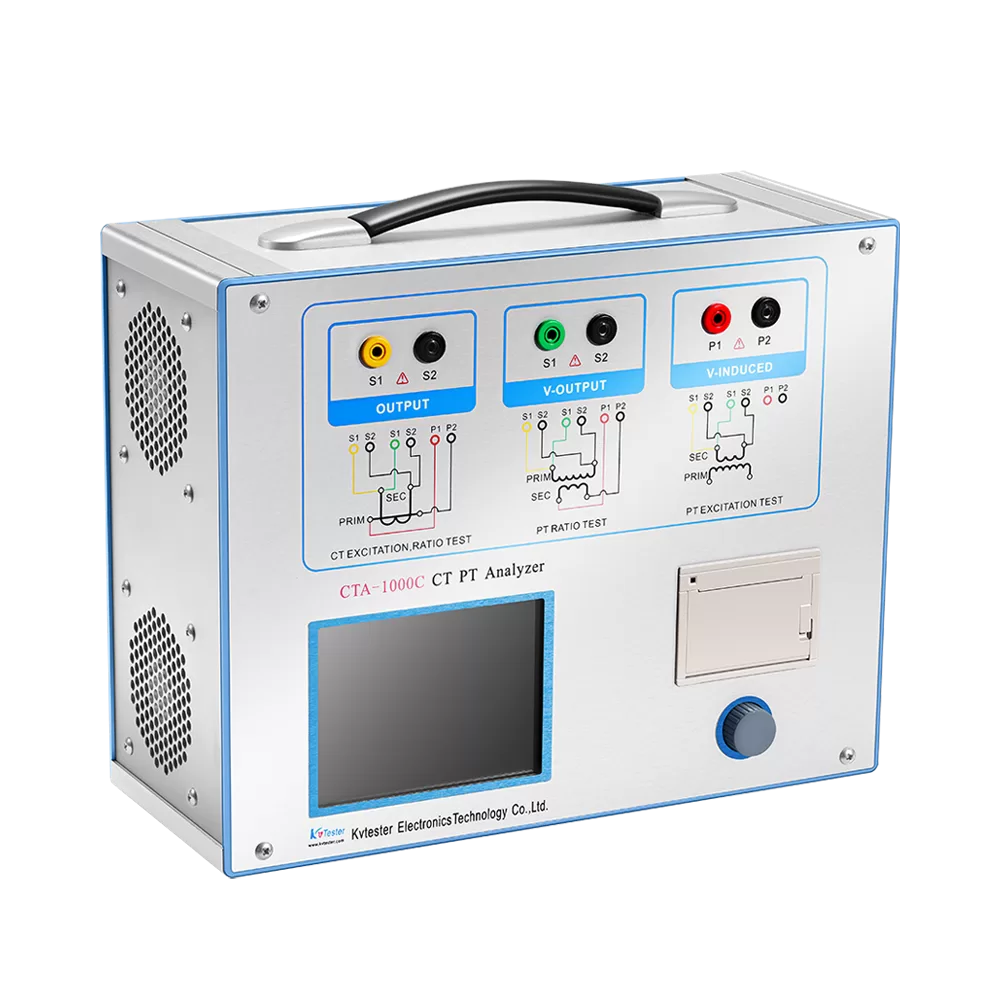
- 5.7-inch transflective graphical LCD, enabling clear visibility even under direct sunlight. Equipped with a rotary photoelectric mouse for simple, fast and user-friendly operation with an easy learning curve.
Industry Standard Compliance Specifications
Reputable, industry-grade CT analyzers must adhere to globally recognized power industry standards, which serve as the primary benchmark for professional equipment qualification:
- IEC 61869-1;IEC 61869-2: International standards governing current transformer performance characteristics and standardized testing procedures
- IEEE C57.13: North American industry standard for metering and protection current transformer calibration and validation
Devices compliant with these standards generate internationally recognized, audit-ready test reports that qualify for power grid acceptance, industrial power system inspections, and third-party calibration certifications worldwide.
Why CT Analyzer Specifications Matter for Testing Quality
Substandard or mismatched CT analyzer specifications lead to inaccurate current transformer performance assessments, introducing critical operational risks to power systems:
First, insufficient measurement accuracy produces erroneous ratio and phase error data, causing inaccurate energy metering and financial losses for power utilities and industrial facilities. Second, limited knee-point voltage and saturation testing ranges fail to detect latent saturation defects in protection CTs, which can trigger relay malfunction or failure during grid fault events. Third, non-compliant testing equipment produces uncertified results that fail official industry acceptance audits.
As such, aligning your CT analyzer specifications with your specific testing use cases is fundamental to reliable CT validation and safe power system operation.
How to Choose CT Analyzer: Specification Matching Guide
Use the following structured criteria to select a CT analyzer with specifications tailored to your operational needs:
- Match specs to your test objects: Choose ±0.05% high-accuracy models for precision metering CT calibration; opt for units with extended knee-point voltage and full ALF/FS calculation capabilities for protection CT testing.
- Align with regional standards: Select IEC-compliant analyzers for global power projects and IEEE C57.13-certified units for North American standard-compliant applications.
- Prioritize portability for field work: Deploy lightweight, rugged, all-in-one CT analyzers for mobile outdoor substation testing and on-site maintenance tasks.
- Verify data management features: Select units with ample onboard storage and one-click standardized report exporting for high-volume batch testing and long-term data archiving.
Final Thoughts
CT analyzer specifications encompass measurement accuracy, testing range, functional capabilities, standard compliance, environmental durability, and portability—all of which define a device’s overall testing performance and application suitability. Understanding these key specifications empowers engineering teams to select appropriate equipment, standardize CT testing workflows, and guarantee the long-term stability and accuracy of power system current transformers.
Whether conducting routine maintenance, project commissioning, or third-party calibration services, prioritizing verified CT analyzer technical specifications is the key to maximizing testing efficiency and maintaining authoritative, audit-ready test results.
FAQs About CT Analyzer Specifications
Q1: What is the standard accuracy of a professional CT analyzer?
Professional field-grade CT analyzers typically deliver 0.2%–0.5% basic measurement accuracy, while laboratory-grade high-precision models achieve up to 0.05% accuracy, supporting calibration for Class 0.2S ultra-precision current transformers.
Q2: What core parameters can a CT analyzer test?
A standard CT analyzer measures and calculates full CT performance metrics, including ratio error, phase error, winding resistance, secondary burden, excitation curves, knee-point voltage, saturation characteristics, ALF, FS, and residual magnetism coefficient, covering all routine and type test requirements for industrial CTs.
Q3: Which standards do CT analyzers comply with?
Top-tier commercial CT analyzers comply with IEC-61869-1/2 and IEEE C57.13 global standards, fully meeting international power industry requirements for current transformer testing, calibration, and official validation.
Related Products
Latest News
-
 2026-09-302026 Top 3 Chinese Insulation Resistance Transformer Testing Equipment Manufacturers
 -
 2026-09-30Industrial CT Tester: How Is It Used for Current Transformer Factory Testing?
 -
 2026-09-30How Can a CT PT Analyzer Improve CT and PT Quality Testing in the Laboratory?
 -
 2026-09-30How to Perform Current Transformer Testing Step by Step?
 -
 2026-09-30How to Perform CT Analyzer Testing and Evaluate the Test Results?