

Home » News » Company News
Choose an Automatic Single Phase PT Tester for Substation
Testing potential transformers (PTs) in substations involves checking several electrical characteristics to verify their measurement performance and operating condition. For single-phase PTs, technicians may need to perform ratio, excitation, polarity, winding resistance, and burden tests as part of inspection and maintenance work.
When these tests are performed on-site, manually configuring each test and recording the results can increase workload, especially when multiple transformers need to be checked. An automatic single phase PT tester can simplify the testing process by integrating multiple measurement functions and reducing repetitive operations.
What should you look for when selecting this type of equipment for substation applications?
What Should Be Tested When Inspecting Single Phase PTs in Substations?
Single-phase PT testing involves more than checking whether the primary and secondary voltages maintain the expected ratio. Different tests help identify potential problems in the transformer’s electrical characteristics and secondary circuit.
PT Ratio and Phase Relationship
The transformation ratio indicates the relationship between the primary and secondary voltages. An incorrect ratio or unexpected deviation may affect the accuracy of voltage measurement in the substation.
Technicians should verify the actual ratio against the rated value and check the phase relationship between the primary and secondary sides where required.
Excitation Characteristics
An excitation test evaluates the relationship between the applied voltage and excitation current of a PT. The resulting excitation curve helps technicians assess the magnetic characteristics of the transformer core.
Abnormal excitation behavior may indicate problems such as core defects or changes in magnetic performance. Testing these characteristics can therefore provide useful information when inspecting PT condition.
Polarity Verification
PT polarity determines the relative direction of the primary and secondary voltage references. Incorrect polarity can affect measurement and protection circuit connections.
Polarity testing helps confirm that the transformer terminals are connected according to the required configuration.
Secondary Winding Resistance
Measuring secondary winding resistance helps identify potential problems such as poor connections, damaged conductors, or differences between winding conditions.
Resistance measurements are particularly useful when checking transformer condition or comparing test results during maintenance.
Secondary Burden Measurement
The connected secondary burden affects PT operating performance and measurement accuracy. Burden testing evaluates the impedance or load connected to the secondary circuit.
When inspecting a PT installation, technicians should consider whether the actual burden is within the transformer’s rated capacity.
How Does Automatic Testing Simplify Single Phase PT Testing in Substations?
Substation testing often takes place under practical site constraints. Technicians may need to work within limited spaces, coordinate testing with maintenance schedules, and complete multiple checks within a defined period.
An automatic PT tester can help simplify these tasks by integrating measurement procedures into one instrument.
Fewer Repetitive Testing Operations
When separate instruments are used for different PT tests, technicians may need to change equipment, reconnect test leads, and configure measurement parameters repeatedly.
An integrated automatic tester can perform several supported tests through a unified operating interface. This reduces the need to switch between multiple instruments and helps organize the testing process.
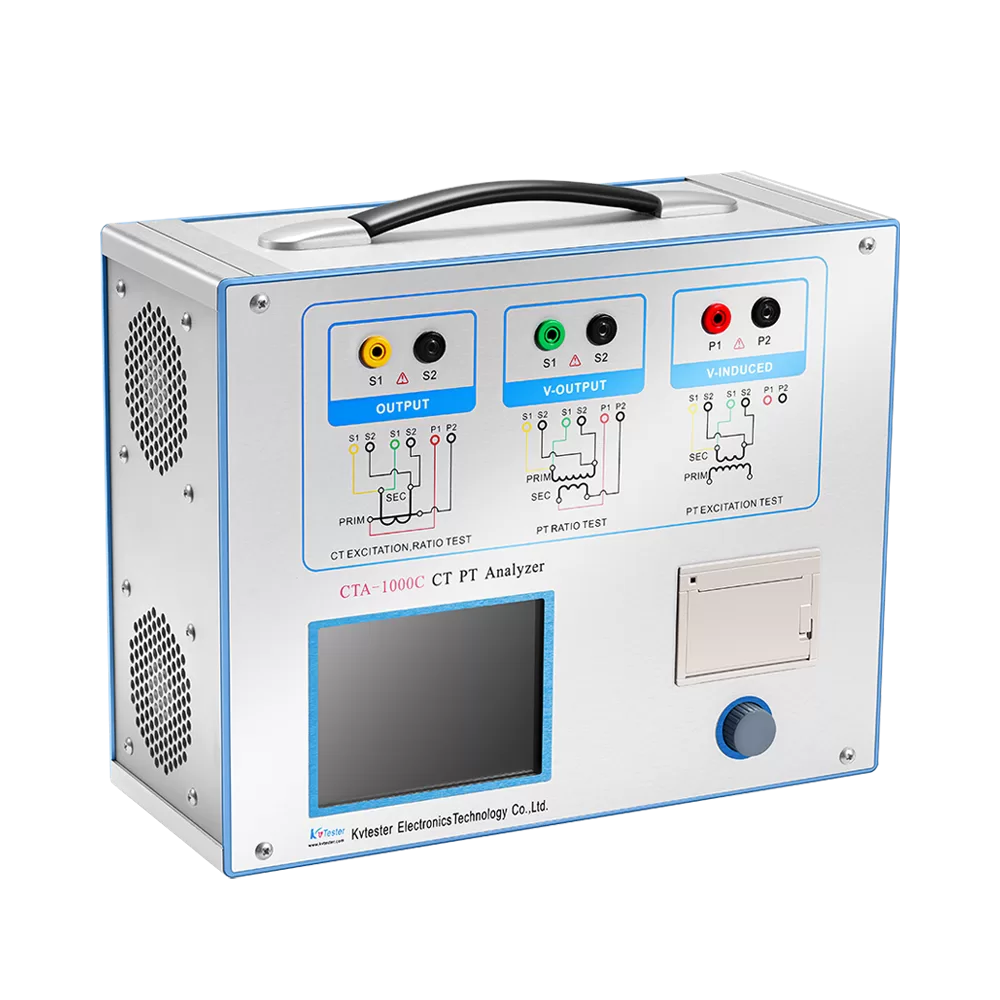
For example, our CTA-1000C CT/PT Analyzer integrates PT ratio, excitation, burden impedance, polarity, and secondary winding resistance testing. Its combination of measurement functions is useful when technicians need to complete multiple PT checks without carrying several separate instruments.
Automatic Calculation and Result Evaluation
Manual calculation can add time to PT testing, particularly when technicians need to compare measured values with rated parameters or applicable requirements.
An automatic analyzer can process measurement data and provide calculated results, reducing repetitive manual work.
The CTA-1000C supports automatic evaluation according to IEC and IEEE standards, helping technicians review test results more efficiently. It also supports report generation, making it easier to organize measurement records for maintenance and inspection.
More Convenient On-Site Testing
Equipment transportation and setup also affect the efficiency of substation testing.
An integrated instrument can reduce the number of separate devices that technicians need to transport and connect. The CTA-1000C weighs less than 10 kg, making it suitable for testing tasks that require equipment to be moved between different working locations.
For maintenance teams that perform inspections across multiple substations or testing points, combining several measurement functions in one instrument can also simplify equipment preparation and transportation.
What Features Should an Automatic Single Phase PT Tester Provide?
Not every automatic PT tester supports the same measurement functions or technical requirements. Before selecting equipment, check whether its capabilities match the PT specifications and testing procedures used in your substation.
Coverage of Essential PT Tests
The instrument should support the measurements required for the intended inspection work.
Depending on the application, these may include:
- PT transformation ratio and phase relationship
- Excitation and saturation characteristics
- Secondary winding resistance
- Polarity verification
- Secondary burden impedance
An integrated analyzer can be particularly useful when several of these tests are required during the same maintenance procedure.
For testing teams that need to cover different PT inspection tasks, the available functions should be checked individually. For example, the CTA-1000D CT/PT Analyzer supports PT-related tests including excitation, burden impedance, polarity, and winding resistance. Its test capabilities can be considered when these measurements are part of the substation inspection requirements.
Suitable Measurement Accuracy and Range
Measurement accuracy should match the requirements of the PT and the applicable testing standards.
For example, the CTA-1000C supports a PT ratio measurement range of 1–40,000 with an accuracy of ±0.2%. These specifications provide a reference when evaluating whether the instrument meets the requirements of a particular testing application.
The test voltage, resistance range, and other measurement specifications should also be checked against the equipment under test. Buyers should compare specifications under equivalent test conditions rather than relying on a single accuracy figure.
Automated Evaluation and Report Generation
Automatic data processing can reduce manual calculations and make test results easier to review.
For substation maintenance teams, useful capabilities include:
- Automatic calculation of measured parameters
- Evaluation against applicable testing standards
- Storage of test data
- Generation of test reports
These functions help maintain organized inspection records and make it easier to compare results from different testing sessions. When testing multiple PTs, consistent data recording can also support subsequent maintenance reviews and equipment condition tracking.
Practical Design for Substation Work
Substation testing equipment should be convenient to transport, connect, and operate in the available working space.
Consider the instrument’s weight, dimensions, connection arrangement, power supply, and operating interface. A compact integrated analyzer may be preferable when technicians frequently move between testing locations or need to complete several measurements with limited equipment.
How to Select the Right PT Testing Equipment for Substation Applications?
The right equipment depends on the PT testing requirements, maintenance workload, and whether the testing task involves individual PT measurements or broader CT/PT inspection.
Start with the Required PT Test Items
Identify which electrical characteristics need to be checked during routine inspection, commissioning, or maintenance.
If the work mainly involves PT ratio, excitation, polarity, burden, and winding resistance measurements, an integrated CT/PT analyzer with the required functions can simplify the process.
You can compare different options in our CT/PT testing equipment range. When evaluating a model, check its individual PT test functions and technical specifications to confirm that they match the intended application.
Check the Applicable Accuracy Requirements
Different applications may have different accuracy requirements. Confirm the required measurement accuracy and test range before comparing instruments.
It is also important to check the conditions under which the stated accuracy applies, rather than comparing accuracy figures without considering the measurement range and test method.
Consider Testing Frequency and Field Conditions
For maintenance teams that regularly inspect multiple PTs, automated measurement and report generation can help reduce repetitive work.
Equipment weight, portability, cable arrangement, and power supply options should also be considered, especially when testing is performed at different locations within a substation.
If the testing workload includes both CT and PT inspections, consider whether one integrated instrument can cover the required measurements. This may reduce the need to prepare and transport separate instruments for different testing tasks.
Choose Between Individual PT Testing and Integrated CT/PT Testing
Some testing tasks focus primarily on PT performance, while others involve both current transformers (CTs) and potential transformers (PTs).
For broader testing requirements, an integrated CT/PT testing solution may provide greater flexibility. The appropriate configuration should be selected according to the actual measurement functions required, rather than assuming that every system supports every type of PT test.
Conclusion
Selecting an automatic single phase PT tester for substation applications requires more than checking whether the instrument supports automatic operation. Its measurement functions, accuracy, data evaluation capabilities, and suitability for on-site work all influence testing efficiency.
An integrated analyzer can simplify PT inspection by combining multiple measurement functions, reducing repetitive operations, and helping technicians organize test results. The most suitable equipment should match the transformer specifications, testing procedures, and maintenance requirements of the substation.
At Kvtester, we provide CT/PT testing instruments for power utilities, electrical testing organizations, and transformer manufacturers. If you are looking for an automatic PT testing solution for your substation applications, Contact Us to discuss your testing requirements and get suitable equipment recommendations.
Related Products
Latest News
-
 2026-11-26Anti-interference High Voltage Insulation Tester Maintain Measurement Accuracy
-
 2026-11-26How Does a Lightweight PT Tester Improve On-Site Testing Efficiency?
-
 2026-11-20How to Use a PT Tester for Accurate Error Calibration
-
 2026-11-20Variable Inductance Resonant Test System: How It Works
-
 2026-11-20High Voltage PT Tester for Accurate Voltage Transformer Testing