
Home » News » Company News
All-in-one Transformer Tester: Scenario Selection Guide 2026
Introduction
Most transformer testing failures in industrial and power industries stem from mismatched testing equipment for application scenarios. Different users including transformer manufacturers, power grid maintenance teams, repair workshops, and third-party labs face unique testing problems, leading to inaccurate test data, low work efficiency, safety hazards, and non-compliant test reports.
An all-in-one transformer tester integrates all core testing functions required for transformer performance verification, replacing scattered single-function testing devices. Choosing a targeted all-in-one testing solution based on scenario pain points and demand priorities is the key to improving testing accuracy, safety, and standardization.
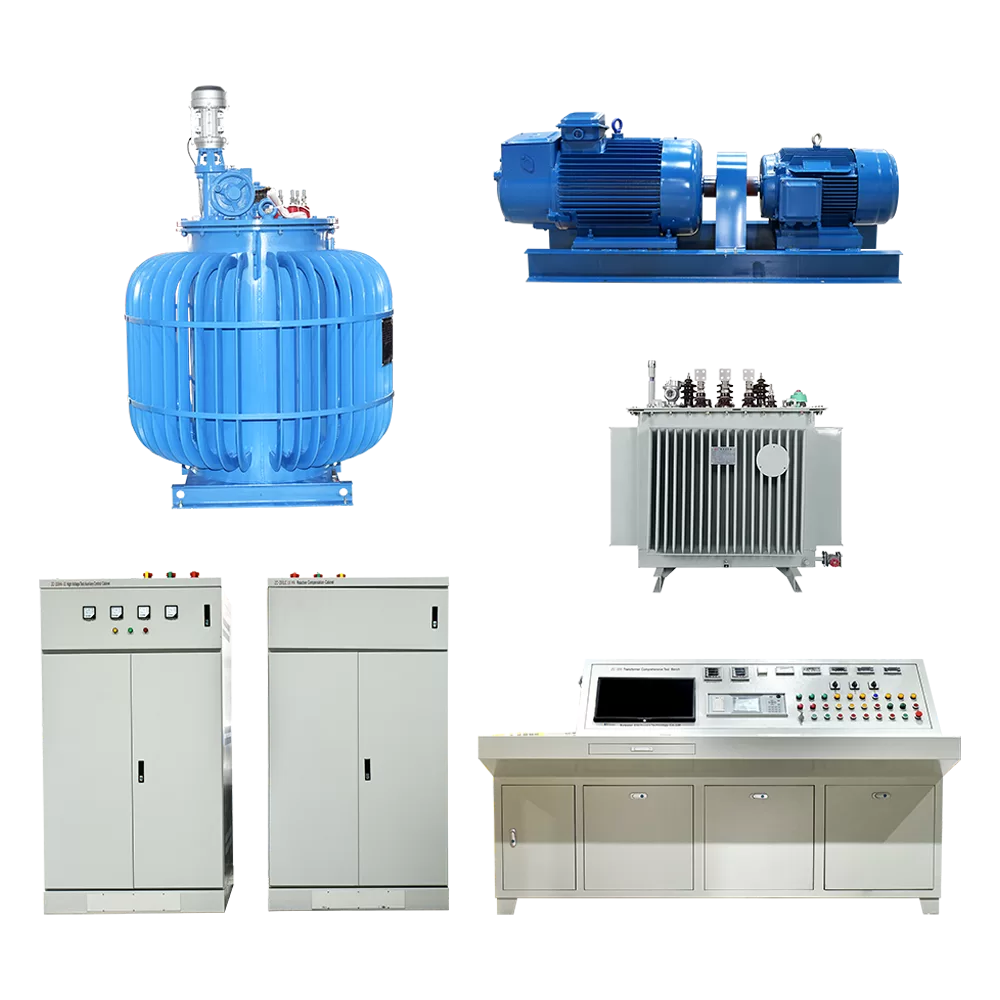
This guide analyzes typical scenario pain points, core functional demands, key selection focus points one by one, and recommends a professional all-in-one transformer test system to solve all common problems: ZC-200 Transformer Test Control Desk.
1. Transformer Manufacturing Factory
1.1 Common Scenario Pain Points
- Low batch testing efficiency: Traditional single-function testers require repeated wiring and manual parameter adjustment, resulting in long testing cycles and inability to match production line output.
- High manual error rate: Manual data observation, recording and calculation cause inconsistent test data, unqualified factory inspection reports and poor product quality traceability.
- Single functional configuration: Fixed-function equipment cannot adapt to flexible testing demands of semi-finished products, finished products and post-maintenance re-inspection of different specification transformers.
- Potential safety risks: Frequent manual operation in mass production is prone to misoperation, causing equipment damage and safety accidents.
1.2 Core User Demands
- Full-automatic testing to reduce manual intervention and improve batch testing speed
- Complete test items covering no-load loss, load loss, winding resistance, transformation ratio, withstand voltage and insulation resistance
- Flexible configurable functions to adapt to multi-specification transformer production
- Automatic report generation to meet factory inspection and audit standards
- Built-in safety interlock protection to avoid operational errors
1.3 Key Selection Focus
Automation level | ✔ |
modular expandability | ✔ |
batch test efficiency | ✔ |
safety protection mechanism | ✔ |
standardized report output capability | ✔ |
environmental data automatic correction function | ✔ |
2. Power Grid Substation & Power Maintenance Station
2.1 Common Scenario Pain Points
- Complex on-site interference: The electromagnetic environment of substations is complex, and ordinary testers have poor anti-interference ability, resulting in fluctuating and inaccurate test data.
- High high-voltage operation risk: High-potential testing lacks effective high-low voltage isolation measures, bringing hidden dangers to operators.
- Incomplete fault detection: Single-function equipment cannot comprehensively detect transformer aging, insulation damage and impedance deviation, leading to missed judgment of potential faults.
- Poor data stability: Test results are easily affected by environmental factors, failing to meet the requirements of regular power grid preventive inspection.
2.2 Core User Demands
- Strong anti-interference performance, stable and repeatable test data
- Complete high-voltage safety isolation and multi-protection design
- Full-item performance testing to realize comprehensive fault diagnosis
- High-precision measurement to accurately judge transformer operating status
2.3 Key Selection Focus
Anti-interference design | ✔ |
high-low voltage isolation technology | ✔ |
multi-dimensional safety protection | ✔ |
measurement accuracy and data stability | ✔ |
3. Transformer Repair & Rewinding Workshop
3.1 Common Scenario Pain Points
- Cost waste: High-end full-function test equipment is expensive, while low-end equipment has incomplete functions and cannot meet repair verification standards.
- High operation threshold: Complex professional test equipment requires professional technicians, increasing training costs.
- Easy secondary damage: Wrong wiring or misoperation during post-repair testing may damage the repaired transformer.
3.2 Core User Demands
- Cost-effective configuration, retaining core repair and verification test items
- Simple and intelligent operation, low technical threshold
- Anti-misoperation protection to protect repaired equipment
3.3 Key Selection Focus
Cost performance | ✔ |
basic test item completeness | ✔ |
operation simplicity | ✔ |
misoperation protection function | ✔ |
configurable and scalable functions | ✔ |
4. Third-Party Power Quality Inspection Laboratory
4.1 Common Scenario Pain Points
- Insufficient accuracy: Ordinary testers have large measurement errors, failing to meet national metrology calibration standards and unable to issue authoritative reports.
- Incomplete test parameters: Lack of synchronous measurement of three-phase loss, power factor, impedance voltage and other professional parameters, unable to complete energy efficiency certification and quality inspection.
- Unstandardized data: No automatic environmental correction function, test data is affected by temperature and harmonics, poor credibility.
4.2 Core User Demands
- High-precision measurement that meets metrology calibration standards
- Full professional parameter testing to support authoritative certification reports
- Automatic environmental correction and standardized data export
4.3 Key Selection Focus
Measurement accuracy level | ✔ |
complete professional test parameters | ✔ |
data correction function | ✔ |
standardized report customization capability | ✔ |
metrology traceability | ✔ |
Core Universal Selection Criteria for All-in-One Transformer Tester
Combined with the pain points and core demands of all scenarios, the core selection focus of high-quality all-in-one transformer testers is summarized as follows, which can be used as a universal purchasing checklist:
- Functional completeness: Cover all mandatory test items for transformer performance verification
- Precision stability: Voltage, current and power accuracy up to 0.2 level, with anti-interference design
- Intelligent automation: Support one-click automatic testing and automatic report generation
- Safety guarantee: Equipped with overvoltage, overcurrent, zero position and high-voltage isolation protection
- Scenario adaptability: Modular configurable design to adapt to different production, maintenance and laboratory scenarios
- Data standardization: Support environmental correction and multi-standard report customization
Best All-in-One Transformer Tester Recommendation
After analyzing the pain points, core demands and selection criteria of all mainstream transformer testing scenarios, the ZC-200 Transformer Test Control Desk stands out as a universal, high-performance all-in-one solution that perfectly matches manufacturing factories, power maintenance stations, repair workshops and third-party laboratories. It integrates all essential transformer testing functions and solves the common industry pain points mentioned above with professional industrial-grade design.
Equipped with a mature PLC + industrial control computer automatic control architecture, this all-in-one tester covers full test items for power and distribution transformers, including no-load characteristics, load characteristics, winding resistance, transformation ratio group, power frequency withstand voltage, induction withstand voltage and insulation resistance. Its flexible modular design supports customizable test item configuration, adapting to low-cost basic testing for repair workshops, efficient batch testing for production lines, and high-precision calibration testing for professional laboratories.
In terms of safety and stability, the ZC-200 adopts CT and PT high-low voltage isolation technology, along with multi-protection mechanisms including zero position protection, overvoltage protection, overcurrent protection and high-voltage ungrounded protection, eliminating operational safety risks effectively. All testing units are built with anti-interference design, maintaining stable test data in complex electromagnetic environments, with high measurement accuracy of ±(0.2% reading + 0.1% range) for voltage, current and power parameters, fully meeting national and IEC metrology standards.
Additionally, the system supports automatic test result correction based on environmental temperature and power harmonics, one-click automatic testing, data recording and standardized report generation. It greatly reduces manual operation errors and improves overall testing efficiency, delivering targeted, cost-effective and reliable testing capabilities for all transformer application scenarios.
Conclusion
The core of selecting an all-in-one transformer tester is to solve scenario-specific pain points with targeted functions: manufacturers pursue efficiency and standardization, power stations focus on safety and stability, repair workshops emphasize cost performance and simplicity, and laboratories require high precision and authority.
As a universal industrial-grade integrated testing solution, the ZC-200 Transformer Test Control Desk perfectly covers the functional demands of all mainstream scenarios, with outstanding performance in automation, safety, precision and scalability. It is the most cost-effective all-in-one transformer testing equipment for industrial users, solving common problems such as low efficiency, inaccurate data and poor safety in transformer testing in one stop.
Related Products
Latest News
-
 2026-09-20CT PT Analyzer for Commissioning: Substation Testing Guide
 -
 2026-09-20ANSI Standard CT Tester: Specs, Tests & Buying Guide
 -
 2026-09-18Why does the required capacity of series resonant test equipment usually increase with cable length?
 -
 2026-09-18How should 35kV cable series resonant withstand voltage test equipment be configured?
 -
 2026-09-18How to Select AC Withstand Voltage Test Equipment for 10kV Cables?