
Home » News » Company News
What Should You Look for When Buying a CT/PT Analyzer from a Supplier?
Choosing a CT/PT analyzer is not only about comparing price or checking one accuracy figure. The right instrument should match your transformer type, required test items, applicable standards, working environment, and reporting process.
Whether you work in a substation, power plant, transformer factory, electrical construction project, or maintenance service team, a suitable CT/PT analyzer can make instrument transformer testing more efficient and easier to document.
What CT/PT Tests Does Your Project Require?
The first step is to define what you need to test. CT/PT analyzers are used to evaluate the performance of current transformers (CTs), potential transformers (PTs), and voltage transformers (VTs).
Typical CT test items include:
- Transformation ratio
- Polarity
- Excitation characteristic
- Knee-point voltage
- Secondary winding resistance
- Burden
- Ratio error
- Phase displacement
- Accuracy limit factor
- Instrument security factor
Typical PT or VT test items may include:
- Transformation ratio
- Polarity
- Winding resistance
- Burden
- Ratio error
- Phase displacement
However, not every project requires every function. Metering CTs are usually evaluated for ratio error, phase displacement, burden, and accuracy class. Protection CTs often require additional checks, such as excitation curves, knee-point voltage, winding resistance, and saturation-related parameters.
Therefore, define the required test list before comparing models. This helps avoid buying an instrument with insufficient functions—or paying for functions that will not be used.
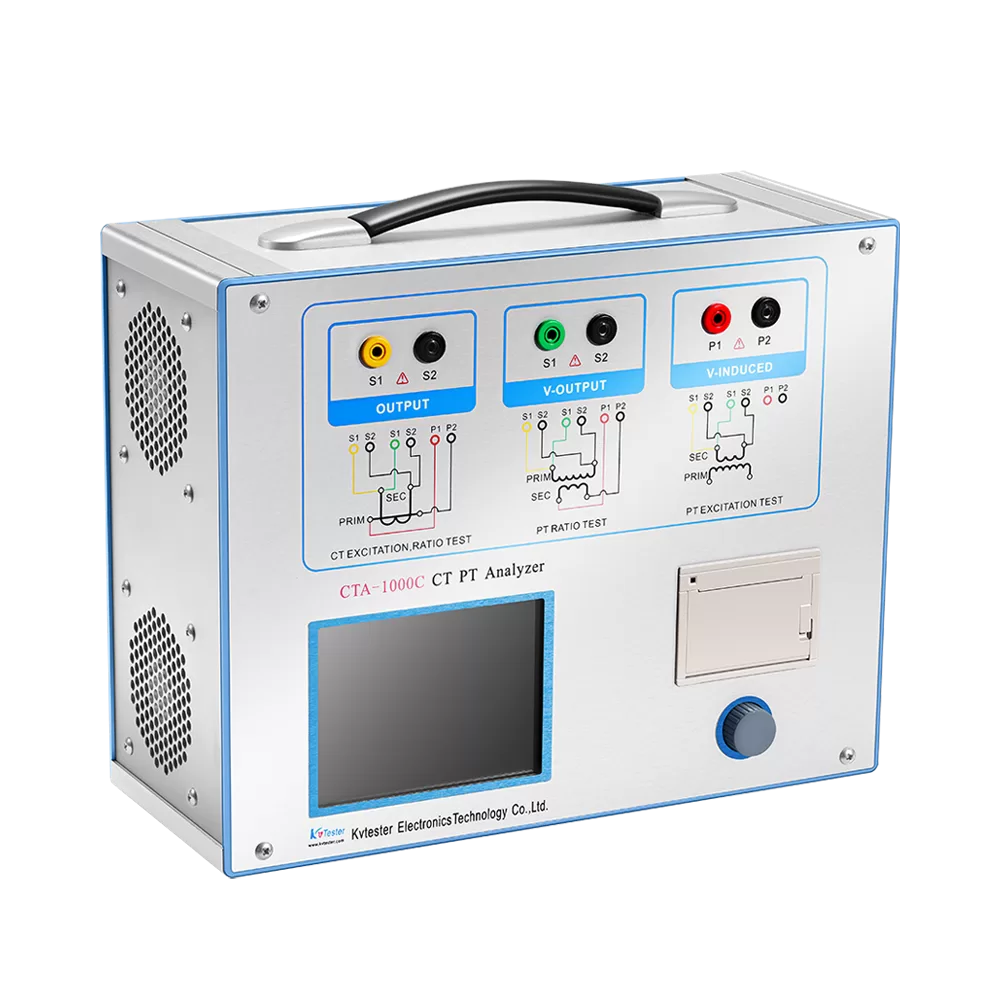
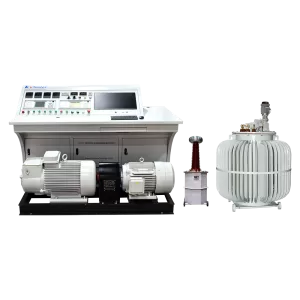
For applications that require CT testing, PT testing, automated systems, or calibration equipment, explore the available CT/PT test equipment range before selecting a configuration.
How Accurate Can a CT/PT Analyzer Be?
Accuracy should be evaluated according to the individual test function. A CT/PT analyzer may provide different accuracy levels for ratio measurement, phase-angle measurement, winding resistance, excitation voltage, excitation current, and burden testing.
Before purchasing, review these specifications carefully:
- CT ratio measurement range and accuracy
- PT ratio measurement range and accuracy
- Phase displacement accuracy
- Winding resistance range and resolution
- Excitation voltage and current capability
- Burden measurement range
- Knee-point voltage test capability
- Supported CT and PT classes
For metering applications, measurement precision should be appropriate for the transformer accuracy class being verified. For protection applications, the analyzer should provide stable and repeatable data for excitation testing, knee-point evaluation, secondary resistance measurement, and related protection parameters.
Does the CT/PT Analyzer Support Your Required Standards?
Test requirements can vary by country, utility, project owner, transformer manufacturer, or inspection organization. Before purchasing, confirm which standards apply to your work and whether the test procedure and report format meet those requirements.
Common references include:
- IEC 61869 for instrument transformers
- IEC 60044 for existing or legacy transformer applications
- IEEE C57.13 for applicable North American projects
- GB/T 20840 and related power-industry requirements
- Project-specific technical specifications
Standards support should be practical, not only listed in a quotation. The analyzer should help users select the relevant transformer class, collect the required test values, and present results clearly for review.
For instance, a protection CT test may require an excitation curve, knee-point voltage, secondary winding resistance, and ratio data. A metering CT test may place greater emphasis on ratio error, phase displacement, burden, and accuracy class.
As a result, it is important to send the applicable standard and CT/PT nameplate details to the supplier before confirming the model.
Can One CT/PT Analyzer Cover Metering and Protection Applications?
Many utilities, EPC contractors, and testing service providers need to handle more than one type of instrument transformer. A versatile CT/PT analyzer can reduce the need to use separate instruments for routine ratio checks, resistance measurement, excitation testing, and burden testing.
When comparing models, ask whether the equipment can support:
- Metering CT and PT testing
- Protection CT testing
- CT ratio and polarity testing
- PT ratio and polarity testing
- Excitation curve testing
- Knee-point voltage testing
- Secondary winding resistance testing
- Burden testing
- Ratio error and phase displacement testing
- Automated or semi-automated test procedures
This comparison matters because the test priorities are different. Metering transformers support accurate energy measurement, while protection transformers provide signals used by protective relays during abnormal operating conditions.
Choosing an analyzer based on the complete testing workflow can help your team use one coordinated solution across commissioning, maintenance, and inspection tasks.
Is the CT/PT Analyzer Suitable for Field Testing?
Laboratory testing and field testing create different demands. In substations and construction projects, teams often need to complete tests efficiently, work around limited shutdown windows, and produce records before leaving the job location.
For field use, consider the following factors:
- Instrument size and weight
- Carrying case and lead storage
- Input power requirements
- Output voltage and current capability
- Test lead length and connection method
- Screen readability
- Guided wiring and operating steps
- Data storage capacity
- Overload and incorrect-connection protection
- Grounding requirements
- Ability to work in electrically noisy environments
A compact instrument is useful, but portability alone is not enough. The analyzer must still provide the output range, measurement capability, and safety protection needed for the CT/PT types under test.
In addition, automated test sequences can reduce repetitive operations and help technicians follow a consistent process across multiple transformers.
How Should You Evaluate a CT/PT Analyzer Supplier?
The equipment specification is important, but supplier capability also affects the long-term value of the purchase. A quotation should be evaluated together with technical documentation, configuration support, delivery planning, warranty terms, training, and after-sales service.
Before making a decision, ask for:
- A detailed technical datasheet
- Complete measurement ranges and accuracy specifications
- Supported CT/PT test functions
- Required standards and transformer class coverage
- Standard accessories and optional accessories
- Operating manual and wiring guidance
- Factory test or inspection information
- Calibration options
- Warranty conditions
- Software and reporting support
- Remote technical support
- Spare parts and maintenance arrangements
- Customization options for specific project requirements
The purchasing decision should focus on total operating value, not only the initial equipment price. An analyzer that matches the application, includes the correct accessories, and is supported by clear technical guidance can reduce delays during testing and commissioning.
Kvtester has supplied power testing equipment since 2008 and serves customers in more than 40 countries and regions. The product offering supports power systems, power generation, manufacturing enterprises, electrical construction projects, industrial and mining applications, railway systems, research institutions, and complete-set manufacturing plants. Learn more about our technical support, quality systems, customization options, and project experience.
What Information Should You Send When Requesting a Quote?
A detailed inquiry helps ensure that the recommended CT/PT analyzer matches the actual application. Before requesting a quotation, prepare the following information:
- CT testing, PT testing, or both
- Metering application, protection application, or both
- Primary and secondary rated current or voltage
- Required transformation ratio range
- Required accuracy classes
- Required test items
- Applicable IEC, IEEE, GB, utility, or project standards
- Laboratory, factory, substation, or field-testing application
- Required report language and data format
- Required test leads and accessories
- Calibration certificate requirements
- Training or technical-support requirements
The more clearly these requirements are defined, the easier it is to select a suitable CT/PT analyzer configuration.
To discuss a project requirement or request a quotation, share your CT/PT nameplate data, test items, target standard, and application environment through our contact channel.
Choose a CT/PT Analyzer for the Complete Test Process
A suitable CT/PT analyzer should support the required test functions, measurement range, accuracy level, applicable standards, field conditions, reporting workflow, and service requirements.
Before purchasing, confirm these key points:
- Required CT/PT test functions
- Measurement range and accuracy
- Metering and protection application coverage
- Applicable standard support
- Field portability and safety features
- Test-report and data-management needs
- Required accessories
- Calibration and technical-support requirements
- Delivery, warranty, and maintenance arrangements
By evaluating the full testing process before ordering, you can select a CT/PT analyzer that supports more reliable instrument transformer testing and more efficient project documentation.
Related Products
Latest News
-
 2026-09-18Multi-function Transformer Testing Equipment OEM Guide
 -
 2026-09-18Compact Transformer Testing Equipment for Field Teams
 -
 2026-09-17How an Intelligent Transformer Tester Supports Safe Transformer Testing
 -
 2026-09-17ANSI Standard Six Phase CT Tester Manufacturer: OEM Selection Guide
 -
 2026-09-17What Transformer Tests Does a Power Plant Need for Reliable Operation?