
How to Choose Between 30kV, 50kV, 60kV, 80kV, and 90kV VLF High-Voltage Generators?
How to Choose Between 30kV, 50kV, 60kV, 80kV, and 90kV VLF High-Voltage Generators?
When selecting a Very Low Frequency (VLF) high-voltage generator, customers often ask: “Should I choose 30kV, 50kV, 60kV, 80kV, or 90kV?”
Answering this question requires more than just looking at whether the cable is rated for 10kV or 35kV; one must comprehensively consider the test voltage, testing standards, cable length, cable capacitance, output frequency, and the equipment’s load-bearing capacity.
Simply put: choosing a VLF high-voltage generator isn’t just about whether the voltage is high enough—it’s also about whether the unit can handle the load.
1. First, clarify: Higher voltage ratings aren’t always better
The voltage rating of a VLF high-voltage generator typically refers to its maximum output capability. Common specifications include 30kV, 50kV, 60kV, 80kV, and 90kV.
However, customers shouldn’t simply assume that “higher voltage is better.” If the voltage rating is too low, it may fail to meet testing requirements; conversely, if the rating is unnecessarily high for the actual test object, it leads to increased procurement costs and potentially more complex on-site operational requirements.
The correct approach to selection is:
First, confirm the cable’s voltage rating and the required test voltage;
Next, determine the cable length and capacitance;
Then, select a unit with suitable output voltage and load-bearing capacity.
VLF testing generally refers to AC testing conducted at frequencies below 1 Hz. IEEE 400.2-2024 serves as the guide for on-site VLF testing of shielded power cable systems. my country’s standard DL/T 849.4—2024 also specifies requirements for VLF high-voltage generators—covering technical specifications, test methods, inspection rules, labeling, packaging, transport, and storage—applicable to their manufacture and inspection.
2. What scenarios are suitable for a 30kV VLF high-voltage generator?
The 30kV specification is generally suitable for withstand voltage tests on lower-voltage cables, commonly used in on-site testing scenarios for cables rated at 10kV and below. For short 10kV cables—provided the required test voltage falls within the equipment’s output range—a 30kV unit generally meets basic operational needs.
Its advantages include a compact size, light weight, portability, and lower cost, making it suitable for users dealing with shorter cable lengths and relatively simple on-site testing tasks.
However, if the 10kV cable is long, has high capacitance, or if the client desires greater output headroom, relying solely on the 30kV specification is not recommended; the equipment’s load-bearing capacity must be carefully calculated.
3. In what scenarios is the 50kV VLF (Very Low Frequency) high-voltage generator suitable?
The 50kV specification is a common choice for users testing 10kV cables.
Compared to the 30kV model, the 50kV unit offers greater output voltage headroom and a wider application range. It provides more operational margin for scenarios such as 10kV cable acceptance testing, preventive maintenance testing, and withstand voltage verification following fault repairs.
If a client primarily tests 10kV cables but seeks broader equipment applicability and better compatibility with future projects, the 50kV model is often a safer, more reliable choice than the 30kV model.
It is suitable for power construction units, power distribution engineering companies, industrial and mining enterprises, and O&M teams for new energy plants—particularly where testing tasks are frequent and on-site cable lengths vary.
4. In what scenarios is the 60kV VLF high-voltage generator suitable?
The 60kV model represents an intermediate specification, typically used in scenarios requiring an output voltage higher than 50kV but not yet necessitating 80kV or 90kV.
Clients primarily testing 10kV cables who desire significant operational headroom might consider the 60kV model. It is also applicable in situations where test voltage requirements are high, even if the cable length itself is not excessive.
However, caution is required when considering this model for 35kV cable testing; one must carefully verify whether 60kV is sufficient. Since 35kV cables generally demand higher test voltages and equipment capacities, the model should not be selected simply because “60kV seems close enough.” In simple terms: The 60kV model is better suited for 10kV cable testing where a high safety margin is desired, or for special projects with requirements falling between the 10kV and 35kV ranges. If a customer primarily works with 35kV cables, equipment with a higher voltage rating should generally be prioritized.
5. What scenarios are suitable for the 80kV VLF (Very Low Frequency) high-voltage generator?
The 80kV model is commonly used for on-site withstand voltage testing of 35kV cables and is a model frequently sought after by users dealing with 35kV cables.
Compared to 10kV cables, 35kV cables require higher test voltages and often have larger cross-sectional areas and longer installation distances; consequently, there are stricter requirements for the VLF generator’s output voltage and load-bearing capacity.
If a customer primarily performs acceptance tests, preventive tests, or post-maintenance verification on 35kV cables, an 80kV model is usually more appropriate than 50kV or 60kV versions.
However, voltage rating is not the only factor to consider for 80kV equipment. Long-distance 35kV cables can have significant capacitance; if the equipment lacks sufficient load-bearing capacity, issues such as the inability to ramp up voltage, overcurrent protection trips, or failure to complete the test may still occur.
Therefore, when selecting an 80kV model, it is essential to verify the maximum load capacitance the equipment can handle at frequencies of 0.1Hz, 0.05Hz, or 0.02Hz.
6. What scenarios are suitable for the 90kV VLF high-voltage generator?
The 90kV model is suitable for 35kV cable testing scenarios that demand a higher output voltage margin, as well as for projects involving particularly long cables, stringent testing requirements, or a need for broader equipment versatility.
Compared to the 80kV model, the 90kV model offers the advantages of a more substantial voltage margin and a wider application range. However, this comes with increased equipment size, weight, and cost, as well as more demanding on-site operational requirements.
If a customer frequently tests 35kV cables of varying lengths, or if project technical specifications mandate higher test voltages, output capabilities, and equipment margins, the 90kV model should be prioritized. If a client only occasionally tests short-distance 35kV cables and has a limited budget, they can choose between 80kV and 90kV models by weighing the actual test voltage requirements against the cable capacitance.
7. Why consider cable length and capacitance?
Cables are typical capacitive loads. The longer the cable, the higher its capacitance. During VLF (Very Low Frequency) withstand voltage testing, the equipment must continuously charge and discharge the cable; therefore, the cable’s capacitance directly determines whether the equipment can successfully ramp up the voltage and complete the test.
At a given voltage, a lower frequency results in lower capacitive current, allowing the equipment to handle a larger capacitive load. Consequently, some VLF devices adjust their frequency (ranging from 0.01Hz to 0.1Hz) based on cable length and capacitance to accommodate loads with higher capacitance.
Therefore, three key questions should be clarified during equipment selection:
What is the voltage rating of the cable?
How long is the cable, and what is its capacitance?
What is the maximum capacitance the equipment can handle at the target frequency?
If capacitance is not calculated—and selection is based solely on rules of thumb like “30kV for 10kV cables” or “80kV for 35kV cables”—the equipment may still prove insufficient for the actual load on-site.
8. Simple selection guidelines
A preliminary assessment can generally be made based on the following:
30kV: Suitable for testing cables rated 10kV or lower, particularly short-distance cables with low capacitance.
50kV: Suitable for testing most 10kV cables; offers a broader application range than the 30kV model.
60kV: Suitable for 10kV cable testing with a high safety margin, or for specific testing requirements.
80kV: Suitable for on-site VLF withstand voltage testing of most 35kV cables.
90kV: Suitable for 35kV cables requiring a higher safety margin, longer cables, or scenarios with stricter project specifications.
These are merely preliminary guidelines. Final equipment selection should be based on testing standards, project technical agreements, specific cable parameters, and the equipment’s rated load capacity. 9. Pay attention to peak vs. RMS values during selection
Different manufacturers may use different conventions for specifying output voltage; some list peak values, others list RMS (root mean square) values, and some provide both.
Even if a unit is labeled “80kV,” the actual meaning can differ depending on the specification standard used. When purchasing, customers should verify the following:
Whether the output voltage is peak or RMS;
The rated output frequency;
The maximum load capacitance;
Load-bearing capacity at different frequencies;
Support for automatic frequency reduction or selectable frequencies;
Inclusion of discharge devices, protection functions, and data logging/test reporting capabilities.
This is crucial. Relying solely on the model name without examining detailed specifications can easily lead to incorrect equipment selection.
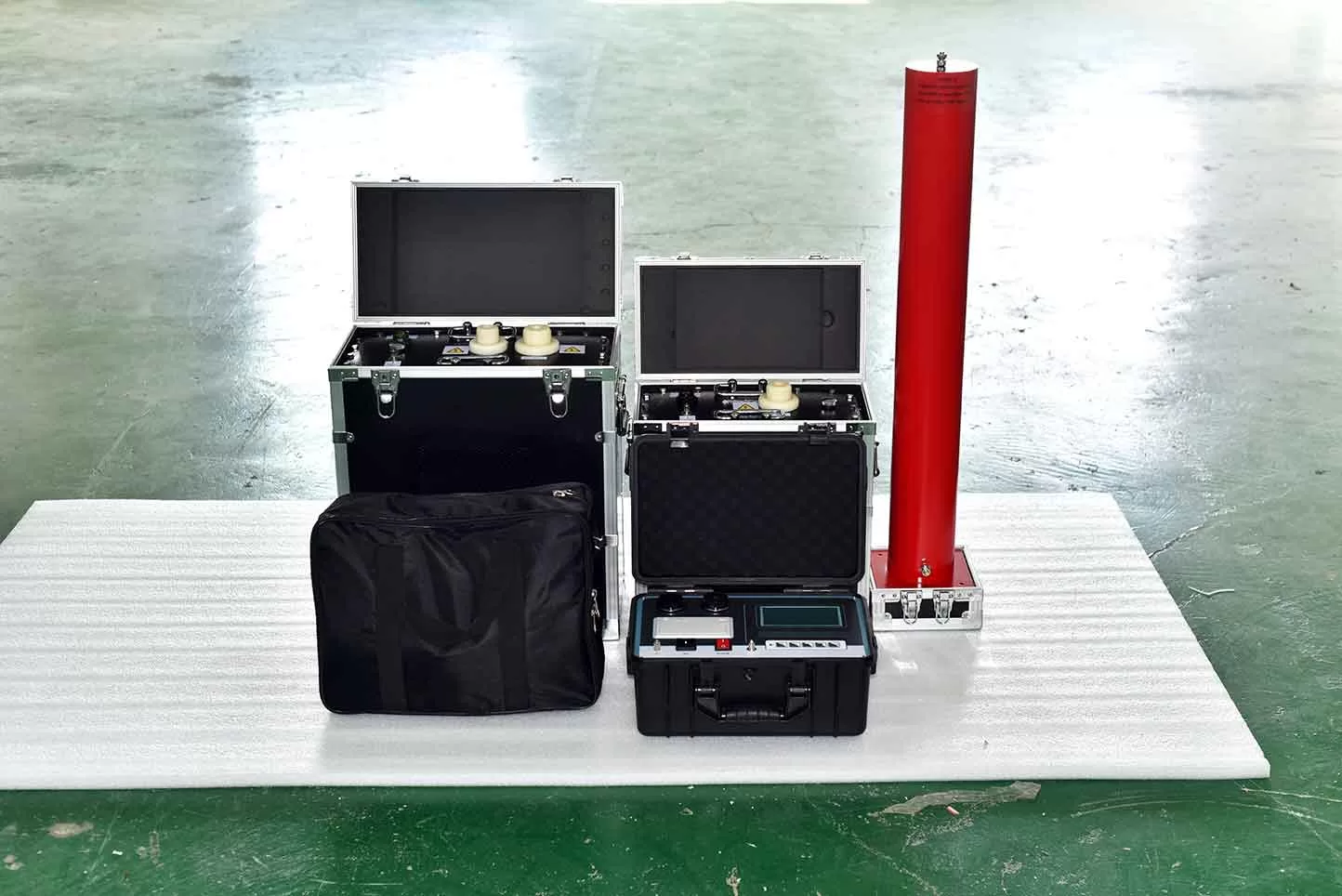
10. Summary
When selecting a VLF (Very Low Frequency) high-voltage generator—whether 30kV, 50kV, 60kV, 80kV, or 90kV—the key is not simply matching the voltage rating, but comprehensively evaluating the test voltage and load capacity.
For testing 10kV cables, options typically include 30kV, 50kV, and 60kV models. The 50kV model offers a broader application range, while the 60kV model provides a greater safety margin.
For testing 35kV cables, 80kV or 90kV models should generally be prioritized. The 80kV model is commonly used, whereas the 90kV model is suitable for applications requiring a higher safety margin or meeting complex on-site requirements.
When making the final selection, it is essential to consider the cable voltage rating, cable length, capacitance, test voltage, output frequency, equipment load capacity, and testing standard requirements. For VLF high-voltage generators, selecting the correct voltage is merely the first step; selecting the correct capacity is the critical factor for successfully completing on-site tests.
Related Products
Latest News
-
 2026-09-302026 Top 3 Chinese Insulation Resistance Transformer Testing Equipment Manufacturers
 -
 2026-09-30Industrial CT Tester: How Is It Used for Current Transformer Factory Testing?
 -
 2026-09-30How Can a CT PT Analyzer Improve CT and PT Quality Testing in the Laboratory?
 -
 2026-09-30How to Perform Current Transformer Testing Step by Step?
 -
 2026-09-30How to Perform CT Analyzer Testing and Evaluate the Test Results?