
Why is an ultra-low frequency high voltage generator commonly used for voltage withstand tests on 10kV cables?
Why is an ultra-low frequency high voltage generator commonly used for voltage withstand tests on 10kV cables?
In the voltage withstand verification after 10kV cable handover tests, preventive tests, and fault repairs, many sites utilize 0.1Hz ultra-low frequency high-voltage generators. Compared to traditional power frequency voltage withstand equipment, ultra-low frequency high-voltage generators are more suitable for large-capacitance test objects such as power cables, especially in on-site operating environments.
So, why is an ultra-low frequency high voltage generator commonly used for 10kV cable voltage withstand tests? The main reasons can be seen from three aspects: cable characteristics, test capacity, and on-site usage.
1. The cable itself is a large-capacitance device
The structure of a power cable determines its distinct capacitive characteristics. An equivalent capacitance is formed between the cable conductor, insulation layer, and metallic shielding layer. Generally, the longer the cable and the larger its cross-sectional area, the larger the capacitance tends to be.
During the AC withstand voltage test, the cable will generate capacitive current. This current is related to the test frequency, cable capacitance, and test voltage:
I = 2πfCU
Where I is the capacitive current, f is the frequency, C is the capacitance, and U is the test voltage.
From this relationship, it can be observed that, with the cable length and test voltage remaining constant, the higher the frequency, the greater the capacitive current; conversely, the lower the frequency, the smaller the capacitive current.
The output frequency of ordinary power frequency voltage withstand equipment is generally 50Hz, while the common output frequency of ultra-low frequency high voltage generators is 0.1Hz. Since 0.1Hz is only 1/500 of 50Hz, it can significantly reduce the capacitive current during testing.
This is also the core reason why ultra-low frequency high voltage generators are suitable for cable voltage withstand tests.
2. It can reduce the capacity of test equipment
If a traditional 50Hz power frequency voltage withstand test equipment is used to conduct an AC voltage withstand test on a 10kV cable, especially when the cable length is long, the required test capacity will be significant. The equipment may be bulky and heavy, and it also demands a higher on-site power capacity.
After using a 0.1Hz ultra-low frequency high-voltage generator, the capacitive current decreases due to the significant reduction in frequency, resulting in a notable decrease in the required capacity of the equipment.
As a result, on-site tests no longer require bulky high-capacity power frequency test equipment, and the test equipment can be made more portable, facilitating easier handling, wiring, and operation.
Portability and ease of operation are crucial for sites such as power distribution rooms, substations, industrial and mining enterprises, new energy power stations, and municipal engineering projects. Therefore, using an ultra-low frequency high voltage generator in 10kV cable voltage withstand tests is a more suitable solution for on-site conditions.
3. Ultra-low frequency is not direct current (DC), but low-frequency alternating current (AC)
Some customers tend to misunderstand ultra-low frequency high voltage generators as “DC high voltage generators”, which is inaccurate.
The ultra-low frequency high voltage generator outputs alternating current (AC) high voltage, but with a very low frequency. Taking 0.1Hz as an example, the voltage completes a full cycle every 10 seconds, with the positive and negative polarities slowly alternating.
That is to say, instead of applying DC voltage in one direction, it applies a low-frequency AC electric field to the cable insulation. For cable insulation voltage withstand tests, this approach not only reduces the test capacity but also retains the characteristics of AC voltage withstand tests.
Therefore, ultra-low frequency voltage withstand test and DC voltage withstand test are not the same testing method. In on-site cable testing, ultra-low frequency high-voltage generators are often used to replace bulky power frequency voltage withstand equipment, rather than simply replacing DC high-voltage generators.
4. In what scenarios would 10kV cables be used?
The use of ultra-low frequency high voltage generators for 10kV cables is commonly seen in the following scenarios:
Before the newly laid cable is put into operation, a handover voltage withstand test is required to verify the insulation condition of the cable body, terminal head, and intermediate joint.
After operating for a period of time, cables need to undergo preventive tests to identify potential hazards such as insulation aging, moisture, and joint defects.
After a cable fault is repaired, a voltage withstand test is also necessary to confirm that both the repaired section and the entire line are ready for re-commissioning.
In wind farms, photovoltaic power stations, substations, distribution rooms, factory power distribution systems, railway subways, and municipal power projects, 10kV cables are numerous and widely distributed, and on-site testing requirements are also quite common.
5. When selecting a model, one should not solely rely on the voltage level
When selecting an ultra-low frequency high voltage generator, many customers’ first reaction is to look at the output voltage. For example, when conducting a 10kV cable test, they focus on how many kilovolts the equipment can output at most.
But in reality, when selecting a model, one should not only consider the voltage, but also the load capacity of the equipment.
The capacitance varies with different cable lengths, cross-sectional areas, and structures. The longer the cable, the greater the capacitance, and the higher the requirements for the output capacity of the ultra-low frequency high voltage generator. If the equipment capacity is insufficient, issues such as failure to increase voltage, slow voltage increase, overcurrent protection, or inability to complete the test may occur on site.
Therefore, when selecting equipment, it is necessary to comprehensively consider cable voltage level, cable length, cable capacitance, test voltage requirements, output frequency, and on-site power supply conditions.
6. Summary
An ultra-low frequency high voltage generator is commonly used for voltage withstand tests on 10kV cables, primarily because cables are high-capacitance devices. If traditional power frequency voltage withstand testing is employed, the test capacity would be large, the equipment would be bulky, and on-site operations would be inconvenient.
The 0.1Hz ultra-low frequency high voltage generator significantly reduces capacitive current by lowering the test frequency, thereby reducing equipment capacity and making on-site cable AC voltage withstand tests more convenient, economical, and practical.
In brief, its advantages can be summarized into three points:
Firstly, it is suitable for testing large-capacitance objects such as cables.
Secondly, the test equipment has a smaller capacity, making it easier to handle and operate on-site.
Thirdly, the output is low-frequency AC high voltage, which is suitable for verifying cable insulation and voltage resistance.
Therefore, in the 10kV cable handover test, preventive test, and post-fault repair verification, the ultra-low frequency high-voltage generator is a commonly used and practical on-site testing equipment.
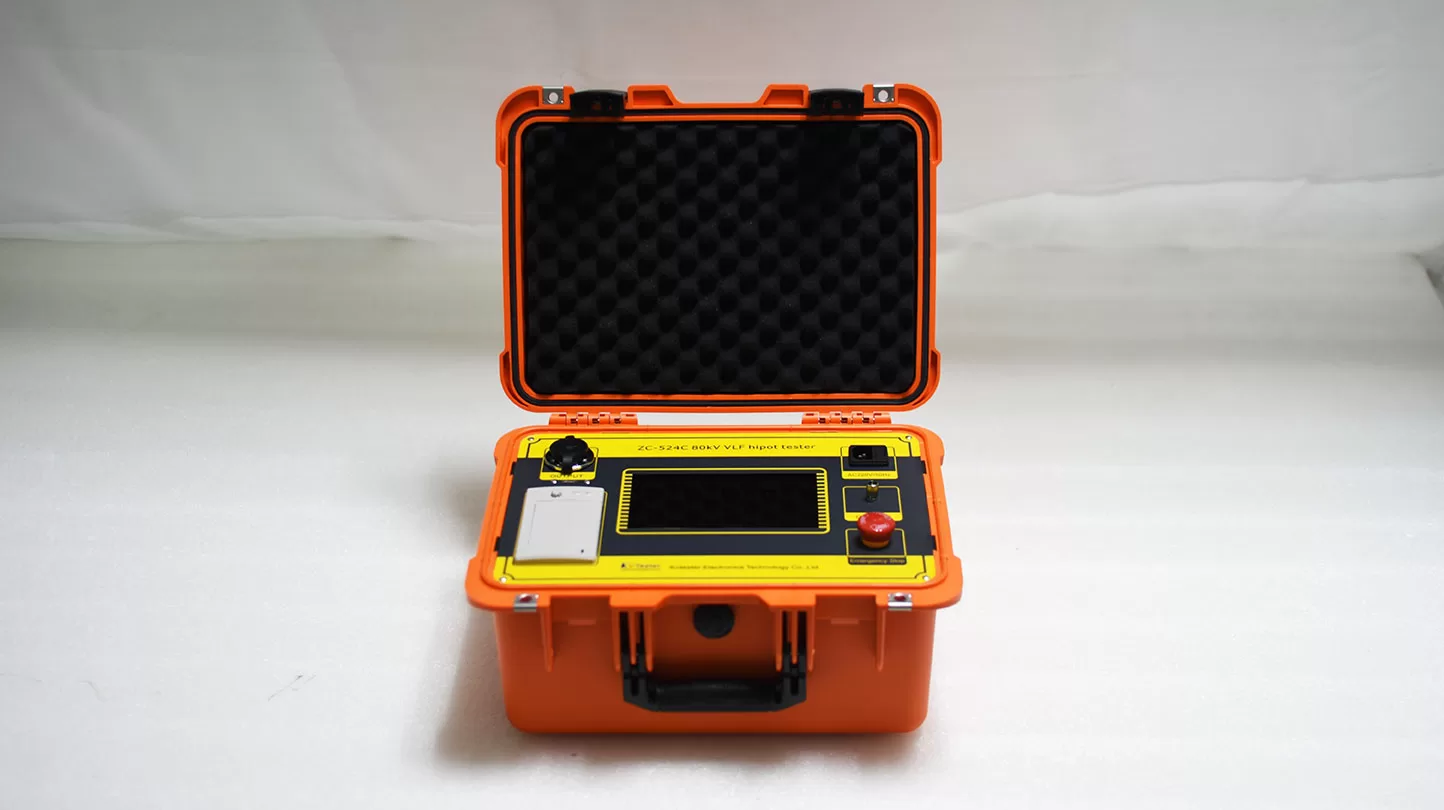
The withstand voltage test can be divided into ac withstand voltage test and dc withstand voltage test. The ac withstand voltage test can be divided into power frequency, frequency conversion and 0.1hz ultra-low frequency test technology, of which 0.1hz ultra-low frequency technology is the latest technology recommended by the current international electrotechnical commission.
Kvtester Electronics Technology Co.,Ltd. is a high-tech enterprise specializing in power testing, testing, research and development, production, and sales of testing equipment. It has been engaged in the electrical testing industry for many years, and its products are of high quality. We welcome customers to come and purchase. Service hotline: 0086-27-81778799, to learn more, visit the official website: www.kvtester.com
Related Products
Latest News
-
 2026-09-302026 Top 3 Chinese Insulation Resistance Transformer Testing Equipment Manufacturers
 -
 2026-09-30Industrial CT Tester: How Is It Used for Current Transformer Factory Testing?
 -
 2026-09-30How Can a CT PT Analyzer Improve CT and PT Quality Testing in the Laboratory?
 -
 2026-09-30How to Perform Current Transformer Testing Step by Step?
 -
 2026-09-30How to Perform CT Analyzer Testing and Evaluate the Test Results?