Home » News » Company News
What Can a Multi-Function CT Tester Measure in One Test?
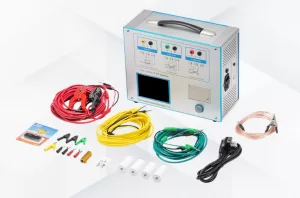
A multi-function CT tester brings several current transformer test functions into one testing platform, making the testing process more efficient and easier to manage. For power system commissioning, CT manufacturing, maintenance, and laboratory testing, the real value lies in how many required measurements can be completed with the same instrument and testing setup.
For teams handling different CT specifications, a multi-function CT and PT tester can combine ratio, polarity, resistance, excitation, burden, and error measurements instead of requiring a separate instrument for each test. The right configuration can also simplify wiring, automatic calculations, and test data management.
What Can a Multi-Function CT Tester Measure?
A multi-function CT tester is designed to cover several key CT performance measurements within one testing workflow. The exact functions depend on the model, but a comprehensive CT test can include:
- CT turns ratio
- Polarity
- Secondary winding resistance
- Excitation characteristics
- Knee-point voltage and current
- Secondary burden
- Ratio error
- Phase angle error
- Accuracy Limit Factor (ALF)
- Instrument Security Factor (FS)
- Secondary time constant
- Remanence factor
These measurements do not all serve the same purpose. Ratio and polarity confirm the basic transformation relationship, while resistance checks the secondary winding. Excitation and knee-point testing provide more information about the magnetic characteristics of protection CTs, while burden and error measurements help assess CT performance under its intended secondary load.
CT Ratio and Polarity Testing
Ratio testing verifies whether the CT transformation ratio meets its specified value. Polarity testing checks the relationship between the primary and secondary terminals.
Kvtester CTA-1000E CT/PT tester supports CT ratio measurement from 1 to 40,000 with an accuracy of ±0.05%. It also supports polarity testing as part of its integrated CT testing functions.
Because ratio and polarity can be performed as part of the same testing workflow, operators can move from basic verification to more detailed CT analysis without changing to another testing platform.
Secondary Winding Resistance
Secondary winding resistance is another important measurement when checking CT condition and secondary circuit connections.
CTA-1000E provides a DC resistance measurement range of 0–300 Ω with an accuracy of 0.1% ±2 mΩ. CTA-100A provides the same 0–300 Ω range with an accuracy of 0.5% ±2 mΩ.
This makes resistance testing part of the same workflow rather than a separate measurement step with another instrument.
How Does a Multi-Function CT Tester Handle Excitation Testing?
Excitation testing becomes particularly important when the CT is used for protection. The excitation curve shows how the secondary current changes as the applied voltage increases, helping determine the CT’s magnetic characteristics and saturation behavior.
A suitable multi-function CT tester needs enough output capability to reach the required excitation point while maintaining stable measurement.
Excitation Characteristics and Knee Point
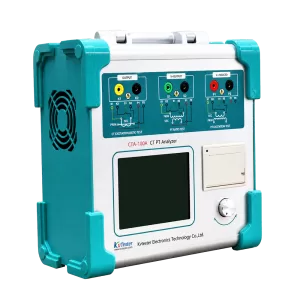
Kvtester CTA-100A CT/PT Tester uses a variable-frequency method to test CT/PT volt-ampere characteristics and 10% error curves. It provides up to 180 Vrms AC voltage and 12 Arms AC current, with a 36 A peak current. The tester can handle CTs with an inflection point of up to 60 kV.
The tester can also automatically determine several protection-related parameters, including knee-point voltage and current, 5% and 10% error curves, ALF, FS, secondary time constant, remanence factor, and saturated and unsaturated inductance.
This is especially useful when a testing team needs more than a simple ratio result and wants a clearer picture of the CT’s excitation and saturation characteristics.
Can One CT Tester Measure Burden and CT Errors?
Yes. A multi-function CT tester can integrate secondary burden and error measurements into the same CT testing process, provided the selected model supports these functions.
Burden testing checks the load connected to the CT secondary circuit. Ratio error and phase angle error, meanwhile, provide information about CT measurement performance.
CTA-1000E measures burden from 0 to 1000 VA with an accuracy of 0.2% ±0.02 VA. Its phase measurement range is ±2 minutes, with an accuracy of 0.5 minute. The CT ratio measurement accuracy reaches ±0.05%.
CTA-100A covers an AC load range of 0–3000 VA and provides CT ratio measurement from 1 to 40,000 with ±0.2% accuracy.
The appropriate range and accuracy should be matched to the CT class and the test requirements rather than selected simply by maximum specification.
Why Does Single-Connection Testing Improve CT Testing?
For field testing, the testing method matters as much as the number of functions.
Repeatedly changing test wiring between resistance, excitation, ratio, and polarity measurements can slow down a test sequence. It also creates more opportunities for connection mistakes. A tester that supports multiple measurements from a common wiring setup can make the process more straightforward.
Kvtester CTA-100A supports single-connection testing for CT DC resistance, excitation characteristics, turns ratio and polarity, as well as phase and ratio errors. Its control system also provides dynamic wiring diagrams according to the selected test item.
For field teams testing multiple CTs during commissioning or maintenance, reducing repeated wiring can make the overall workflow more consistent.
What Output Performance Should a Multi-Function CT Tester Provide?
A multi-function CT tester should not be selected by the number of functions alone. Output capability determines whether the instrument can actually reach the required test conditions.
For excitation testing in particular, the required voltage and current depend on the CT characteristics being tested. Measurement accuracy and test range are equally important because they determine whether the resulting data is suitable for the intended evaluation.
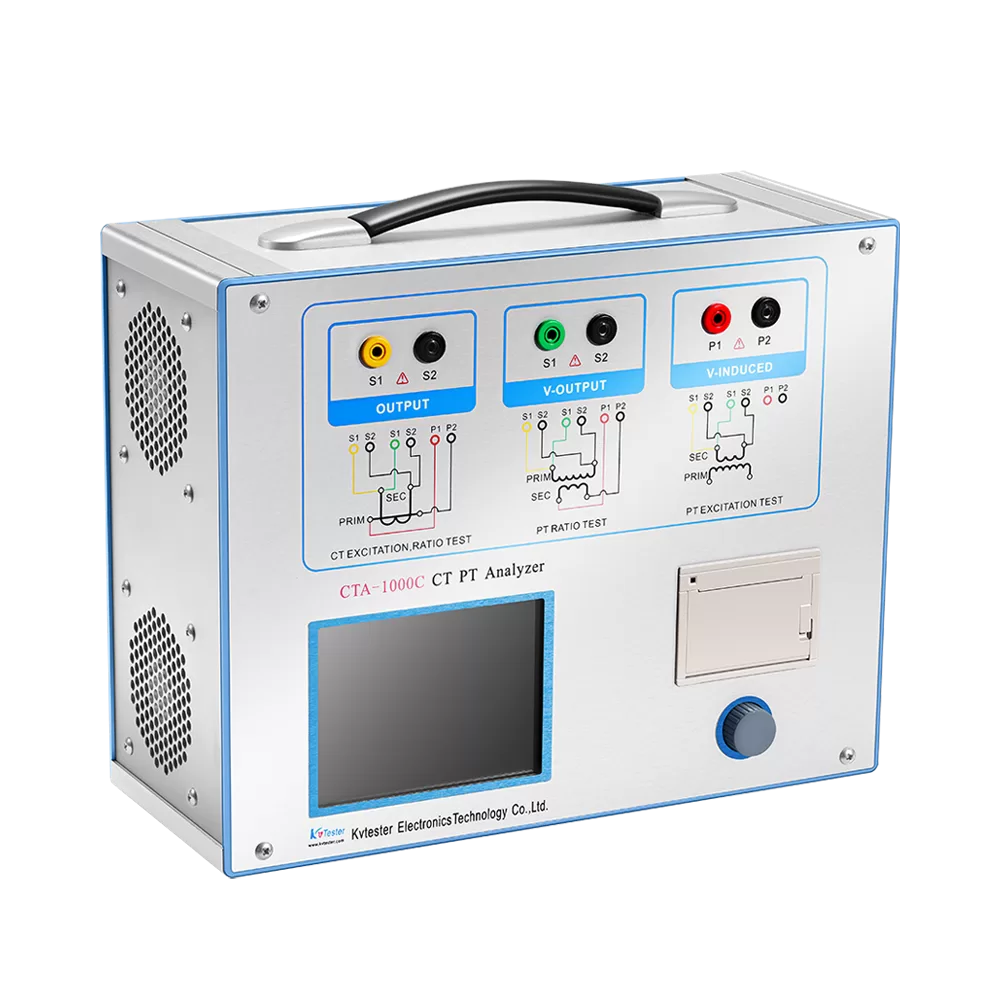
CTA-1000E provides:
| Parameter | CTA-1000E |
| AC voltage output | 0–180 Vrms |
| AC current output | 12 Arms |
| Peak current | 36 A |
| CT ratio range | 1–40,000 |
| CT ratio accuracy | ±0.05% |
| DC resistance range | 0–300 Ω |
| Burden range | 0–1000 VA |
| Phase measurement range | ±2 min |
| Weight | <10 kg |
These specifications give CTA-1000E the output and measurement capability needed for a broad range of CT analysis tasks.
How Should You Choose a Multi-Function CT Tester?
The right choice depends on the CTs you test, the parameters you need to measure, and where the testing takes place.
Match the Test Functions to Your CT Requirements
Before selecting a tester, define the required test sequence:
- CT ratio and polarity
- Secondary winding resistance
- Excitation characteristics
- Knee-point analysis
- Secondary burden
- Ratio and phase angle error
- Protection CT parameters
Not every project requires every function. A tester should provide the functions that match your actual CT classes and acceptance requirements.
Check Output, Accuracy, and Test Range
Once the required functions are clear, compare the technical specifications that affect the actual test.
Pay particular attention to:
- CT ratio range
- Voltage and current output
- Excitation test capability
- Resistance measurement range
- Burden measurement range
- Ratio and phase error accuracy
- Data storage and export
- Test wiring requirements
This approach helps prevent a common purchasing problem: choosing a tester with many functions but insufficient output or measurement range for the CTs being tested.
Which Kvtester CT Tester Fits Different Testing Needs?
Kvtester offers CT/PT testing equipment covering portable field testing and more comprehensive CT analysis.
CTA-100A for Portable Field Testing
For applications where portability is a priority, CTA-100A CT PT Analyzer weighs less than 5 kg and measures 300 × 285 × 140 mm. It provides 0–120 Vrms voltage output and 5 Arms current output.
It supports CT excitation, turns ratio, polarity, secondary winding resistance, secondary burden, ratio error, and phase angle error testing. CT ratio measurement covers 1–40,000 with ±0.2% accuracy.
This combination is well suited to on-site CT/PT verification where equipment size and mobility are important.
CTA-1000E for More Extensive CT Analysis
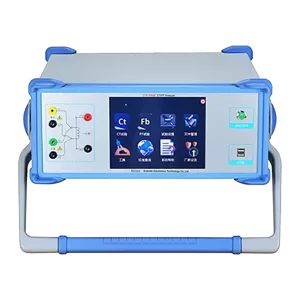
When the testing scope requires higher output and a broader set of analysis functions, CTA-1000E CT/PT Analyzer provides a larger testing capability.
It supports CT ratio testing from 1 to 40,000 with ±0.05% accuracy, 0–300 Ω DC resistance measurement, and 0–1000 VA burden measurement. Its excitation testing capability reaches CT inflection points up to 60 kV, while the built-in storage can retain 10,000 groups of test data.
The 8.4-inch TFT LCD touch screen, dynamic wiring diagrams, USB data export, and background analysis software also support a more complete testing and reporting workflow.
What Should a Complete CT Testing Workflow Cover?
A multi-function CT tester becomes most useful when its functions match the actual sequence used by the testing team.
| Test Function | What It Helps Check |
| Ratio test | CT transformation ratio |
| Polarity test | Terminal polarity |
| Winding resistance | Secondary winding condition |
| Excitation test | Magnetic characteristics |
| Knee-point test | Protection CT excitation behavior |
| Burden test | Secondary circuit load |
| Ratio error | Measurement accuracy |
| Phase angle error | Phase performance |
| ALF / FS | Protection and measurement characteristics |
| Remanence analysis | Residual magnetism characteristics |
The combination of these measurements gives a more complete view of CT performance than a single ratio or resistance measurement. More importantly, integrating them into one testing platform can reduce equipment changes and simplify the test process.
Select a Multi-Function CT Tester Based on Your Actual Tests
A multi-function CT tester should ultimately be selected around the CTs, test items, and working conditions rather than the number of functions shown in a specification table.
At Kvtester, we can help match the CT/PT analyzer to your required ratio range, excitation characteristics, accuracy, output, and field testing needs. For a specific CT application, you can contact Kvtester for CT testing equipment selection and provide the CT ratio, class, required test items, and testing environment.
Related Products
Latest News
-
 2026-10-12Top 5 Electrical Testing Equipment Manufacturers in China 2026
 -
 2026-09-302026 Top 3 Chinese Insulation Resistance Transformer Testing Equipment Manufacturers
 -
 2026-09-30Industrial CT Tester: How Is It Used for Current Transformer Factory Testing?
 -
 2026-09-30How Can a CT PT Analyzer Improve CT and PT Quality Testing in the Laboratory?
 -
 2026-09-30How to Perform Current Transformer Testing Step by Step?