
Home » News » Company News
Transformer Testing Equipment List: Full Factory & Field Guide [2026]
Power transformers serve as the backbone of power generation, transmission, and distribution infrastructure. Their reliable performance is critical to the overall safety, stability, and efficiency of electrical grids worldwide. Consistent, standardized transformer testing is indispensable for factory quality validation, on-site commissioning, routine operational maintenance, and proactive fault diagnosis. A well-configured set of transformer testing equipment enables technicians to accurately identify insulation degradation, electrical parameter deviations, mechanical defects, and energy loss anomalies, preventing unexpected equipment downtime and costly grid failures.
Whether you’re assembling a complete transformer testing equipment list for a new testing lab, upgrading on-site field test tools, or refining your standard testing workflows, this curated guide has you covered. We organize essential testing devices by core test categories, break down their key functions, industry use cases, and applicable scenarios, and deliver practical, field-proven references for power engineering teams, third-party testing agencies, and transformer manufacturers of all sizes. If you need a customizable, project-specific transformer testing equipment checklist tailored to your voltage class and test requirements, our team can provide targeted equipment configuration recommendations for your factory or field testing projects.
1. Insulation Characteristic Testing Equipment
Insulation integrity is the most critical performance metric for transformer operational safety. Insulation dampness, aging, and breakdown are the leading causes of transformer short circuits, flashovers, and catastrophic failures. Insulation testing devices are designed to assess the health of both main and longitudinal transformer insulation, forming a mandatory testing procedure for factory acceptance and annual preventive maintenance across global power industry standards.
1.1 Insulation Resistance Tester (Megohmmeter)
An insulation resistance tester, commonly known as a megohmmeter, is the most fundamental device for transformer insulation testing. It generates stable high DC voltage to measure insulation resistance between transformer windings and between windings and ground. Standard voltage ratings include 500V, 1000V, 2500V, and 5000V, with low-voltage models for distribution transformers and high-voltage variants for substation and power grid transformers. Technicians can accurately assess insulation dampness, aging, and surface contamination issues by analyzing real-time resistance readings.
1.2 Dielectric Loss Tester (Tan Delta Tester)
The dielectric loss factor (tan delta) is a highly sensitive indicator for detecting early-stage insulation faults that basic resistance tests cannot capture. Professional dielectric loss testers precisely measure the dielectric loss value and capacitance of transformer windings, bushings, and insulating oil. This equipment effectively identifies latent issues including partial insulation dampness, internal contamination, and premature aging, making it a staple tool for preventive testing on medium and high-voltage power transformers.
1.3 AC/DC Hipot Tester
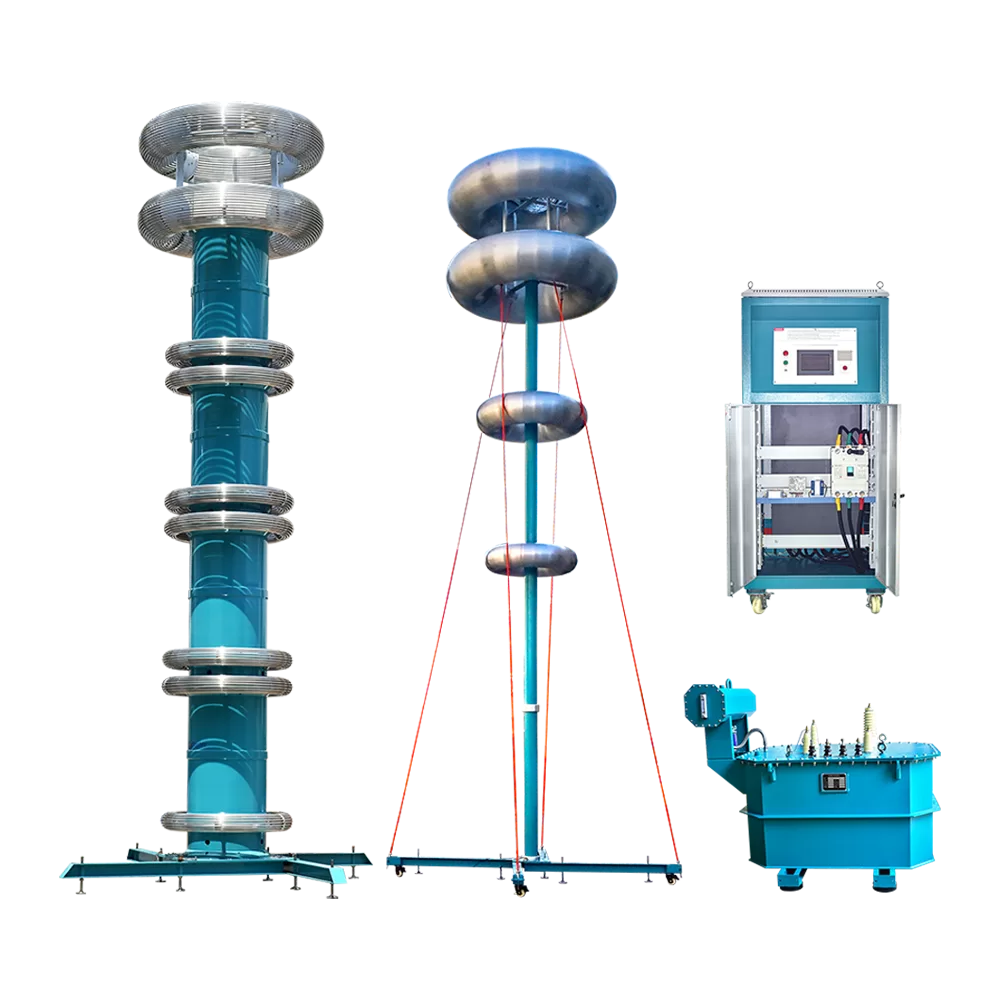
AC/DC hipot testers, or high voltage withstand testers, simulate extreme overvoltage operating conditions to verify the maximum voltage tolerance of a transformer’s insulation system. AC withstand testing targets main insulation defects between windings and ground, while DC withstand testing focuses on longitudinal insulation performance of individual windings. Built-in overcurrent and overvoltage protection features ensure safe, accurate testing for factory calibration, product certification, and on-site project acceptance.
2. Winding Electrical Parameter Testing Equipment
Transformer winding electrical parameters directly govern power transmission efficiency and voltage regulation accuracy. Irregularities in winding DC resistance, turn ratio, or phase polarity can result in voltage drift, excessive operational losses, and even permanent winding burnout. This category of test equipment calibrates core electrical parameters to ensure transformers comply with design specifications and grid interconnection standards.
2.1 Transformer Winding DC Resistance Tester
Specialized transformer winding DC resistance testers measure the DC resistance of three-phase transformer windings with test currents ranging from 1A to 100A, compatible with small distribution transformers and large-capacity power transformers alike. Featuring fast charging cycles and high-precision data acquisition, these devices efficiently detect common winding faults such as inter-turn short circuits, loose terminal connections, and poor wire joints. They are a standard requirement for transformer on-site commissioning and post-overhaul testing.
2.2 Transformer Turns Ratio & Polarity Tester
Integrated turns ratio and polarity testers accurately measure the phase-to-phase transformation ratio of transformers and verify winding polarity and vector group configuration. The device automatically calculates ratio error margins and identifies incorrect winding wiring, eliminating grid connection risks caused by ratio mismatches or reversed polarity. It supports fully automated testing for single-phase, three-phase, and autotransformer models for universal field and factory use.
2.3 Sweep Frequency Response Analyzer (SFRA Tester)
Sweep Frequency Response Analyzers (SFRA) are professional diagnostic tools for transformer winding mechanical integrity testing. By comparing the frequency response signatures of transformer windings against baseline data, technicians can accurately detect winding deformation, core displacement, structural distortion, and hidden inter-turn short circuits. SFRA testing is irreplaceable for post-fault diagnosis, transportation vibration inspection, and post-overhaul condition assessment of power transformers.
3. Loss & Operational Characteristic Testing Equipment
No-load loss, load loss, and impedance voltage are key performance indicators that define a transformer’s energy efficiency and operational stability. Dedicated loss and characteristic testing equipment is primarily used for factory type approval and energy efficiency certification, delivering precise, repeatable test data to support transformer energy consumption evaluation and real-time operational condition analysis.
3.1 Transformer No-Load & Load Loss Tester
Transformer no-load and load loss testers integrate high-precision voltage, current, and power acquisition modules to measure critical parameters including no-load current, no-load loss, rated load loss, and impedance voltage under standard operating conditions. Built-in automatic temperature and voltage error correction ensures all test results comply with IEC and international power industry standards, making these devices essential for factory performance verification and product certification.
3.2 Three-Phase Power Quality Analyzer
Three-phase power quality analyzers are designed for real-time on-site transformer operational monitoring. They continuously track key operating parameters such as three-phase voltage balance, load current, power factor, harmonic distortion, and real-time load rate. Field technicians use this data to identify operational anomalies including phase unbalance, overloading, and harmonic interference, enabling targeted maintenance and optimal operational tuning for in-service transformers.
4. Partial Discharge & Fault Detection Equipment
Partial discharge (PD) is the primary trigger of progressive insulation degradation and eventual transformer breakdown. Undetected partial discharge activity gradually erodes internal insulation materials, leading to permanent equipment damage and premature failure. High-precision PD testing equipment enables early fault warning and hidden defect troubleshooting for medium and high-voltage transformers, minimizing unplanned outages.
4.1 Transformer Partial Discharge Tester
Modern transformer partial discharge testers adopt integrated UHF and ultrasonic detection technology to achieve non-intrusive PD testing. They accurately capture and locate internal discharge defects such as insulation gaps, metal burr arcing, and oil bubble discharge. Supporting live-line testing without power shutdown, these tools are ideal for routine patrol inspections and hidden danger screening of operating substation and grid transformers.
4.2 Transformer Oil Quality Tester
For oil-immersed transformers, insulating oil quality directly determines insulation performance and heat dissipation efficiency. A complete oil testing suite includes oil dielectric strength testers, oil moisture analyzers, and dissolved gas chromatographs. These devices test oil breakdown voltage, water content, and dissolved gas composition, accurately assessing oil aging levels and revealing latent internal transformer faults to guide oil filtration, purification, or replacement maintenance.
5. Multifunctional Integrated Transformer Test System
To meet the demands of fast on-site commissioning and high-volume factory batch testing, multifunctional integrated transformer test systems have become the preferred solution in the power industry. Combining multiple standalone test functions into one compact device eliminates repeated equipment setup and improves overall testing efficiency significantly.
All-in-one transformer test systems integrate winding DC resistance testing, turns ratio verification, insulation resistance measurement, and loss parameter testing capabilities. They support one-click automated testing and intelligent test report generation, perfectly suited for rapid on-site commissioning of substation transformers and batch quality inspection for transformer manufacturers. This integrated design resolves the inefficiency of switching between multiple single-function devices for full-scope testing.
6. Classification Summary of Transformer Testing Equipment List
To simplify equipment procurement, laboratory setup, and test workflow arrangement, we categorize the full transformer testing equipment list into three core groups based on practical industry application scenarios:
Basic Routine Test Equipment: Insulation resistance tester, winding DC resistance tester, turns ratio & polarity tester, AC/DC hipot tester (mandatory for routine on-site commissioning and annual preventive maintenance)
Performance Calibration Test Equipment: Dielectric loss tester, no-load & load loss tester, three-phase power quality analyzer (used for factory type testing, energy efficiency certification, and performance calibration)
Precision Fault Detection Equipment: SFRA analyzer, partial discharge tester, transformer oil quality testing suite (used for advanced fault diagnosis, post-fault assessment, and in-depth hidden danger troubleshooting)
Conclusion
A comprehensive transformer testing equipment list covers full-lifecycle testing requirements for transformers, spanning factory production quality control, on-site commissioning, daily operational monitoring, and periodic overhaul maintenance. Selecting matched professional testing equipment based on industry standards and project scenarios is fundamental to guaranteeing transformer safety, stability, and long service life. For power testing teams and transformer manufacturers, standardized equipment configuration and systematic testing workflows effectively reduce failure rates, extend equipment lifespan, and sustain reliable operation of global power grid systems.
Related Products
Latest News
-
 2026-09-302026 Top 3 Chinese Insulation Resistance Transformer Testing Equipment Manufacturers
 -
 2026-09-30Industrial CT Tester: How Is It Used for Current Transformer Factory Testing?
 -
 2026-09-30How Can a CT PT Analyzer Improve CT and PT Quality Testing in the Laboratory?
 -
 2026-09-30How to Perform Current Transformer Testing Step by Step?
 -
 2026-09-30How to Perform CT Analyzer Testing and Evaluate the Test Results?