
How do you interpret the key parameters of a relay protection tester? A detailed look at current, voltage, phase, and frequency accuracy.
A relay protection tester is a specialized instrument commonly used for relay protection testing. When purchasing one, users often encounter specifications such as current/voltage output, phase accuracy, frequency range, timing accuracy, binary inputs, and binary outputs. However, they may not fully understand what these parameters signify or which ones are most critical.
When selecting a tester, one should not focus solely on price or whether it is a “three-phase” or “six-phase” model. The factors that truly determine performance in the field are the device’s output capability, testing accuracy, channel configuration, software functionality, and stability. Understanding these key parameters is essential for choosing a tester that meets your specific operational needs.
① Current output capability is a crucial parameter.
Relay protection testers must output current signals to simulate conditions for tests such as overcurrent, instantaneous trip, zero-sequence, and differential protection. Users should pay close attention to the maximum output current, the output range per phase, parallel output capability, and long-duration output capability. While standard overcurrent protection tests generally have modest current output requirements, high-current tests, differential protection tests, or specialized protection calibrations require attention to output power and the stability of continuous output.
② Voltage output capability is equally important.
These testers typically need to output three-phase AC voltage for tests such as undervoltage, overvoltage, distance protection, synchronism check, and directional protection. When selecting a model, consider the voltage output range, accuracy, stability, and the ability to control the phase relationship between the three phases. For tests like distance protection and synchronism checks, the accuracy of voltage and phase directly impacts the test results.
③ Phase accuracy is a key indicator of a tester’s performance.
Many protection functions rely not only on the magnitude of current and voltage but also on the phase relationship between them. Functions such as directional, power, distance, and differential protection are closely linked to phase. Significant phase errors in the tester can lead to inaccurate results or even incorrect assessments of protection operation.
④ Frequency output and accuracy are primarily relevant for tests involving under-frequency protection, over-frequency protection, under-frequency load shedding, and frequency slip. Relay protection testers must be capable of outputting voltage and current signals at varying frequencies as required by the test, ensuring that the frequency variation process remains stable and controllable. Frequency-related capabilities are particularly critical for power plants, renewable energy stations, and applications involving low-frequency/low-voltage protection schemes.
⑤ Timing accuracy is primarily used to measure the operating time of protection systems. Relay protection devices must not only operate correctly but also do so within specified time limits. The tester receives protection trip signals via binary inputs and records the elapsed time from the application of the fault quantity to the device’s operation. Higher timing accuracy facilitates the verification of functions such as instantaneous trip, overcurrent protection, distance protection, differential protection, auto-reclosing, and automatic bus transfer (ABT).
⑥ Binary inputs and outputs are parameters often overlooked during the selection of relay protection testers. Binary inputs are mainly used to receive feedback signals—such as contact operations, trip/close commands, and alarms—from the protection device. Binary outputs are used to simulate status signals, such as circuit breaker positions, blocking signals, and external start commands. While a limited number of inputs and outputs suffice for simple protection tests, complex functions like automatic bus transfer, auto-reclosing, synchronization, and complex logic protection require a greater number of channels.
⑦ Output power is a key indicator of a tester’s load-bearing capacity. In scenarios involving high secondary circuit impedance or requirements for high current output, insufficient output power can lead to issues such as an inability to ramp up current, unstable output, or waveform distortion. Therefore, when purchasing, one should consider not only the maximum output current but also the output power and rated output conditions.
⑧ Software functionality directly impacts the efficiency of field testing. High-quality tester software typically supports features such as manual testing, automatic testing, state sequencing, harmonic injection, differential protection, distance protection, synchronization testing, low-frequency/low-voltage testing, and report generation. For power engineering companies and relay protection teams, factors such as software usability, the availability of comprehensive test templates, and the standardization of reports often have a greater impact on the user experience than individual hardware specifications.
⑨ Portability and suitability for field environments are also important considerations. Relay protection testers are frequently used in substations, power plants, power distribution rooms, and outdoor project sites; factors such as equipment weight, size, heat dissipation, interference immunity, terminal design, and test lead quality all impact operational efficiency in the field. Portability is particularly crucial for users who frequently travel to perform commissioning tasks.
In summary, when evaluating the specifications of a relay protection tester, key attention should be paid to current and voltage output, phase and frequency accuracy, timing precision, the number of binary inputs and outputs, output power, and software capabilities. Since testing requirements vary among users, equipment selection should be based on specific protection applications rather than simply comparing prices or channel counts. Ultimately, the right choice depends on a combination of suitable specifications, matching functionality, ease of operation, and reliable after-sales support.
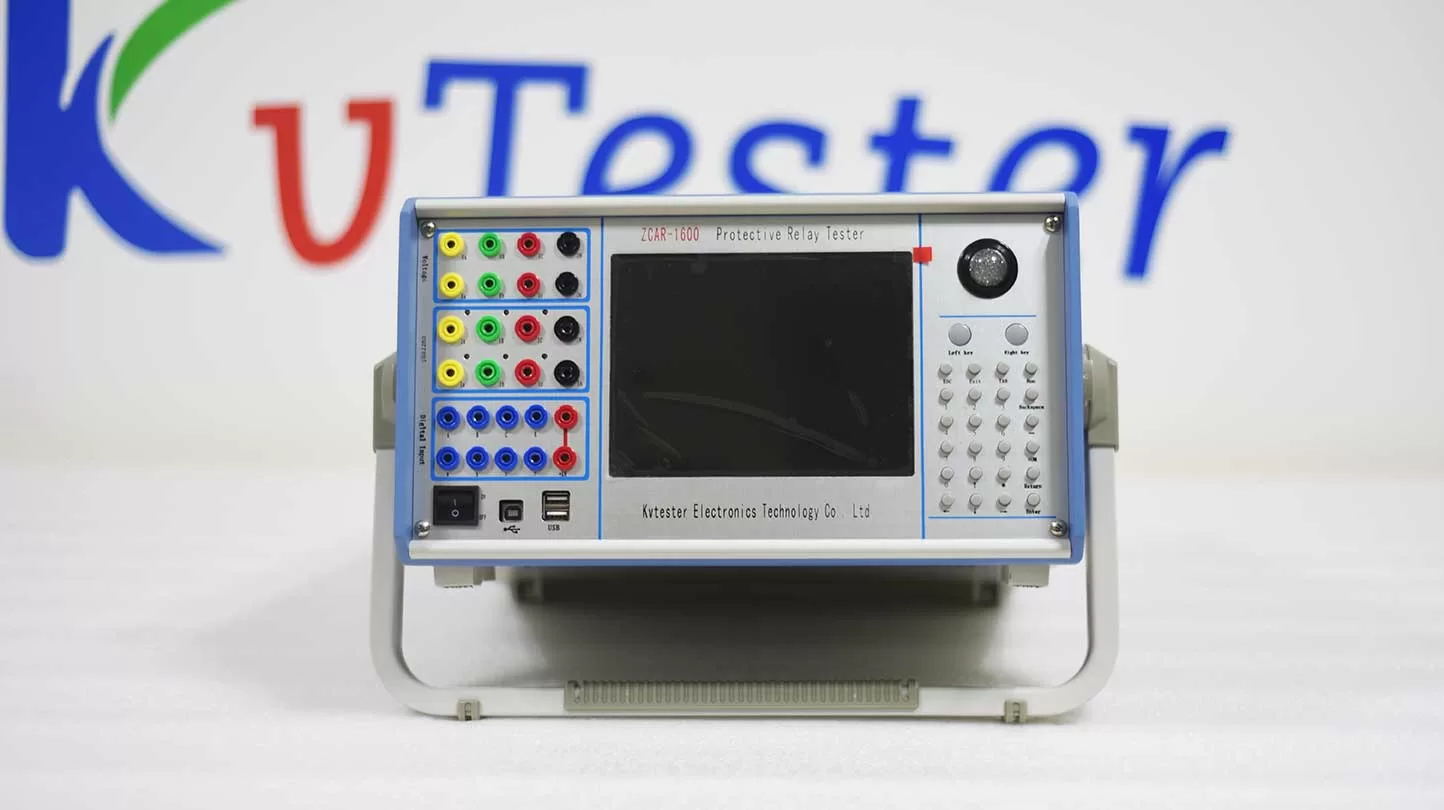
ZCAR-1600 microcomputer relay protection tester is developed based on the standards of Technical conditions of microcomputer relay protection test device which was published by electric power department originally, referenced and summarized development and production experience, adopted modern latest new digital technology, high precision electronic parts, micro system with new circuits and new structure.It Can independently complete test of microcomputer protection, relay protection, excitation, measurement, fault recording and other professional fields tests, widely used in electric power, petrochemical, metallurgy, railway, aviation, military and other industries of scientific research, production and electrical test site.
Kvtester Electronics Technology Co.,Ltd. is a high-tech enterprise specializing in power testing, testing, research and development, production, and sales of testing equipment. It has been engaged in the electrical testing industry for many years, and its products are of high quality. We welcome customers to come and purchase. Service hotline: 0086-27-81778799, to learn more, visit the official website: www.kvtester.com
Related Products
Latest News
-
 2026-09-20CT PT Analyzer for Commissioning: Substation Testing Guide
 -
 2026-09-20ANSI Standard CT Tester: Specs, Tests & Buying Guide
 -
 2026-09-18Why does the required capacity of series resonant test equipment usually increase with cable length?
 -
 2026-09-18How should 35kV cable series resonant withstand voltage test equipment be configured?
 -
 2026-09-18How to Select AC Withstand Voltage Test Equipment for 10kV Cables?