
How to Choose a Relay Protection Tester? Differences Between Three-Phase, Six-Phase, and Digital-Analog Integrated Models
Relay protection testers are essential power testing devices used for commissioning, periodic inspection, acceptance testing, and troubleshooting of relay protection systems. A common question for users during procurement is: how should one choose a relay protection tester? Should one opt for a three-phase model, a six-phase model, or a digital-analog integrated model?
Different types of relay protection testers are suited to different scenarios; one should not base the decision solely on price or the number of output channels. Selection should be determined by comprehensively evaluating factors such as test requirements, field applications, voltage and current output capabilities, software and reporting functions, and future operational needs.
1.Three-phase relay protection testers are common devices, typically featuring three-phase voltage and current outputs, making them suitable for most standard protection tests. Tasks such as overcurrent protection, instantaneous trip protection, zero-sequence protection, earth-fault protection, undervoltage protection, under-frequency protection, directional protection, and auto-reclosing can all be performed using a three-phase tester.
For scenarios such as routine substation maintenance, protection calibration in high-voltage distribution rooms of industrial enterprises, and on-site commissioning for power projects, a three-phase tester usually suffices if the primary testing involves standard protection schemes. Its advantages include ease of operation, portability, and moderate cost, making it ideal for routine relay protection testing and basic protection calibration.
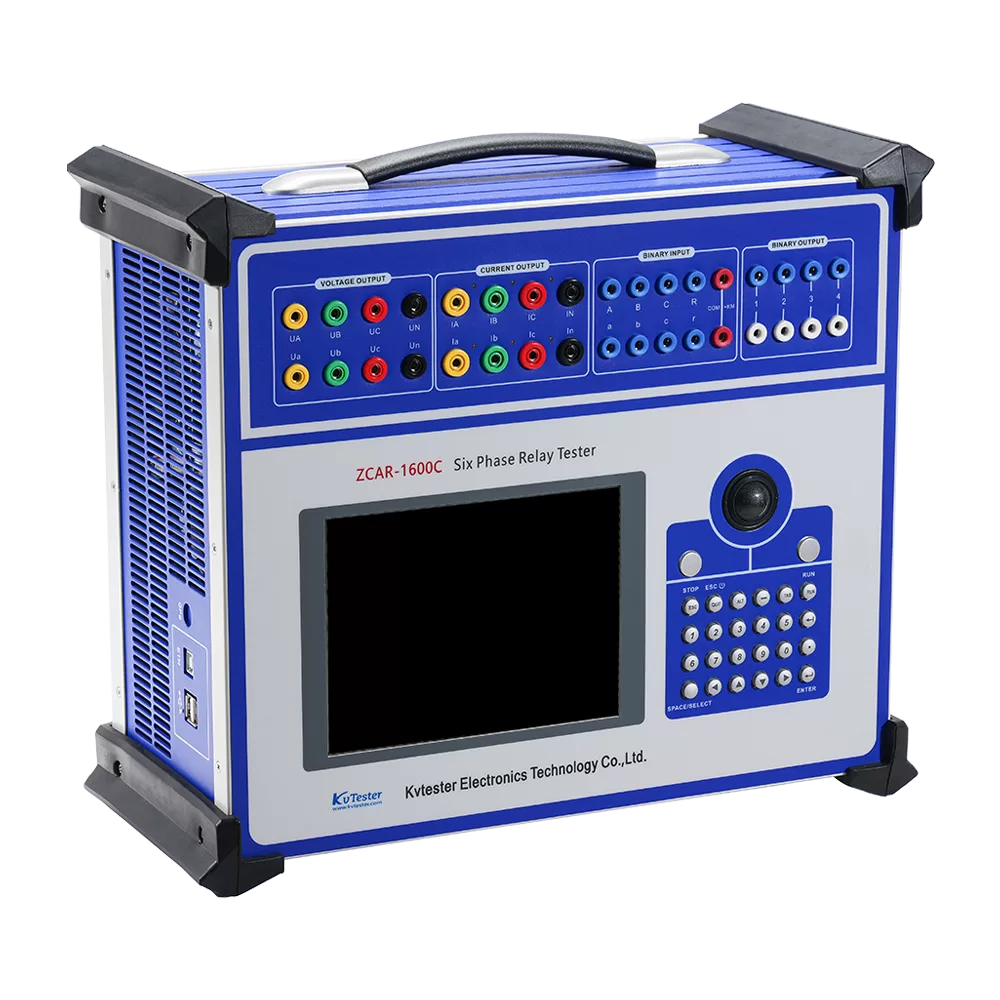
2.Compared to three-phase units, six-phase relay protection testers offer more output channels and enhanced testing capabilities, making them suitable for complex protection schemes and multi-circuit testing scenarios. Applications such as transformer differential protection, line differential protection, busbar protection, automatic bus transfer (ABT), synchro-check, fast bus transfer for station service power, and multi-terminal protection coordination often require a higher number of voltage and current channels.
Users who frequently work on commissioning large substations, power plants, renewable energy step-up stations, or complex protection devices—or those seeking to improve on-site testing efficiency—might consider a six-phase tester. While six-phase units offer a wider application range and greater convenience for complex tests, they are generally more expensive than three-phase units and require a higher level of technical expertise from the operator.
3.Digital-analog integrated relay protection testers are primarily used for compatibility testing across both traditional and digital substations. Standard relay protection testers primarily output analog voltage and current signals. In contrast, hybrid (analog-digital) relay protection testers support not only conventional analog testing but also tests relevant to digital substations—such as SV and GOOSE message testing, optical port communication, digital sampling, and joint commissioning of intelligent terminals.
If a user’s project involves smart substations, digital substations, or IEC 61850-compliant protection devices—or if there are future plans for digital upgrades—a hybrid relay protection tester is a more suitable long-term choice. While offering more comprehensive functionality, the selection process requires careful evaluation of protocol support, the number of optical ports, time synchronization methods, message configuration capabilities, software compatibility, and the manufacturer’s technical support capabilities.
When purchasing a relay protection tester, one must look beyond the basic distinctions between three-phase, six-phase, and hybrid models and focus on several core parameters. First, the voltage and current output ranges must meet the requirements of on-site protection testing. Second, the output power must be sufficient, particularly regarding stability during high-current output. Third, the measurement accuracy for phase, frequency, and timing must be reliable. Fourth, the number of binary inputs and outputs must be adequate for the application. Fifth, the testing software should support functions such as automatic testing, state sequencing, differential protection, distance protection, synchronization, and report generation.
For general users, a three-phase relay protection tester is suitable if the primary task is conventional protection verification. A six-phase tester is appropriate for more complex testing scenarios involving differential protection, automatic bus transfer (ABT), synchronization, or multi-terminal protection. A hybrid relay protection tester is recommended for projects involving digital or smart substation testing.
In summary, the selection of a relay protection tester should be driven by actual testing requirements. Three-phase units are suited for routine tests, six-phase units for complex protection schemes, and hybrid units for digital and smart substation environments. Selecting the right tester not only improves on-site commissioning efficiency but also avoids the need for redundant purchases or issues arising from insufficient functionality later on.
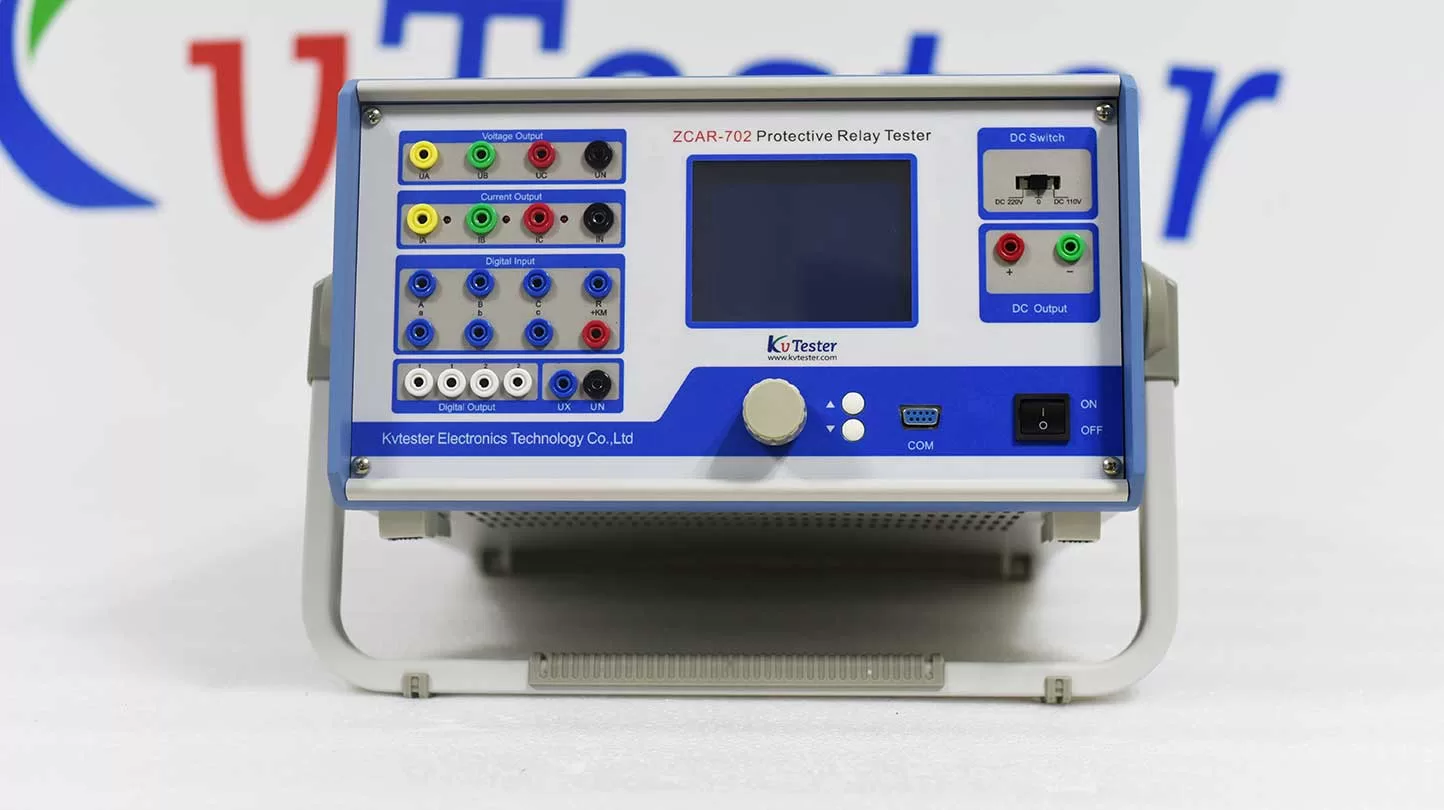
The ZCAR-702 three-phase relay protection tester comes with a large screen LCD display and a flexible and convenient rotating mouse controller. Single machine independent operation already has strong functionality and can perform most experiments, while connecting to a computer for operation has even more powerful operational capabilities. Small size and high precision. It not only has the superior performance and advanced functions of large testers, but also has the advantages of small and flexible testers, easy operation, and high reliability, with a high cost performance ratio. It is a handy tool for relay protection workers. In addition to being able to calibrate various relays (such as current, voltage, inverse time limit, power direction, impedance, differential, low cycle, synchronous, frequency, DC, intermediate, time, etc.) and microcomputer protection, it can also simulate transient, permanent, and conversion faults from single-phase to three-phase for whole group testing. It can also complete various highly automated large-scale complex verification tasks, automatically test and scan various protection settings, store test data in real time, display vector graphics, and print reports online.
Kvtester Electronics Technology Co.,Ltd. is a high-tech enterprise specializing in power testing, testing, research and development, production, and sales of testing equipment. It has been engaged in the electrical testing industry for many years, and its products are of high quality. We welcome customers to come and purchase. Service hotline: 0086-27-81778799, to learn more, visit the official website: www.kvtester.com
Related Products
Latest News
-
 2026-09-20CT PT Analyzer for Commissioning: Substation Testing Guide
 -
 2026-09-20ANSI Standard CT Tester: Specs, Tests & Buying Guide
 -
 2026-09-18Why does the required capacity of series resonant test equipment usually increase with cable length?
 -
 2026-09-18How should 35kV cable series resonant withstand voltage test equipment be configured?
 -
 2026-09-18How to Select AC Withstand Voltage Test Equipment for 10kV Cables?