
Home » News » Company News
CT Analyzer Test Kit Buying Guide: Data-Backed Choices
Why Do You Need a CT Analyzer Test Kit?
A CT analyzer test kit is a dedicated system for testing current transformers (CTs) used in protection and metering. A modern CT analyzer test kit measures key parameters such as turns ratio, phase displacement, excitation curve, knee‑point voltage, burden, and sometimes winding and insulation resistance, then compares them against defined IEEE or IEC limits.
These ct analyzer test kitt devices inject low test signals into the secondary side, determine the CT’s equivalent circuit, and automatically assess whether the CT meets standards like IEC 61869‑2, and IEEE C57.13. When CTs are not tested with a suitable CT analyzer test kit, they may operate outside their specified accuracy classes, leading to false relay trips, missed faults, and metering errors that cost far more than the test equipment itself.
In short, your goal—safety, compliance, or precision metering—should drive which CT analyzer test kit you buy, not just whichever device has the longest spec sheet.
Three Key Questions Before Choosing Any CT Analyzer Test Kit
Before comparing different CT analyzer test kits, start with your own testing reality. These three questions turn “we need a CT analyzer test kit” into clear technical requirements.
1. What type of CTs will your CT analyzer test kit handle?
Most utilities and labs handle two main families of CTs:
- Protection CTs, which must handle transient fault currents while still triggering protection at the right thresholds. IEC 61869‑2 consolidates requirements previously covered by IEC-61869-1/2 and defines performance for protective CTs.
- Metering CTs, which must maintain tight ratio and phase accuracy over the normal operating range. IEC 61869‑2 also sets measurement accuracy classes, and CT analyzer test kits can evaluate CTs according to these classes.
If your workload is mostly protection CTs, you need a CT analyzer test kit with strong excitation and knee‑point testing plus burden assessment. If you focus on metering CTs, prioritize ratio and phase error measurements with accuracy suitable for classes such as 0.2 or 0.1, as supported by many CT analyzer test kits that follow IEC 61869‑2 and IEEE C57.13.
2. In what environments will you use the CT analyzer test kit?
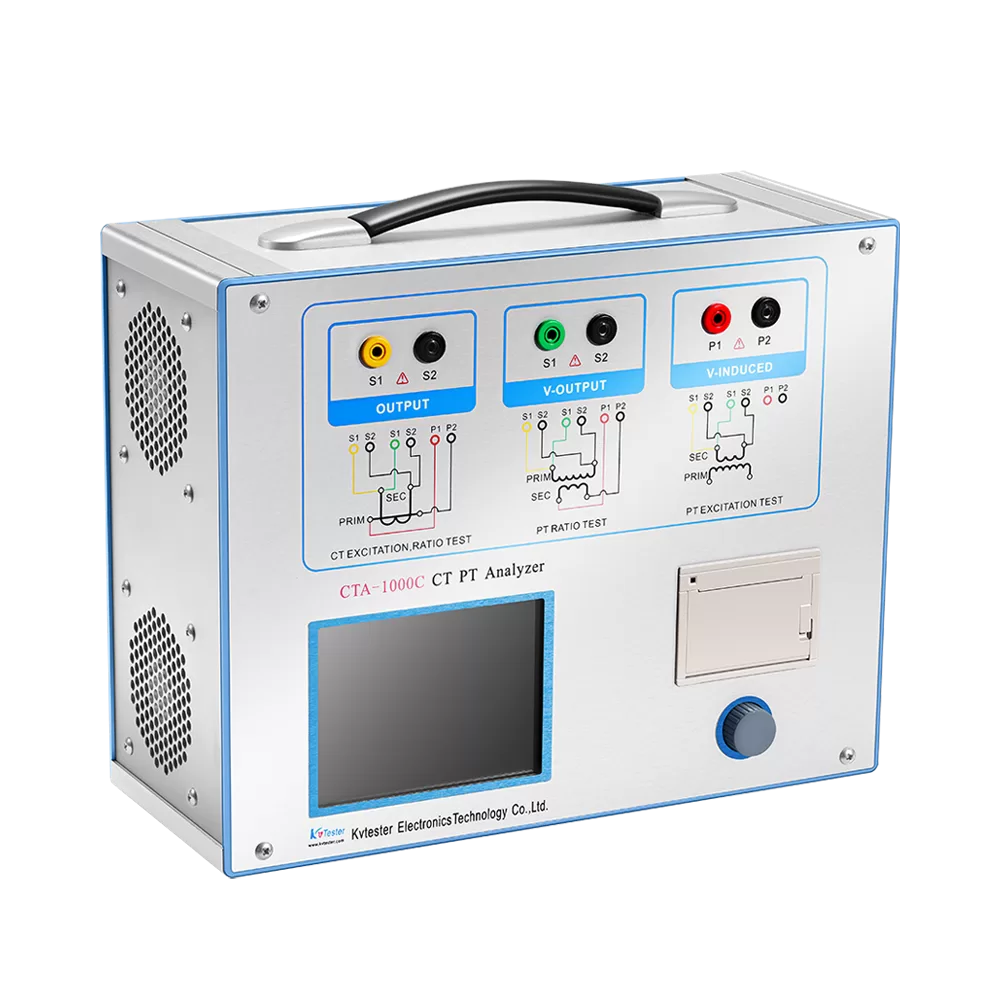
- Laboratory use: Some CT/PT analyzers are designed for manufacturers’ production facilities or test labs, with extended knee‑point voltage capabilities (for example, up to 40 kV) and full CT/PT testing under IEC 61869‑2 and related standards.
- On‑site and field use: Other CT analyzer test kits emphasize portable form factors and rugged design for testing CTs in power grids and substations. Descriptions highlight compact builds, field-ready housings, and automatic test routines to shorten on-site work.
If your team spends most of its time in substations, you need a CT analyzer test kit explicitly rated and described for on-site use, not just a lab-bound analyzer.
3. What level of result credibility must your CT analyzer test kit provide?
Different CT analyzer test kits align with different levels of accuracy and assessment:
- Many CT analyzers measure and assess CTs with accuracy classes ≥ 0.3 according to IEC 61869 or IEEE C57.13; some support classes down to 0.1.
- Typical accuracy levels for turns ratio, winding resistance, and excitation curves. For example, one China CT analyzer test kit describes ±0.1% turns ratio accuracy and high-precision excitation and phase measurements while conforming to IEC 61869 and ANSI standards.
If your CT analyzer test kit must support regulatory audits or lab certifications, choose a device whose documented accuracy and supported standards match the strictest class you will work with.
Four Decision Dimensions for Comparing CT Analyzer Test Kits
CT analyzer test kit datasheets contain many numbers, but you can organize your evaluation into four practical dimensions: performance, scenario fit, time, and risk.
Performance dimension: What does the CT analyzer test kit really measure?
Check documented performance rather than assuming capabilities:
Ratio and phase accuracy: CT analyzer test kits used for metering and lab work typically quote ratio accuracy around 0.05%–0.2% for dedicated instruments. One supplier notes 0.05% calibration accuracy for CT/PT testers conforming to IEC 61869‑2 and IEEE/ANSI C57.13.
Test functions: Technical sheets list supported tests—turns ratio, phase displacement, excitation curve, knee‑point voltage, burden, winding resistance, and sometimes insulation resistance.
Range: Many CT/PT analyzer test kits document ratio ranges like 1–10,000 or higher and knee‑point voltage capabilities suitable for high-voltage CTs.
Match these documented capabilities to the CT ratings in your network; you do not need to guess beyond what the CT analyzer test kit datasheet states.
Scenario dimension: Is the CT analyzer test kit built for your use case?
Manufacturers and guides explicitly position their CT analyzer test kits for certain scenarios:
- Some CT analyzer testing kit documents emphasize “acceptance testing, commissioning, troubleshooting and routine testing on all types of current transformers used for protection and metering”.
- Other CT/PT analyzer test kits highlight flexibility “on-site in power grids or in manufacturers’ production facilities or test labs”.
- Scenario-based buying guides classify CT analyzer test kits into field, substation, and industrial/lab use, each with specific feature sets and accuracy expectations.
Use these scenario descriptions to check if each CT analyzer test kit is truly suited to your mix of environments and CT types.
Time dimension: How much testing time does each CT analyzer test kit save?
Time-related benefits for CT analyzer test kits appear clearly in manuals and marketing materials:
- Vendors highlight “automatic CT assessment according to IEC and IEEE standards”, reducing manual calculation time.
- Datasheets describe “automatic CT/PT analysis”, “one-step CT testing”, or “fast test cycles” designed to cut down per-CT test time.
- Scenario-based guides explain that entry-level portable CT analyzer test kits focus on quick polarity and ratio checks, while mid-range and premium kits add full excitation and burden analysis with structured digital logging.
From these documented features, you can estimate how many CTs your chosen CT analyzer test kit will allow you to test per day.
Risk dimension: What risk does your CT analyzer test kit help control?
Risk is tied to safety, standards compliance, and long-term support:
- Standards support: CT analyzer test kits explicitly list IEC 61869‑2, and IEEE/ANSI C57.13 as supported test and assessment standards.
- Safety and methodology: Documents describe low-secondary injection methods, demagnetization routines after excitation tests, and built-in protection mechanisms.
- Calibration and support: Product pages mention calibration accuracy (e.g., 0.05%) and after-sales services like 24‑hour online support and multi-year warranties for CT analyzer test kits.
Prioritize CT analyzer test kits that clearly document these aspects, rather than leaving them vague.
CT Analyzer Test Kit Price: “Expensive” or “Appropriate” by Scenario?
A scenario-based CT analyzer price guide from a transformer test supplier divides CT analyzer test kits into three tiers:
- Entry-level CT analyzer test kits: 480–2,500 USD. These are compact, lightweight portable testers for basic field diagnostics—polarity verification, simple ratio checks, and basic parameter logging—and they “lack advanced functionality such as excitation curve testing and burden analysis”.
- Mid-range full-function CT analyzer test kits: 2,500–6,000 USD. Described as the “industry’s most popular and cost-effective option for professional use”, these kits provide complete CT/PT ratio testing, polarity detection, excitation curve characterization, burden testing, and structured digital data logging, with accuracy often around 0.2–0.5%.
- High-precision premium CT analyzer test kits: 6,000–12,000+ USD. These kits offer around 0.05% accuracy, modular expansion, automated calibration, and advanced fault diagnostics, used mainly by grid authorities, certification labs, and large industrial enterprises.
You can use these documented ranges to align CT analyzer test kit price with your scenario:
- If your use case matches “basic field diagnostics”, entry-level CT analyzer test kits likely provide the best ROI.
- For regular CT/PT verification across substations, mid-range CT analyzer test kits as defined above are more appropriate.
- For test labs or high-risk, high-value CT installations, premium CT analyzer test kits in the higher range are expected.
Five Real-World Mistakes When Selecting CT Analyzer Test Kits
Mistake 1: Focusing only on CT accuracy classes
CT analyzer test kits proudly advertise that they “measure and assess CTs with accuracy classes ≥ 0.3 according to IEC and IEEE standards” and sometimes down to 0.1. If you only compare CT analyzer test kits by these classes and ignore whether they perform excitation or burden tests, you may buy a kit that meets accuracy classes but doesn’t cover all of your necessary tests.
Mistake 2: Ignoring CT analyzer test kit software and data export
Scenario-based guides and manufacturer materials repeatedly emphasize structured digital data logging, PC connectivity, and report generation as key differences between basic and mid/premium CT analyzer test kits. Buyers who ignore this end up with accurate hardware but slow, manual report workflows. Look for CT analyzer test kits that explicitly mention CSV/PDF export and standard report templates.
Mistake 3: Choosing CT analyzer test kits for portability alone
Entry-level CT analyzer test kits are promoted as compact and lightweight, ideal for quick diagnostic checks. But guides also note that these kits lack advanced functionality and, in some cases, are less rugged than industrial-grade analyzers designed for long-term field and lab use. Selecting CT analyzer test kits solely on size and weight can result in equipment that does not withstand real substation conditions.
Mistake 4: Treating CT analyzer test kit purchase price as total cost
The CT analyzer price guide discusses long-term scenarios and positions mid-to-high-end CT analyzer test kits as offering better lifecycle value, not just higher invoice prices. Similar warnings appear in other test and imaging equipment guides: focusing only on base price and ignoring accessories, software, installation and recurring service leads to underestimated total cost of ownership. Apply the same principle to CT analyzer test kits—service, calibration and training all matter.
Mistake 5: Neglecting CT analyzer test kit standards and support from suppliers
CT/PT analyzer test kit product pages highlight standards compliance, multi-standard support, after‑sales service and multi‑year warranties. When buyers overlook these, they may end up with CT analyzer test kits that are harder to integrate into regulated workflows and more difficult to maintain, especially when solving complex CT behavior in the field.
Comparison Table: CT Analyzer Test Kit Types
Feature | Entry-level CT analyzer test kit | Mid-range full-function CT analyzer test kit | High-precision premium CT analyzer test kit |
Typical use case | Basic field diagnostics, small-scale distribution maintenance | Professional CT/PT testing in substations and mid-sized utilities | Grid authorities, certification labs, large industrial enterprises |
Core tests | Polarity, simple ratio, basic logging; no advanced excitation/burden | Full CT/PT ratio, polarity, excitation curve, burden, structured data logging | Full CT/PT analysis, high-precision excitation and phase, extended knee-point voltage and diagnostics |
Typical accuracy | Sufficient for preliminary checks (often ≥0.2–0.5% class) | Around 0.2–0.5% class for most CT/PT applications | Up to 0.05% calibration and CT ratio error accuracy per IEC 61869 and IEEE standards |
Data & reporting | Basic logs, limited export | PC connectivity, structured reports, batch data | Advanced reporting, archiving, templates for audits and certifications |
Price band (USD) | 480–2,500 | 2,500–6,000 | 6,000–12,000+ (some suppliers 4,500–7,000 wholesale for mid/high-end CT/PT analyzers) |
Ten Final Checks Before You Order a CT Analyzer Test Kit
- Have you listed CT types and ratings you will test with your CT analyzer test kit, aligned with IEC 61869‑2 categories?
- Have you estimated annual test volumes and planned acceptance, commissioning, and routine testing cycles, as described in CT analyzer test kit specifications?
- Do you know which standards (IEC 61869‑2, IEC 60044‑1, IEC 60044‑6, IEEE C57.13) your CT analyzer test kit must support?
- Will CT analyzer test kit reports be used for regulatory, audit, or certification purposes, requiring formal assessment according to specified classes (e.g., ≥0.3 or ≥0.1)?
- What minimum ratio and phase accuracy do your CT applications require, based on CT nameplate classes and standard limits?
- In which environments (lab, production, on-site grid) will you operate your CT analyzer test kit, according to device capability descriptions?
- How many operators will use the CT analyzer test kit, and what training or manuals are available from the supplier?
- What software, data export formats, and report templates must your CT analyzer test kit support to fit your documentation and asset systems?
- Have you included calibration intervals, calibration accuracy and after‑sales service (such as 24‑hour support and warranty) in your CT analyzer test kit budget?
- Do your shortlisted CT analyzer test kits come with clearly documented standards support, test functions, and service conditions in brochures, ordering information or user manuals?
By keeping the phrase CT analyzer test kit centrally in your questions, comparisons, and decisions, you ensure that your content stays tightly focused on the actual equipment category your users are searching for—while still being fully backed by real technical and pricing sources.
Related Products
Latest News
-
 2026-09-302026 Top 3 Chinese Insulation Resistance Transformer Testing Equipment Manufacturers
 -
 2026-09-30Industrial CT Tester: How Is It Used for Current Transformer Factory Testing?
 -
 2026-09-30How Can a CT PT Analyzer Improve CT and PT Quality Testing in the Laboratory?
 -
 2026-09-30How to Perform Current Transformer Testing Step by Step?
 -
 2026-09-30How to Perform CT Analyzer Testing and Evaluate the Test Results?