
Home » News » Company News
Anti-Interference CT PT Analyzer Wholesale: OEM Buying Guide
Buying an anti-interference CT PT analyzer in volume is not simply a matter of comparing prices and checking a basic specification sheet. For distributors, power utilities, transformer manufacturers, EPC contractors, and testing laboratories, the right supplier must deliver stable measurements in demanding electrical environments, consistent product quality, and OEM support that remains dependable after the first shipment.
KVTester power testing equipment is designed for utilities, instrument-transformer manufacturers, and electrical testing professionals who need practical solutions for CT, PT, VT, and transformer testing. When sourcing for wholesale or private-label projects, buyers should evaluate the instrument, the manufacturer, and the long-term supply process together.
Why Anti-Interference Performance Matters
CT and PT testing is frequently carried out in environments that are electrically noisy rather than laboratory-clean. Energized busbars, transformers, auxiliary power circuits, switching devices, inverter systems, long parallel leads, and unequal grounding potentials can affect low-level secondary signals.
When interference is not properly controlled, technicians may see:
- Unstable ratio-error readings
- Drifting phase-angle results
- Inconsistent excitation or saturation curves
- Unrepeatable knee-point values
- Repeated testing and delayed commissioning
- Difficulty determining whether a result reflects the transformer or the test environment
A professional anti-interference CT PT analyzer should therefore support more than basic measurement functions. It should help technicians obtain repeatable data through sound instrument design, correct test connections, appropriate grounding, shielded leads, and robust signal-processing methods.
The core goal is simple: the same transformer, wiring configuration, and test settings should produce consistent results across repeated tests.
What a CT PT Analyzer Should Test
Before comparing OEM quotations, identify exactly which instrument transformers and test tasks your customers need to cover. A universal CT/PT analyzer may be suitable for many routine applications, while specialized VT/CVT equipment may be needed for higher-voltage or capacitive voltage transformer projects.
For current transformers, buyers commonly require:
- Excitation characteristic and saturation curve testing
- Knee-point voltage and knee-point current calculation
- CT ratio and turns-ratio testing
- Polarity verification
- Secondary winding resistance measurement
- Secondary burden measurement
- Ratio error and phase displacement measurement
- 5% and 10% error curve analysis
- Remanence coefficient, inductance, ALF, FS, and transient-performance parameters where applicable
- Multi-tap detection for multi-ratio CTs
For voltage transformers, the required scope may include:
- VT/PT ratio and polarity tests
- Phase-angle and ratio-error measurement
- Secondary winding resistance measurement
- Excitation characteristic testing
- Secondary burden measurement
- Metering-class and protection-class evaluation
- VT, CVT, and CCVT compatibility where required
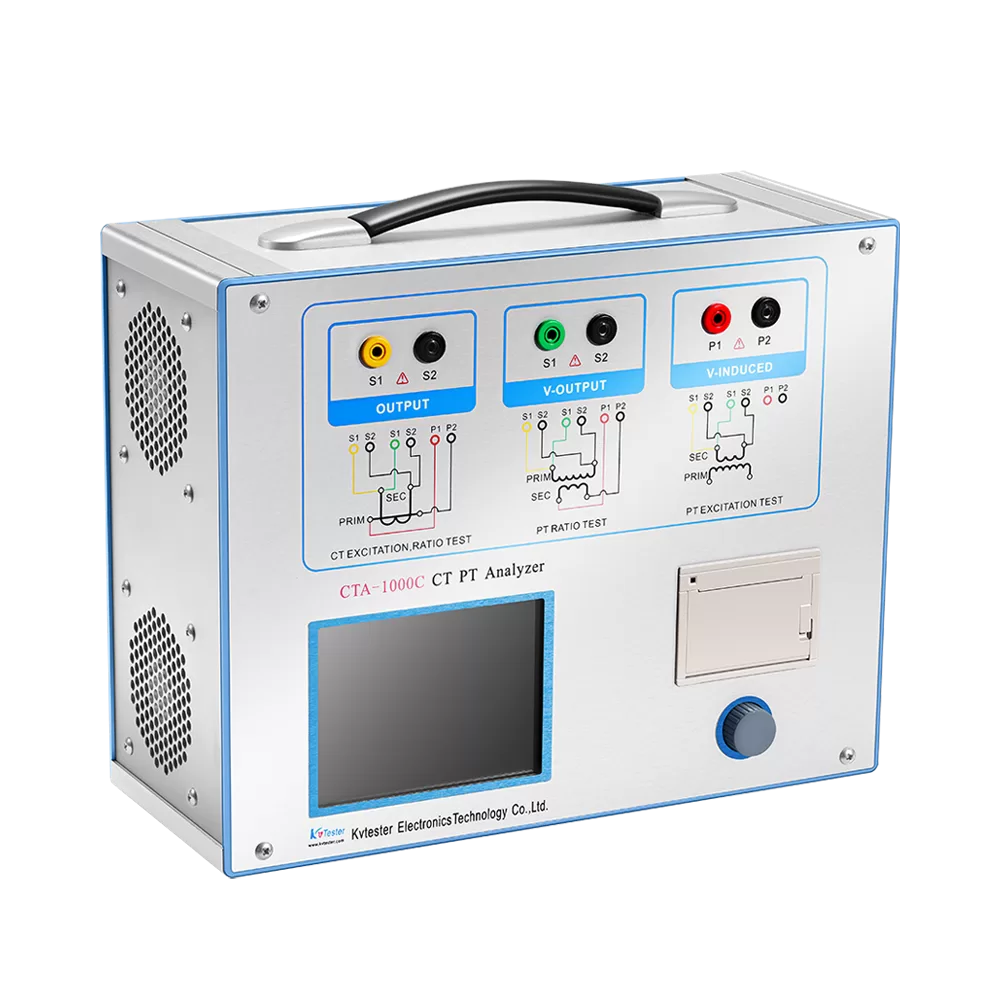
The CTA-1000C CT/PT Analyzer is a practical option for routine CT and PT analysis. It supports CT/PT ratio testing, polarity checking, secondary winding resistance measurement, burden testing, excitation characteristics, ratio error, and phase displacement. Its CT ratio range is 1 to 40,000, while its secondary winding resistance range is 0 to 300 Ω and its burden test range is 0 to 1000 VA.
For purchasers working specifically with electromagnetic voltage transformers and capacitive voltage transformers, the PTA-2000C VT/CVT Analyzer provides dedicated testing for VT, CVT, and CCVT applications. It is intended for ratio, phase error, winding resistance, excitation, and burden measurements across these voltage-transformer types.
How to Evaluate Anti-Interference Design
“Anti-interference” should not be accepted as a general marketing promise. A reliable manufacturer should be able to explain how its instrument reduces interference and how buyers can verify field stability before placing a bulk order.
1.Shielded instrument enclosure
A metal chassis can help reduce the effect of radiated electromagnetic fields on sensitive internal circuits. Ask whether the enclosure, connector design, grounding terminal, and cable shielding are designed as part of a complete EMC strategy rather than as isolated features.
2.Isolation between key circuits
Signal acquisition, power supply, and control circuits should be designed to reduce the influence of conducted interference and common-mode voltage variations. Buyers should ask the supplier how signal isolation is implemented and whether the unit includes protection against abnormal field conditions.
3.Analog and digital filtering
Useful anti-interference designs may include power-frequency rejection, low-pass filtering, surge suppression, and digital processing to distinguish valid test signals from unwanted noise. However, filtering should not conceal measurement instability or distort the result. The manufacturer should be able to provide repeatability data and explain the test conditions.
4.Shielded leads and grounding provisions
Field performance depends on the complete test system, not only on the main instrument. Shielded test leads, reliable connectors, a dedicated grounding point, and clear wiring guidance all affect measurement stability.
Long leads installed in parallel with energized conductors can pick up induced noise. Poor grounding may create ground loops and unstable reference potentials. Buyers should request the recommended lead arrangement, grounding method, and maximum practical cable length for each test mode.
5.Repeatability evidence
The most useful proof of anti-interference capability is not a feature list. Ask the supplier to provide:
- Repeated-test data from the same CT or PT
- Ratio, phase-angle, and knee-point result variation across multiple test runs
- Test records from a realistic electrical environment
- Details of the grounding and cable arrangement used
- A factory acceptance procedure for verifying repeatability
- Calibration and final-inspection documents for each instrument
Standards to Include in Your RFQ
Do not accept a vague statement such as “IEC compliant.” Your RFQ should state the standards, transformer types, test functions, and required report fields.
For CT projects, IEC 61869-1 and IEC 61869-2 should be central reference standards. IEC 61869-2 consolidates the earlier CT-focused requirements previously covered by IEC 60044-1 and IEC 60044-6.
For VT, CVT, and CCVT projects, buyers may need to consider:
- IEC 61869-3 for inductive voltage transformers
- IEC 61869-5 for capacitive voltage transformers
- IEEE C57.13 for applicable North American VT requirements
- ANSI C93.1 for relevant CVT/CCVT applications
The OEM should confirm which standards are supported by the instrument’s current firmware and which test calculations, transformer classes, and report outputs correspond to each selected standard.
OEM Manufacturer Qualification Checklist
A reliable OEM manufacturer should be evaluated as carefully as the instrument itself. A low initial quotation can become expensive when the supplier cannot maintain calibration quality, delivery consistency, documentation, or technical support.
Confirm real manufacturing capability
Ask for evidence that the supplier controls product development and production rather than only rebranding an externally sourced device.
Key verification points include:
- Factory address and production-area verification
- R&D capability for hardware and firmware
- Assembly and final-test procedures
- Calibration equipment and traceability process
- Serial-number control for each delivered unit
- Test-lead, connector, enclosure, and accessory quality control
- Product revision and firmware-version management
Check quality-control procedures
A professional supplier should be able to explain how each instrument is inspected before shipment. Request information about:
- Incoming component inspection
- Production-process checks
- Burn-in or stability testing
- Accuracy verification against reference equipment
- Electrical safety checks
- Final functional testing
- Inspection records linked to serial numbers
- Packaging verification for international shipping
Define OEM scope clearly
OEM requirements should be documented before samples and mass production begin. Typical options may include:
- Private-label logo and nameplate
- Custom front-panel branding
- Startup screen customization
- Localized user interface
- English, German, Spanish, or other language manuals
- Customized test-report header and company information
- Branded transport cases and outer cartons
- Dedicated model number or SKU
- Barcode labels and serialized traceability labels
Clarify which changes are cosmetic, which require engineering work, and whether customized firmware or report layouts create a minimum-order requirement.
Review documentation quality
Technical documentation is an important indicator of manufacturer capability. Request:
- Product datasheet
- User manual
- Wiring diagrams
- Test-function list
- Calibration certificate sample
- Factory acceptance test template
- Packing list
- Warranty terms
- Spare-parts list
- Firmware update procedure
Avoid suppliers that promise automatic reporting without explaining available output formats. Report export should be described accurately and should not be presented as PDF export unless that capability is specifically supplied and verified.
Compare Wholesale Quotations Fairly
A quotation should be compared on total delivered value rather than unit price alone.
| Evaluation Area | Questions to Ask |
| Test coverage | Which CT, PT, VT, CVT, and CCVT tests are included? |
| Accuracy | What is the accuracy and resolution for ratio, phase, resistance, burden, and excitation tests? |
| Anti-interference | What shielding, isolation, filtering, lead, and grounding measures are included? |
| Standards | Which IEC, IEEE, or ANSI functions are available in the current software version? |
| OEM scope | What can be customized on the instrument, interface, reports, manuals, packaging, and labels? |
| Quality control | Is each unit serialized, calibrated, and tested before dispatch? |
| Supply | What are the sample lead time, mass-production lead time, and monthly capacity? |
| Support | What warranty, remote support, spare parts, and firmware-update options are provided? |
| Delivery | What packaging, export documentation, and shipping terms are available? |
A quotation with a slightly higher unit cost may be the lower-risk choice if it includes stable delivery, consistent documentation, tested accessories, clearer OEM ownership, and responsive post-sales support.
Factory Acceptance Test for Bulk Orders
A factory acceptance test, or FAT, gives buyers a practical way to verify that the delivered configuration matches the agreed requirements before shipment.
A useful FAT should include:
- Verification of model number, serial number, firmware version, accessories, and branded components
- CT ratio, polarity, excitation, resistance, and burden testing using a known test object
- PT or VT ratio, polarity, resistance, and burden testing where included in the order
- Repeat measurements under identical conditions to assess stability
- Inspection of test leads, grounding leads, connectors, transport case, and labels
- Verification of saved records, data transfer, and report-output functions
- Confirmation of safety warnings, overcurrent protection, and abnormal-condition prompts
- Signed FAT documentation shared by the buyer and manufacturer
For CT and PT tests, correct wiring and grounding remain essential. A good instrument cannot compensate for unsafe or incorrect test connections. The CTA-1000C CT/PT Analyzer supports practical field testing with functions for ratio, polarity, resistance, burden, excitation, and error-related analysis.
Red Flags to Avoid
Be cautious if an OEM supplier shows any of the following signs:
- “High accuracy” is claimed without stating measurement conditions
- “Anti-interference” is claimed without describing design or repeatability testing
- The product manual, quotation, and product image show inconsistent specifications
- No calibration sample or final-inspection record is available
- No serial-number traceability is provided
- The supplier cannot explain the difference between CT, VT, CVT, and CCVT testing
- Standard compliance is stated without a corresponding test function or report example
- OEM support is promised without defining branding, language, software, or MOQ requirements
- Key components or firmware can be changed without customer approval
- Warranty, spare-parts availability, and technical-support response are unclear
Choose a Supplier for Long-Term Reliability
The best anti-interference CT PT analyzer supplier is not necessarily the one offering the lowest price. The right OEM partner should combine appropriate test coverage, credible measurement performance, clear standard support, stable production, documented quality control, and flexible branding support.
For routine CT and PT testing, the CTA-1000C CT/PT Analyzer offers a compact solution for ratio, polarity, resistance, burden, excitation, and error-related analysis. For projects requiring dedicated VT, CVT, and CCVT capability, the PTA-2000C VT/CVT Analyzer provides a more specialized configuration for voltage-transformer applications.
Before confirming a wholesale order: request a detailed RFQ response, sample test data, calibration documentation, OEM specification, and a signed FAT procedure. This approach helps protect your brand, reduce post-delivery issues, and establish a dependable supply relationship for the long term.
Related Products
Latest News
-
 2026-09-302026 Top 3 Chinese Insulation Resistance Transformer Testing Equipment Manufacturers
 -
 2026-09-30Industrial CT Tester: How Is It Used for Current Transformer Factory Testing?
 -
 2026-09-30How Can a CT PT Analyzer Improve CT and PT Quality Testing in the Laboratory?
 -
 2026-09-30How to Perform Current Transformer Testing Step by Step?
 -
 2026-09-30How to Perform CT Analyzer Testing and Evaluate the Test Results?