
Review of Research and Application of Coupling Capacitor Voltage Transformers (CCVTs)
Abstract
The Coupling Capacitor Voltage Transformer (CCVT) is a critical primary component in high-voltage and extra-high-voltage (EHV) power transmission systems, serving multiple functions such as voltage measurement, signal acquisition for relay protection, and coupling for power line carrier communication. Compared to traditional electromagnetic voltage transformers, CCVTs achieve high-voltage step-down through capacitive voltage division; they offer advantages such as relatively simple insulation structures, lower manufacturing costs, and suitability for high-voltage transmission lines. This paper reviews the basic structure, operating principles, functional characteristics, engineering applications, and operation and maintenance issues of CCVTs, aiming to provide a reference for equipment selection, operational management, and fault analysis.
1. Introduction
As voltage levels in power systems continue to rise, transmission lines impose increasingly stringent requirements on the reliability of measurement, protection, and communication equipment. In high-voltage and EHV systems, voltage transformers must not only step down high primary-side voltages to low-voltage signals suitable for secondary equipment but also ensure excellent insulation performance, measurement accuracy, and transient response capabilities. The CCVT is a key piece of equipment that has found widespread application against this backdrop.
CCVTs are typically deployed on transmission lines and in substations operating at voltage levels of 110 kV and above. Their primary functions include supplying voltage signals to voltage measurement devices, relay protection systems, automatic control systems, and fault recording equipment, while also serving as vital coupling components for power line carrier communication systems. Consequently, CCVTs are not merely voltage measurement devices; they are also integral to grid protection, control, and communication systems.
2. Basic Structure and Operating Principles of CCVTs
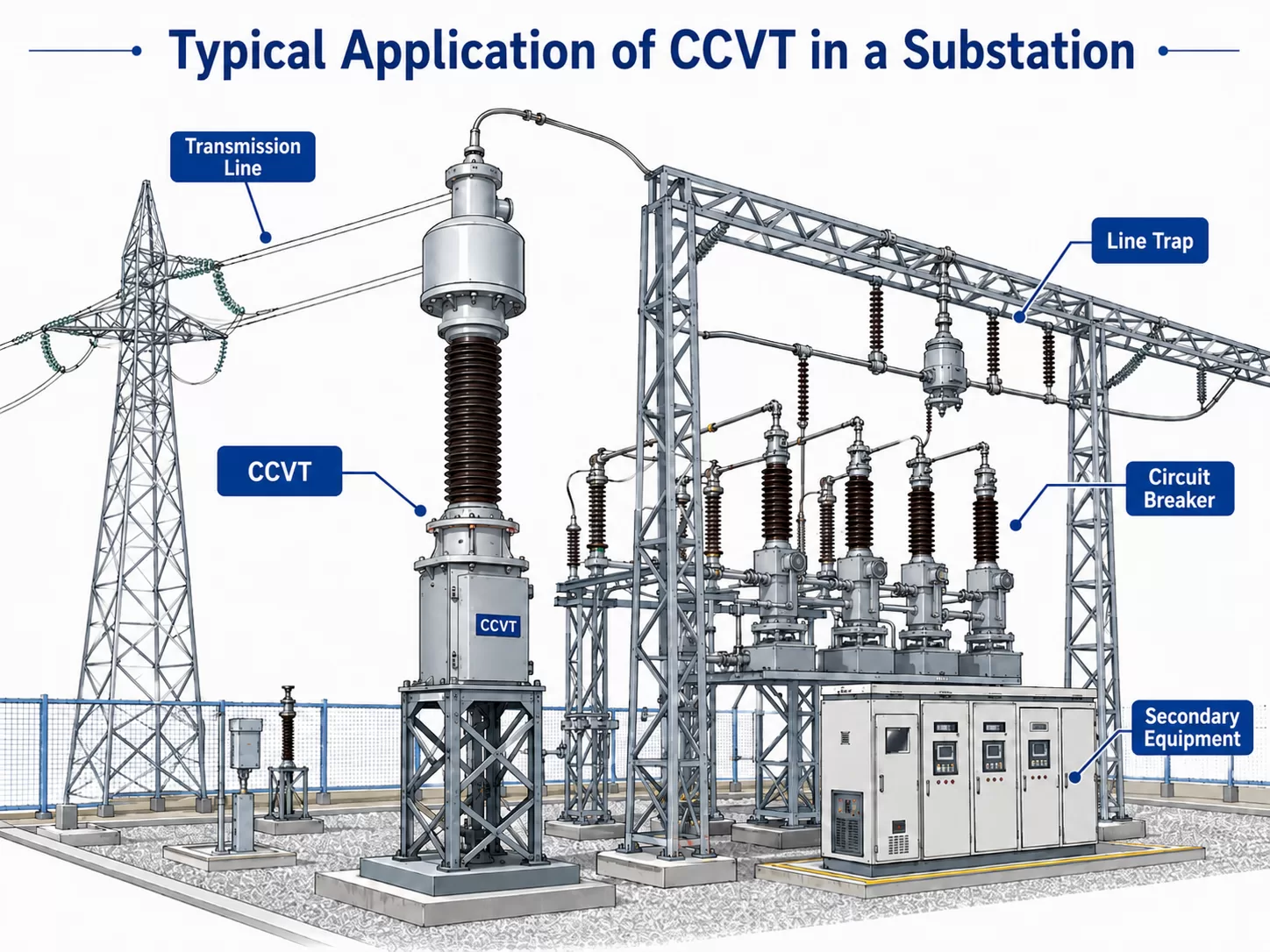
A CCVT primarily consists of a capacitive voltage divider, an electromagnetic unit, a tuning reactor, a damping device, secondary windings, and an insulating support structure. The capacitive voltage divider is typically formed by connecting a high-voltage capacitor and an intermediate-voltage capacitor in series; it proportionally divides the primary high voltage to produce an intermediate voltage. Subsequently, the electromagnetic unit transforms this intermediate voltage into a standard secondary voltage to meet the operational requirements of measuring instruments, protective relays, and control devices. Due to the inherent capacitive nature of the capacitive voltage divider, which affects the amplitude and phase of the voltage signal, CCVTs are typically equipped with a tuning reactor. This component compensates for phase errors caused by capacitive voltage division, ensuring high measurement accuracy at the rated frequency. Additionally, internal damping circuits are incorporated to suppress ferroresonance and transient oscillations, thereby enhancing operational stability.
In terms of operation, the CCVT first steps down the primary voltage via capacitive division and then outputs a standard secondary voltage through electromagnetic transformation. The secondary-side signal can be used for voltage metering, protection logic calculations, and sampling by automation systems. Furthermore, the capacitive divider section provides a coupling path for high-frequency carrier signals, enabling the transmission line to function as a communication medium.
3. Main Functions of the CCVT
3.1 Voltage Measurement Function
The fundamental function of a CCVT is to convert the primary voltage of a high-voltage system into a low-voltage signal suitable for safe use by secondary equipment. This signal serves applications such as voltmeters, energy metering, monitoring systems, and automation devices. Since primary voltage cannot be measured directly in high-voltage systems, the CCVT acts as an interface between the primary and secondary systems, providing both voltage transformation and electrical isolation.
3.2 Relay Protection Function
Voltage signals are a critical basis for fault detection in transmission line protection. For instance, distance protection schemes require the simultaneous acquisition of line voltage and current to determine fault locations through impedance calculations. The accuracy and transient characteristics of the CCVT’s output voltage directly influence the performance of protection devices. Significant transient deviations during the initial stages of a fault can lead to misoperation or delayed action by the protection system. Therefore, factors such as accuracy class, transient response, and secondary burden matching must be carefully considered during the design of protection systems.
3.3 Power Line Carrier Communication Function
Another key role of the CCVT is providing a coupling path for power line carrier (PLC) communication. PLC utilizes transmission lines to carry high-frequency signals, supporting applications such as remote protection, dispatch communication, telemetry, remote signaling, and control. The coupling capacitor within the CCVT allows high-frequency signals to enter the transmission line while blocking high-voltage power-frequency signals. When used in conjunction with equipment such as line traps and coupling filters, it enables directional communication over specific transmission lines.
4. Engineering Advantages of CCVTs
Compared to electromagnetic voltage transformers, CCVTs offer distinct engineering advantages in high-voltage systems. First, CCVTs utilize capacitive voltage division, which simplifies the insulation design of primary equipment and allows for a more compact structure. Second, while electromagnetic voltage transformers are bulky and expensive in extra-high-voltage systems, CCVTs are more cost-effective. Third, CCVTs can simultaneously perform voltage measurement and carrier communication coupling functions, helping to reduce the number of devices and simplify engineering layouts.
Consequently, CCVTs are widely used in high-voltage substations, transmission line bays, line protection systems, and power line carrier communication systems. Their comprehensive functional advantages are particularly pronounced in long-distance transmission lines.
5. Operational Issues and Maintenance Essentials
Despite their many advantages, CCVTs contain internal components such as capacitors, inductors, and iron cores, resulting in complex operational characteristics. Under conditions such as system faults, circuit breaker operations, lightning-induced overvoltages, or sudden voltage fluctuations, transient oscillations and output errors may occur on the secondary side. Furthermore, issues such as capacitor aging, increased dielectric loss, poor sealing, and secondary circuit anomalies can compromise equipment reliability.
Operation and maintenance efforts should focus on the following areas: checking for abnormalities in the capacitance and dielectric loss of the capacitive voltage divider; verifying the integrity of secondary terminals, grounding circuits, and wiring connections; detecting localized overheating defects via infrared thermography; assessing equipment insulation status by combining preventive test results with online monitoring data; and monitoring carrier communication quality to promptly troubleshoot coupling circuit anomalies.
6. Conclusion
The CCVT is a vital piece of equipment in high-voltage and extra-high-voltage power systems, integrating measurement, protection, and communication functions. It achieves the safe conversion of high voltage to low voltage through capacitive voltage division and electromagnetic transformation, while also providing an effective coupling channel for power line carrier communication. Compared to traditional electromagnetic voltage transformers, CCVTs offer advantages such as compact structure, superior cost-effectiveness, and high functional integration in high-voltage applications. However, due to the significant nature of their transient characteristics and resonance issues, thorough analysis remains essential during the stages of design, selection, operation, and maintenance. Looking ahead, with the advancement of smart grid and online monitoring technologies, the condition assessment, fault diagnosis, and digital application of CCVTs will become key areas for further research.
Related Products
Latest News
-
 2026-09-20CT PT Analyzer for Commissioning: Substation Testing Guide
 -
 2026-09-20ANSI Standard CT Tester: Specs, Tests & Buying Guide
 -
 2026-09-18Why does the required capacity of series resonant test equipment usually increase with cable length?
 -
 2026-09-18How should 35kV cable series resonant withstand voltage test equipment be configured?
 -
 2026-09-18How to Select AC Withstand Voltage Test Equipment for 10kV Cables?