The accuracy of battery internal resistance testing equipment is influenced by various factors, which may stem from the design and manufacturing of the equipment itself, or may be related to the testing environment, operation method, or battery state. The following are the key factors affecting accuracy and their specific analysis:
1. Equipment hardware factors
① Sensor quality and accuracy
a. Current/voltage sensor: The linearity, temperature drift, and noise level of the sensor directly affect the measurement results. For example, a low-precision sensor may cause internal resistance value fluctuations of ±5% due to temperature changes, while a high-precision sensor can control the error within ±1%.
b. Sampling rate: High-frequency sampling can more accurately capture voltage/current transient changes and reduce dynamic errors. Low-sampling-rate devices may cause deviations in internal resistance calculations due to signal distortion.
② Circuit design and anti-interference capability
a. Four-terminal test clip: Separates the current loop and voltage sampling loop to eliminate the influence of contact resistance. If a common two-terminal clip is used, contact resistance may introduce additional errors.
b. Electromagnetic compatibility: The equipment must possess the ability to resist electromagnetic interference, preventing noise generated by nearby chargers, inverters, and other devices from interfering with test signals. For instance, in a strong interference environment, an unshielded test cable may cause fluctuations of ±3% in the internal resistance value.
③ Temperature compensation and calibration
a.Temperature sensor: The internal resistance of batteries changes significantly with temperature (for example, the internal resistance of lead-acid batteries decreases by about 20% for every 10℃ increase). The device needs to have a built-in temperature sensor and perform automatic compensation, otherwise the internal resistance value may be falsely high by 20%-30% during low-temperature testing.
b.Regular calibration: After prolonged use, sensors may experience drift due to aging or environmental factors. It is recommended to calibrate the device every 3-6 months, using a standard resistor (with an accuracy of 0.001mΩ, for example) to verify the accuracy of the device.
2. Factors of testing method
① Selection of testing frequency
a. AC injection method: When the frequency is too low (such as <100Hz), the battery polarization effect is significant, and the measured internal resistance includes polarization resistance, resulting in a higher result; when the frequency is too high (such as >10kHz), the inductance effect may interfere with the measurement. Usually, 1kHz is chosen as the standard testing frequency.
b. Direct Current High-Current Method: The pulse width should be less than 10ms to avoid internal resistance changes caused by battery heating. If the pulse duration is too long (such as 100ms), the internal resistance value may decrease by 5%-10% due to temperature increase.
② Testing current magnitude:
a. Current too low: The voltage drop is not obvious, and the signal-to-noise ratio is low, leading to increased measurement error. For example, when testing a 12V battery, if the current is only 0.1A, the voltage drop may be lower than the device's resolution (such as 1mV), making it impossible to accurately calculate the internal resistance value.
b. Excessive current: It may cause battery polarization or heating, altering the internal resistance characteristics. It is recommended to test the current at 1/10 of the battery's rated capacity.
3. Environmental and Operational Factors
① Environmental Temperature and Humidity
a. Temperature: The operating temperature range of equipment is typically from -10℃ to 50℃. Exceeding this range may lead to a decrease in sensor accuracy. For instance, in an environment at -20℃, the measurement error of internal resistance in some equipment may increase to ±5%.
b. Humidity: High humidity (>85%) may lead to condensation or short circuits inside the equipment, affecting circuit stability. It is necessary to choose equipment with a protection level of IP65 or above (such as the DST-3000 series).
② Battery status and connection
a. Battery voltage: Under-voltage (e.g. <10.8V) or over-voltage (e.g. >14.4V) may damage the tester or cause measurement errors due to non-linear characteristics. Before testing, it is necessary to confirm that the battery voltage is within the normal range.
b. Connection method: Corrosion, loosening, or oxidation of the terminal post can increase contact resistance. For example, an oxide layer on the terminal post may lead to an increase in contact resistance by 1mΩ, resulting in a falsely high internal resistance test value of 20%-50%. Before testing, it is necessary to clean the terminal post and tighten the connection.
③ Operating specifications
a. Testing duration: When testing multiple batteries consecutively, the device may experience a decrease in accuracy due to heating. It is recommended to pause for 5 minutes after testing 10 batteries and allow the device to cool down before continuing.
b. Data recording: Manual data recording may introduce human errors. It is preferable to choose devices that support data storage and export to reduce human intervention.
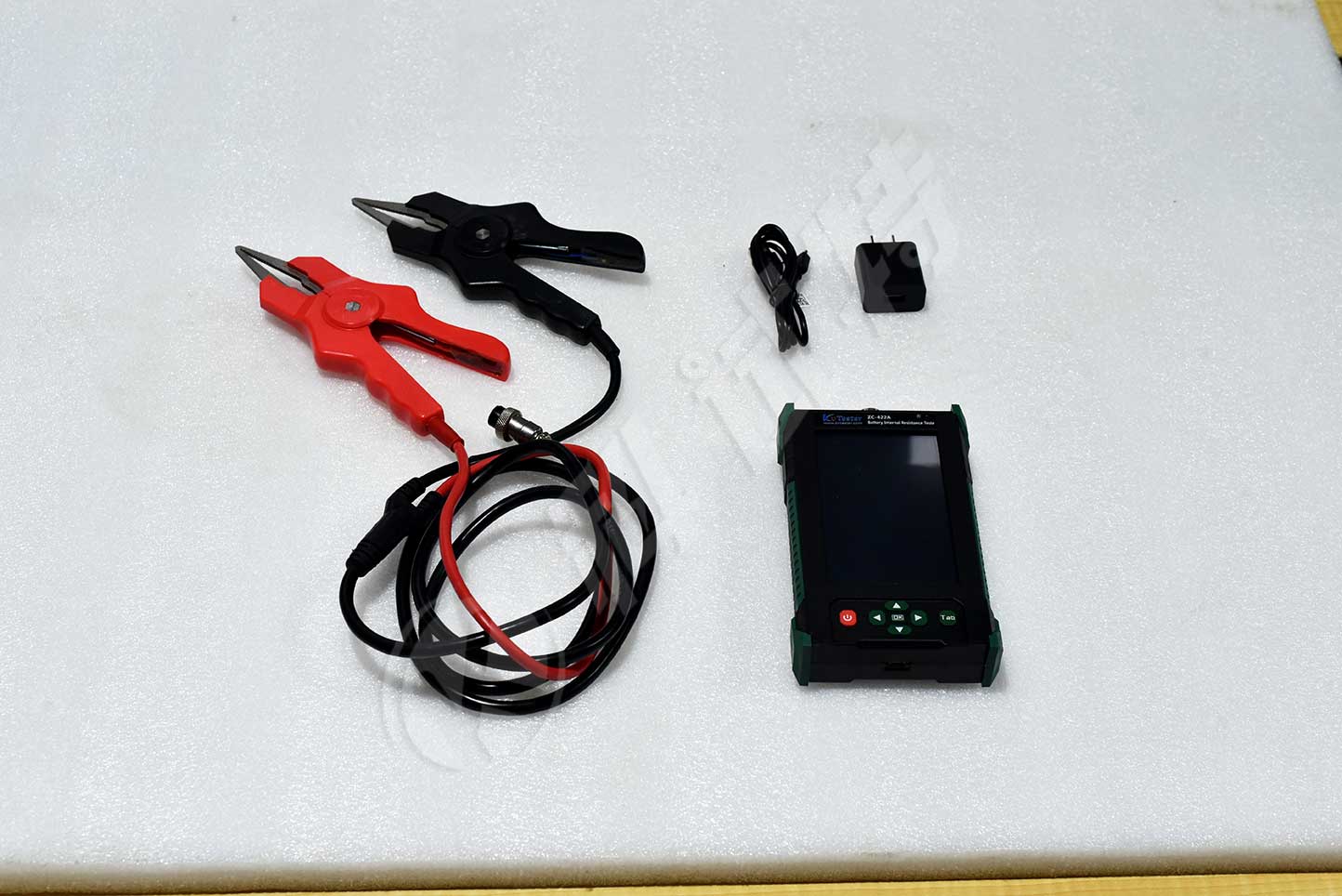
ZC-422A Battery Internal Resistance Tester is designed using the advanced AC discharge measurement method to test voltage, resistance and conduct of cell battery online. It can store , process the detected data and alarm the battery failure. The tester can accurately and effectively discern the condition of cell battery. The instrument saves, queries, deletes and exports the test data. The upper computer software analyzes and displays the test data through various charts and graphs . It automatically generates the battery test report.
Kvtester Electronics Technology Co.,Ltd. is a high-tech enterprise specializing in power testing, testing, research and development, production, and sales of testing equipment. It has been engaged in the electrical testing industry for many years, and its products are of high quality. We welcome customers to come and purchase. Service hotline: 0086-27-81778799, to learn more, visit the official website: www.kvtester.com