The core function of the transformer comprehensive test bench is designed around the electrical performance testing of transformers, aiming to comprehensively evaluate the safety, reliability, and efficiency of transformers through a systematic and automated testing process. The following is a detailed summary of its core functions:
1. No load test function
① Test objective: To evaluate the magnetization performance of transformer iron cores and the insulation status of windings.
② Key parameters:
a. No load current: reflects the loss of the iron core and the rationality of the magnetic circuit design.
b. No load loss: mainly composed of eddy current loss and hysteresis loss of the iron core, used to determine whether the iron core material and manufacturing process meet the standards.
c. Application scenarios: Factory inspection, fault diagnosis (such as multi-point grounding of iron core).
2. Load test function
① Test objective: To verify the operational capability of the transformer under rated load.
② Key parameters:
a. Load loss: including winding resistance loss and additional loss (such as stray loss caused by leakage), reflecting the material of the wire and the structure of the winding.
b. Impedance voltage percentage: characterizes the percentage of voltage drop when a transformer is short circuited, affecting load distribution during parallel operation.
c. Application scenarios: Verification of rated capacity, analysis of temperature rise characteristics.
3. Ratio and group testing function
① Test objective: To ensure that the turns ratio of the transformer winding meets the design requirements and to determine the wiring group.
② Key parameters:
a. Ratio error: The deviation between the actual ratio and the rated ratio should be controlled within ± 0.5%.
b. Wiring group: such as Yyn0, Dyn11, etc., determines the phase matching during parallel operation of transformers.
c. Application scenario: Pre parallel detection of multiple transformers and verification after winding modification.
4. DC resistance testing function
① Test purpose: To test the quality of winding wire connections and the contact status of tap changers.
② Key parameters:
a. Three phase unbalance rate: The percentage difference between the maximum and minimum values of the three-phase DC resistance should be ≤ 2% (below 1600kVA) or ≤ 1% (above 1600kVA).
b. Temperature conversion: According to the resistance temperature relationship formula, convert the test value to the value at the standard temperature (such as 75 ℃).
c. Application scenario: After maintenance of tap changer, quality inspection of winding welding points.
5. Insulation resistance testing function
① Test objective: To evaluate the insulation performance of windings to ground and between windings.
② Key parameters:
a. Insulation resistance value: measured with a megohmmeter (such as 2500V), it needs to be ≥ 1000M Ω (for new transformers) or ≥ 500M Ω (for transformers in operation).
b. Absorption ratio/polarization index: reflects the degree of insulation moisture or aging (absorption ratio ≥ 1.3, polarization index ≥ 1.5).
c. Application scenarios: Preventive testing, insulation fault diagnosis.
6. Voltage withstand test function
① Test objective: To verify the insulation system's ability to withstand overvoltage.
② Key parameters:
a. Power frequency withstand voltage: Apply adjustable AC voltage from 0 to 100kV for 1 minute without breakdown or flashover.
b. Frequency doubling withstand voltage: For induction withstand voltage testing, simulate overvoltage scenarios during operation.
c. Application scenarios: Factory type testing, insulation strength verification after major repairs.
7. Dielectric loss factor (tan δ) testing function
① Test purpose: To detect the degree of deterioration of insulation materials (such as insulation paper, oil).
② Key parameters:
a. Tan δ value: reflects the loss of insulation medium, which should be ≤ 0.5% (at 20 ℃).
b. Capacitance value: assists in determining winding deformation or insulation moisture.
c. Application scenarios: Insulation oil analysis of oil immersed transformers, screening before partial discharge.
8. Partial discharge detection function (optional)
① Test objective: To locate internal defects in insulation, such as bubbles and cracks.
② Key parameters:
a. Discharge capacity: In pC (picocoulomb), it should be ≤ 10pC (new transformer) or ≤ 50pC (operating transformer).
b. Discharge mode: Determine defect type through pulse sequence analysis.
c. Application scenarios: Factory inspection and fault warning during operation of high-voltage transformers.
9. Automation control and data management functions
① Automated testing process:
Support automatic switching of multiple experimental projects (such as no-load → load → variable ratio). Automatic voltage regulation, data collection, and result judgment.
② Data storage and analysis:
Store experimental parameters, environmental conditions (temperature, humidity), dates, and other information in the database. Generate standard test reports (including curves and charts), supporting export in Excel/PDF format.
③ Security protection mechanism:
Overvoltage/overcurrent protection, line connection error alarm, automatic discharge return to zero. Emergency stop button and door interlock protection.
10. Environmental adaptability function
① Temperature compensation: automatically corrects the impact of temperature on parameters such as resistance and loss.
② Anti interference design: Digitalization of sensor front-end combined with fiber optic transmission to reduce electromagnetic interference. Shielding test lines and grounding devices to ensure data stability.
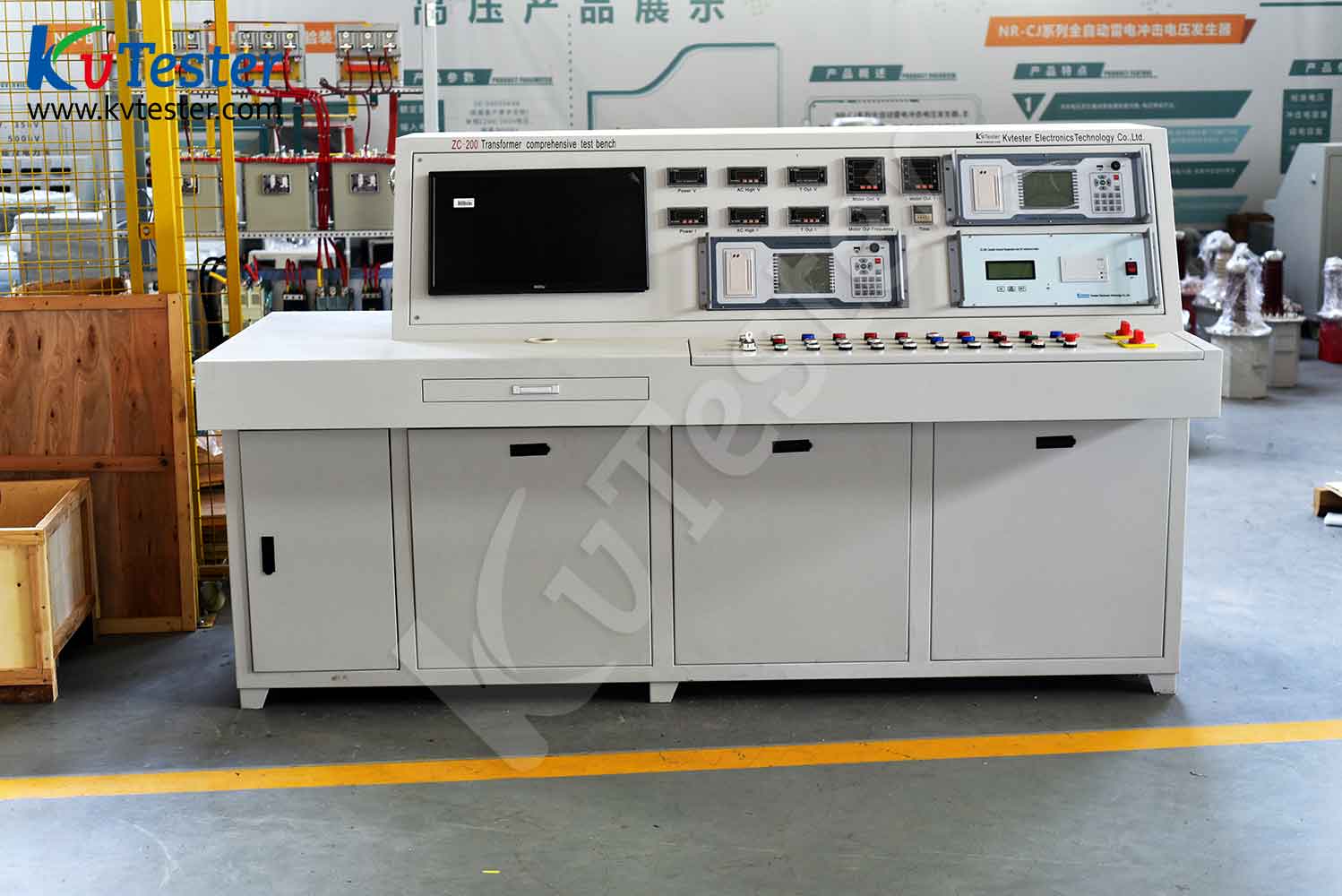
ZC-200 transformer comprehensive test bench is mainly used to test the no-load and load characteristics of power transformers and distribution transformers, and can also perform frequency doubling induction and power frequency withstand voltage tests on the tested transformers. The measuring part of the device is controlled by a high-end microcontroller, and the digital display, no-load, short circuit and other test data are synchronously sampled by the microcontroller, avoiding the errors caused by manual calculation of voltage, ammeter and power meter readings in traditional testing methods. This equipment is suitable for factory and routine testing of three-phase transformers with a capacity of 5000kVA/36.2-13.2KV and below in the production and maintenance departments of power transformers.
Kvtester Electronics Technology Co.,Ltd. is a high-tech enterprise specializing in power testing, testing, research and development, production, and sales of testing equipment. It has been engaged in the electrical testing industry for many years, and its products are of high quality. We welcome customers to come and purchase. Service hotline: 0086-27-81778799, to learn more, visit the official website: www.kvtester.com