The working principle of the fully automatic oil dielectric breakdown voltage tester is based on the dielectric strength test of insulating oil under high voltage electric field. By simulating the electric field environment in actual working conditions, the insulation performance of the oil is quantitatively evaluated. The core process can be divided into four stages: high voltage application, electric field action, breakdown detection, and data processing. The specific principles are as follows:
1. High voltage application: constructing a test electric field
① High voltage power supply system
The instrument is equipped with a built-in high-voltage transformer or high-frequency switching power supply, which boosts the mains voltage to the required voltage for testing (usually adjustable from 0-80kV).
The voltage output is regulated by a precision control module, supporting a constant boost rate to ensure consistency in testing conditions.
② Electrode structure
Using standard flat or spherical electrodes to form a uniform electric field.
The electrode material is a highly conductive metal, and the surface is polished to reduce partial discharge.
2. Electric field effect: simulating insulation oil working conditions
① Oil sample injection and pretreatment
Inject the oil sample to be tested into the electrode gap to ensure that the thickness of the oil layer meets the standard.
Start the magnetic oscillator stirring system and stir the oil sample at a speed of 50-100rpm to eliminate bubbles and impurities and avoid local electric field concentration.
② Static state and electric field stability
After stirring, let it stand for 5-10 minutes to redistribute the internal charges of the oil sample and make the electric field more uniform.
The settling time can be adjusted through instrument settings to adapt to different oil characteristics.
3. Breakdown detection: Capture the moment of insulation failure
① Boosting and breakdown triggering
Gradually increase the voltage at a preset rate until the oil sample is broken down.
Breakdown is defined as a sudden surge in current (usually exceeding 5mA) or a sudden drop in voltage, at which point the electric field strength reaches the dielectric strength limit of the oil sample.
② Instantaneous protection mechanism
At the moment of breakdown, the instrument detects abnormal signals through current transformers or voltage sensors.
The control system cuts off the high-voltage power supply within 0.01-0.02 seconds to prevent electrode erosion or further carbonization of the oil sample.
4. Data processing: Quantifying insulation performance
① Record of breakdown voltage
The instrument automatically records the voltage value at breakdown (unit: kV), which directly reflects the dielectric strength of the oil sample.
Support multiple tests (such as 6 times) and calculate the average value to reduce accidental errors.
② Result analysis and output
Determine whether the oil sample is qualified according to international standards (such as IEC 156) or national standards (GB/T 507).
Output test reports through built-in printers or USB interfaces, including parameters such as voltage values, testing time, and environmental conditions.
5. Key technical details
① Anti interference design
The all metal shielding shell reduces external electromagnetic interference and ensures the stability of high-voltage circuits.
High frequency switching power supply technology reduces voltage distortion rate (usually<3%) and improves testing accuracy.
② Security protection
Door lock protection: High voltage cannot be activated when the test door is not closed.
Grounding detection: Automatically check the grounding status of the equipment to avoid the risk of electric shock.
Emergency stop button: In case of emergency, manually cut off the power supply.
③ Calibration and traceability
Regularly use standard oil samples or high-pressure dividers to calibrate instruments and ensure accurate measurement values.
Some models support temperature compensation function to correct test deviations at different temperatures.
6. Principle diagram (simplified process)
Input of mains power → High voltage boosting → Oil sample between electrodes → Stirring and standing → Constant speed boosting → Breakdown detection → Voltage recording → Data output
7. Application scenario extension
Transformer oil detection: Evaluate the degree of oil quality deterioration and guide oil filtration or replacement decisions.
Circuit breaker oil test: Verify whether the insulation performance of the oil meets the standard during the breaking process.
Laboratory research: Analyze the impact of oil moisture, oxidation, or pollution on dielectric strength.
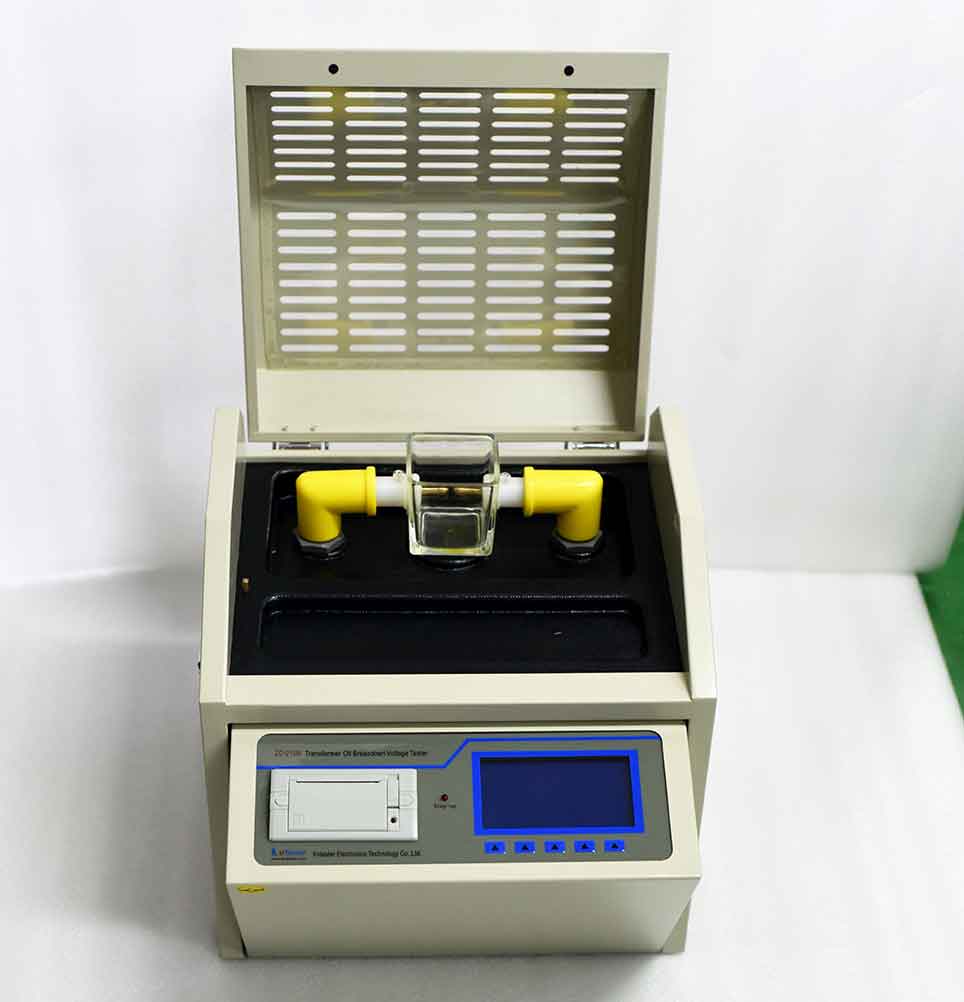
The ZC-210B fully automatic insulation oil dielectric strength tester is a high-precision, fully digital industrial instrument developed by all scientific and technical personnel of our company, in accordance with the relevant provisions of the national standard GB/T 507-1986 and industry standards DL/T 474.4-2006 and DL/T 596-1996, and leveraging its own advantages through multiple on-site tests and long-term unremitting efforts. To meet the needs of different users, this series of instruments can be divided into single cup three cup and multi cup models. The instrument is easy to operate and has a beautiful and elegant appearance. Due to the use of fully automatic digital microcomputer control, it has high measurement accuracy, strong anti-interference ability, and is safe and reliable.
Kvtester Electronics Technology Co.,Ltd. is a high-tech enterprise specializing in power testing, testing, research and development, production, and sales of testing equipment. It has been engaged in the electrical testing industry for many years, and its products are of high quality. We welcome customers to come and purchase. Service hotline: 0086-27-81778799, to learn more, visit the official website: www.kvtester.com